











Challenging the rivers and mountain roads of Peru
By Michael Torney
The ancient cultures in pre-hispanic Peru depicted the three worlds, the world above, the world in which we live and the world below. Travelling in the Andes it’s tempting to see these represented in the sky above and all around us, and in the mountains confronting us on every side but the most dynamic presence is far below, often invisible in the deep canyons, the vivid, surging streams. If the mountains are the stolid stubborn grandparents standing around waiting for things to happen the quick streams are the children racing round their crumbling mansion, gone before seen, turning heads as they run through legs. In the central highlands on our way to Chavín de Huantar on the worst road I’ve ever been on, there are so many streams the mountains seem to be leaking, milky threads round every grey rock, a cold white fire, fresh and chaotic as if newly freed from the rocks’s frozen energy or as if the white pillowy clouds had turned liquid and fallen to earth. A teacup spilt on the summit would be a waterfall in minutes.
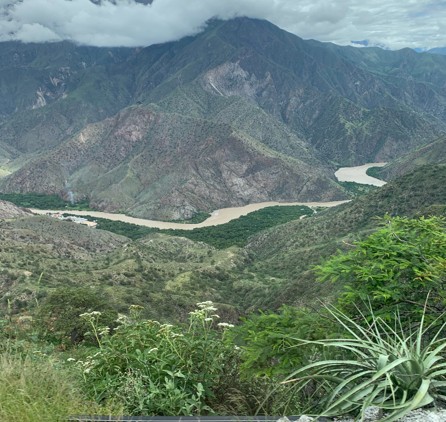
The Marañon River
The burns flood across the roads, wearing away the concrete, undermining the soil, threatening to make the solid as fluid as itself, turning the travellers’ certainties to dubious plans, timetables to wishes. Lower down the rivers take form and rage alongside the road, a storm of liquid chocolate, running and panting along like a dog chasing the bus, always changing, always there, the full moon on a clear night.
When the streams grow up to become rivers they don’t settle down, but move from their charming childhood to a turbulent adolescence as rivers. Instead of tumbling gaily down the mountains now they snake their way for miles round their giant haunches like a mouse going home through a herd of sleeping elephants.
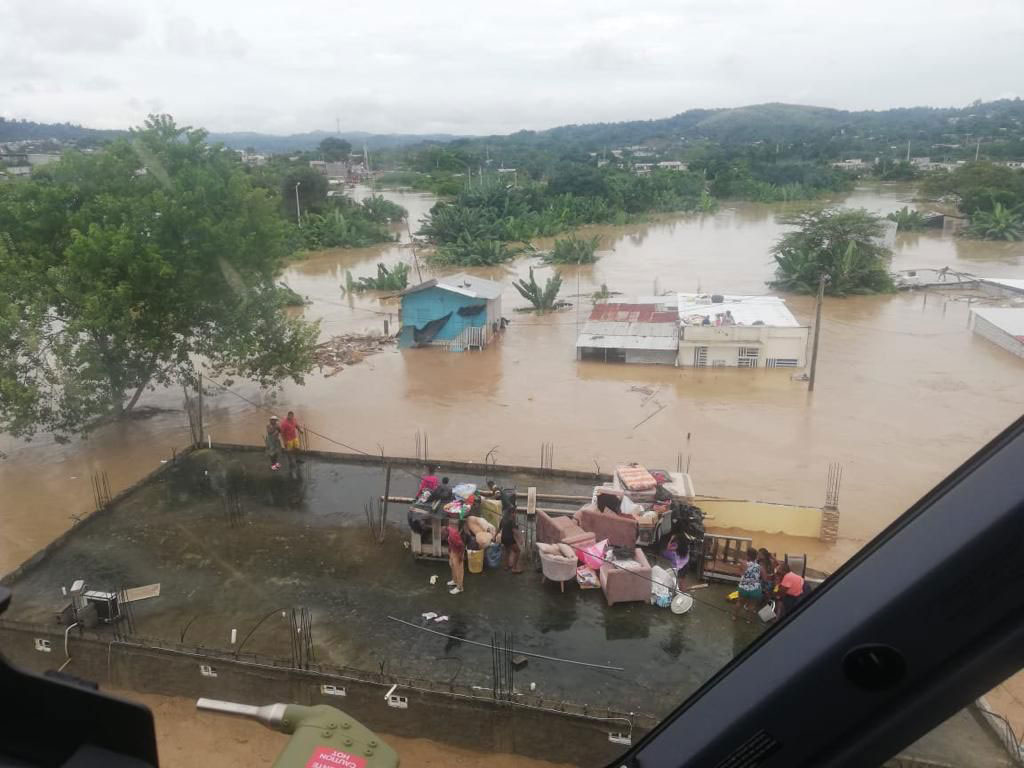
Water is the mountain roads’ greatest enemy whether as rain, landslides, or flood and they are everywhere marked by the passage of water, potholes that could swallow a Volkswagen, edges crumbled away, waves of water crossing the road more imperiously than ducks, all demanding the respect of drivers who slow to a crawl and slalom at two miles an hour on a straight road flinging their passengers higgledy-piggledy from van wall to wall in the world’s slowest roller coaster. I’m not sure whether these journeys make more marriages or divorces. On one journey a woman plays with a toddler bounced here and there and breastfeeds it while trying to keep it earthbound; I swear that child was airborne so much they should have received air miles for the bus journey.
In the mountain towns of Peru the streets swarm with motorbike-taxis — mototaxis —a sputtering three-wheeled ramshackle ‘vehicle’ with room on the backseat for two under a plastic sheet, open at the side in the warmer climes but enclosed at altitude as if you’re travelling in a parcel. They look as if a blender had a threesome with a couple of umbrellas or as if a giant hermit crab colonized a vacuum cleaner under a tarp for modesty. They cluster restlessly at the lights and when they’re finally released they all scuttle away as if fleeing the tide.
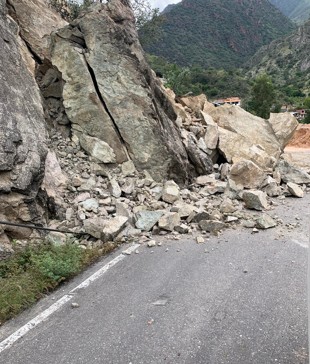
Rockslide on a mountain road
Interruptions are frequent on bus journeys. An eight-hour bus from Jaén, Peru to Vilcabamba, Ecuador takes eleven and a half hours, partly because our larger bus gets stuck in a village where the stream over the main road had strengthened and brought enough mud to halt us. The old word for a river crossing like this was ‘ford’ as in Dublin’s original name, Baile Átha Cliath,’the town of the hurdled ford’. It’s in so many old village and town names because it was such an important landscape feature before bridges became part of the countryside infrastructure. The front of the bus can’t clear the opposite bank so we all get out, the navigator takes out his shovel and pickax and the villagers start digging away as if their lives depended on it instead of merely our timetable. Traffic builds up on both sides, cars, small trucks, other buses, all wait patiently, many joining in with muscle and advice. No-one is going anywhere until this bus vacates the centre of the road — no detours on the mountain — and the riverbank is reduced to manageable proportions. After much shoveling and pickaxing, reversals and advances, the men spelling each other, the bus clambers like a wounded elephant back on to the road. We give heartfelt thanks to all and to the good fortune that it happened in daylight.
On the worst mountain roads in the smallest colectivos we cling with both hands to the handles on the sides, spreadeagled and braced for every bounce and swerve, being airborne and crashing down and that’s on the straight roads. We should have helmets never mind seatbelts. Not a bus trip but a gyroscope on wheels, a roller coaster without end that batters us like olives in a cocktail shaker. On the map the roads look like a pig’s intestines laid out, squiggles that endlessly loop back on themselves aimlessly as if reluctant to go forward at all; on the bus it’s never-ending tight blind hairpin bends that we take at 3 miles per hour because we have no idea what’s twenty feet ahead of us.
The drivers are remarkable. They never seem to lose focus, cheat on those hairpin bends or check their phones on long, long journeys. Our worst is an impatient young man who hammers into the tight bends downshifting like a drifter till it feels we’re on two wheels for seconds at a time. Even the locals are carsick, man and child, puking into tiny plastic bags and out windows because there’s no stopping to let these poor unfortunates out for air. I’m not near them and retain my breakfast. One of the most unnerving moments is when we enter a flooded stretch of glassy road and drive into it not knowing how deep we’ll plunge and relieved to have a local driver.
After waiting three days in a mountain village for the road over the Andes to Chachapoyas to be cleared we make our way hesitantly on muddy, newly swept roads that have had yet another layer of surface scraped off. Rounding a bend we face a front-end loader on a one lane mountainside road — and I use that word generously — so we start to reverse and by now I have given up looking. We find a widening of the road where he can pass us and as he squeaks by I look out the window to the 1,000 ft drop — we’re on the outside of the road of course — and we’re so close to the unprotected, crumbling edge that I can’t even see the road we’re on. A little further up the road the driver gets a call that the road ahead is blocked by yet another mudslide so he does what any reasonable person would do; he proceeds to execute a three point turn on our single lane, nudging the colectivo to the edge so that we’re slightly tilted over the sheer drop to the valley far below. I hold my breath thinking ‘If his brake slips, we’ll plunge onto the six o’clock news’. As we head back down the way we came, he gets another call; the road is open now. So, of course, he does another three-point turn and I have to say, you don’t get used to those views of the valley facing you as you count the inches we can advance before slipping over.
It’s commonplace to praise the mountain views in the Andes but some of my most memorable — and most terrifying — vistas were not looking up but looking down into a distant valley as if from a plane while actually still on this earth and wondering if it would be the crash that killed me or falling 2,000 feet in a cocktail shaker. But then some questions are best left unanswered.
_________________
Michael Torney was born and raised in County Tyrone, Ireland, studied literature at University College, Dublin and worked as a laborer in several countries in Western Europe before moving to the US and working in Las Vegas for thirty years as a Teamster. Now retired in Cuenca, he travels and reads cultural and political history, philosophy, and fiction and watches soccer and rugby union. (MICHAEL TORNEY © 2026)