














Sarayaku Amazonian community demands the government comply with a 2012 court ruling
By Riki Cevallos
Recently, I took a group to the Sarayaku territory, where we participated in a guayusa ceremony alongside two of their most prominent leaders: Jose Gualinga and Noemí Gualinga. Jose revealed the strategy they would use in their upcoming appearance in Costa Rica, before the Inter-American Court of Human Rights. Their strategy was, as usual, brilliant and advanced. The Sarayaku are always a few years ahead of everyone else.
A bit of context: Sarayaku is one of the most respected peoples in the entire Amazon Basin, both for their unwavering commitment to the rainforest they protect and for their cultural and social advancements, for the quality of their leaders, and their integrity in keeping the original American worldview alive.
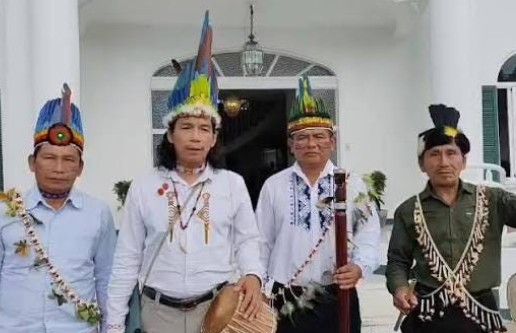
Leaders of the Sarayaku community
In 2012, Sarayaku won a lawsuit against the Ecuadorian State after it was proven that the State violated international treaties obligating it to conduct a prior consultation for an oil project in Sarayaku territory. The ruling was celebrated globally as a historic victory for conservation and the rights of indigenous peoples against economic power.
However, even though the Ecuadorian government complied with some provisions, it ignored others. Clear and binding mechanisms were never established to guarantee that the right of peoples to decide on the arrival of extractive projects would never again be violated. Nor was the order fulfilled to remove the more than 1,400 kilograms of explosives that were buried in their territory during the 2010 seismic survey operation, with the approval of the Ecuadorian army.
For this reason, the Sarayaku people asked the Court to summon the Ecuadorian State to provide explanations.
Back in Costa Rica, a Decade Later
The strategy brought to the Court was forceful. Faced with the obvious and predictable excuse from the Ecuadorian government that removing the explosives was too costly, Sarayaku presented a practical alternative: that the State stop being an obstacle to their conservation work and officially recognize the conservation work of the original peoples. Even if it does not align with the UN’s technocratic “zero carbon” standards, this work has been highly beneficial and essential for the conservation of the Amazon.
Furthermore, they requested that the Sarayaku territory, which is comparable in size to the city of Houston and its metropolitan area, be declared a nature sanctuary and a zone free of extractive industries.
Those of us who view this process favorably can only hope for one thing: that, as a consequence of this lawsuit, the government of Daniel Noboa does not resort to its usual tactics. Over these two years of administration, it has become customary to respond to dissent with institutional harassment, legal persecution, or the freezing of bank accounts. There are also murdered dissidents, and although there is no proof that the killer was the Ecuadorian State, there is evidence to suggest it.
Let us hope that this time the State plays fair and does not unleash a campaign of state terrorism against the Sarayaku leaders. Although we all know that, if it does, there would be serious consequences, always within the framework of peaceful resistance and respect for the law that characterizes the protest of the Sarayaku people.
The Depth of the Sarayaku’s Stance
Sarayaku has pointed out that the State does not understand or recognize their millennia-old conservation work simply because it clashes with the rigid guidelines of the UN. A country that constitutionally defines itself as “plurinational and intercultural” should not be allowing globalism to impose linear and technocratic standards on complex realities. Believing that solutions imported from Geneva will work better than the systems thinking that characterizes indigenous peoples is, in itself, a lack of common sense.
We cannot continue trying to fix the ecological chaos the planet is experiencing with the same linear and reductionist logic that created the problem. While the global bureaucracy reduces life to carbon metrics and standardized audits, Sarayaku demonstrates that real conservation is integral, spiritual, and experiential.
It is time for the State and international organizations to stop accepting the imposition of archaic molds and turn their gaze to those who have protected the Amazon long before environmental ministries or Paris agreements existed.
With this, Sarayaku is once again at the forefront, bringing to the international debate issues that today remain obstacles for indigenous peoples to fulfill their mission: to be the elder brothers who have the long-term vision, and who are willing to teach us how to live in harmony with the planet. Their crusade is not just for their territory; it is for the survival of our species.
___________________
Credit: Riki Cevallos Substack page