













State of emergency declared for weather-related disasters while Cuenca begins clean-up operations
Ecuador has declared a nationwide 60-day state of emergency to respond to weather disasters. According to the executive decree, all of Ecuador’s 24 provinces and 85% of its cantons have suffered as a result of heavy rains in February and March.
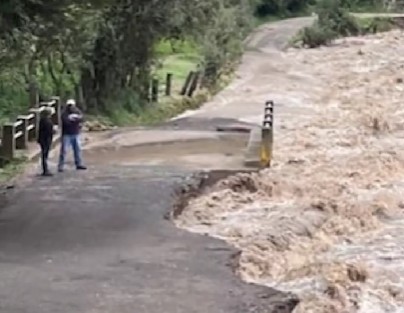
A washed out road on west side of Cuenca.
“Flooding, landslides and other weather-related events have damaged the national road network, infrastructure and affected the livelihoods of more than 50,000 Ecuadorians,” the decree said. “The declaration will allow the adoption and expansion of urgent and immediate measures to counteract the effects of winter, aimed at strengthening hydrometeorological monitoring, the activation of Emergency Operations Committees (COE) and the execution of response plans.”
It listed Guayas, Los Ríos, El Oro, Manabí, Esmeraldas Provinces and Azuay as the most-affected by heavy rainfall.
The declaration assigns the National Secretariat of Risk Management to coordinate remedial work related to the emergency.
Local Impact and Structural Damage
In the province of Azuay, the situation has become particularly critical. While coastal provinces have seen more widespread flooding, Azuay has emerged as the province with the highest death toll, recording three fatalities as of Thursday, March 12. The most affected cantons in the region so far are Girón, Ponce Enríquez, Chaucha, and Cuenca.
The Secretariat of Risk Management reported that the heavy rains have left a trail of destruction across the region. In Cuenca alone, 45 homes have been severely affected, with two completely destroyed. The human toll continues to mount, with 16 people—comprising four families—displaced from their homes, and nine individuals treated for various injuries.
The intensity of the Yanuncay River’s overflow has created a unique crisis in the highlands. The river, which typically maintains an average flow of 7 cubic meters per second, surged to a staggering 100 m³/s during the height of the storm. Experts note that this magnitude represents a 20-year flood event, which overwhelmed the city’s existing mitigation infrastructure, including warning systems and rock reinforcement walls.
Isolation in San Joaquín
The most dramatic scene unfolded in the San José de Barabón sector of the San Joaquín parish. The sheer force of the Yanuncay River dragged away the bridge connecting the communities of San Juan and San José, leaving dozens of families completely isolated.
Mayor Cristian Zamora, who toured the Soldados area to inspect the damage, confirmed that the road “table” (the physical foundation of the road) has simply disappeared in several sections. This has created a logistical nightmare for municipal crews; machinery is currently attempting to work from both sides of the river, but the lack of road access has slowed recovery operations significantly. Witnesses described the terrifying power of the water, noting that the current was strong enough to move five-ton boulders as if they were pebbles.
Environmental Degradation and the Path Forward
Local environmentalists and journalists are pointing to deeper issues within the Yanuncay microbasin that exacerbated the disaster. Beyond the exceptional rainfall, the destruction of the páramo, the alteration of wetlands, and the logging of protective forests for agriculture and livestock have left the landscape unable to absorb water.
“There is a series of constructions directly on the shore or dangerously close to the riverside,” noted Christian Sánchez of Diario El Mercurio. “If we continue to deteriorate the microbasin, these types of events will become more frequent.”
While the construction of new dams has been suggested as a long-term mitigation strategy, experts argue that territory management must be the priority. This includes the restoration of fragile ecosystems like wetlands and forests that serve as natural sponges.
As the city begins clean-up operations, there is a growing sentiment among residents and officials that the response must be sustained. Much like the efforts seen during recent forest fires, the work of conservation and infrastructure repair in the Yanuncay basin is described by local leaders not as a momentary task, but as “work for life” to ensure the city’s future safety.