
















Taking the mystery out of paying your bills in Ecuador
By Garry Vatcher
It is something none of us wants to do, but unfortunately, it is necessary. Getting the bill is usually the easy part. Paying it is not always quite so simple.
 In Ecuador, many bills, including IESS, utility, internet, phone can be paid at small tiendas, banks, credit unions, and other payment locations. Some companies accept credit cards, some do not, and some accept only Ecuadorian-issued credit cards. However, payment locations sometimes have limits on the amount they can process, so an unusually high bill may have to be paid somewhere else.
One of the things that makes the system confusing is that there is no single central payment-processing system used by every company.
Each service provider makes its own arrangements with individual banks, credit unions, and payment-processing companies to accept payments on its behalf. As a result, a bill that can be paid through one bank may not be payable through another.
Those agreements can also change.
There are occasions when an agreement expires or is not renewed on time. Suddenly, a bank or payment service that accepted a particular payment last month may no longer accept it this month.
That is where problems can begin.
Many expats open an Ecuadorian bank account primarily so they can pay their bills automatically. Normally, this works very well-until it doesn’t.
If the bank’s arrangement with a service provider changes, an automatic payment may not go through. You may assume that your electricity bill or IESS contribution has been paid because it always has been.
Then one day your electricity is disconnected.
Or you try to make an IESS medical appointment and discover that your contributions have not been credited.
The important lesson is never assume that an automatic payment was actually made. Check your account periodically and confirm that important payments have been processed.
Utilities can create another source of confusion for renters.
Electricity and water accounts are often registered in the property owner’s name rather than the tenant’s. Depending on the utility and the circumstances, changing the account holder may not be practical or permitted without the owner’s involvement.
As a renter, you will normally be given the account number, contract number, or payment code necessary to pay the bill, which could be in the owner’s name. You do not necessarily need the bill to be in your name in order to make the payment.
You may simply be handed a number by your landlord and told: “This is the number you use to pay the electricity.”
Welcome to Ecuador.
How Do You Know What You Owe?
Sometimes, you do not really know until you try to pay the bill. Some service providers allow you to check your account online to see what is owing, but the system is not consistent. In many cases, you are not sent a traditional invoice or detailed statement.
That can become frustrating when a bill is unusually high or there appears to be a discrepancy. Often, the practical solution is to pay the amount showing as due and then contact the service provider afterward to ask for an explanation or clarification.
For people coming from countries where detailed monthly statements are standard, this can take some getting used to.
Do you own a car?
Welcome to another adventure. Vehicles in Ecuador must go through the annual matriculation or vehicle registration process, and before you can complete it, there are usually several payments, taxes, fees, and outstanding obligations that must first be cleared. Depending on where you live and the vehicle involved, this can include amounts owed to agencies such as SRI, municipal authorities, transit agencies, and other entities.
Some payments can be made online. Others may require a bank, payment center, or in-person transaction. You may also discover traffic violations that you did not know existed. Photo-radar and other automated traffic fines can create unpleasant surprises. An outstanding fine may need to be resolved before the matriculation process can be completed.
The important lesson is to check your vehicle obligations well before your matriculation deadline. Finding out at the last minute that you have an unpaid fine or missing payment can turn a relatively simple process into a very frustrating one.
Is there an easy solution?
At Fundación Hogar de Esperanza, we are always looking for practical solutions to problems faced by the expat community-solutions that can also help support the work of the foundation.
On October 1, 2020, we opened the Expat Services Center. One of the services we provide is bill payment. Instead of trying to determine which bank accepts which payment, where you need to go, or whether a particular service is available that day, you can leave that work to us.
Our automatic bill-pay service allows you to maintain a deposit with the Expat Services Center. As bills become available, we pay them on your behalf.
Going away for a few weeks? Taking an extended vacation? Spending part of the year outside Ecuador? We can continue paying your regular bills, rent, or other agreed expenses while you are away. Each time we make a payment; we provide you with a receipt. At the end of each month, you receive a summary showing what was paid and the remaining balance in your account with us.
Need to pay your rent or make a bank transfer to your landlord? We can take care of that as well. One of the most important benefits of using the service is documentation. Every payment we make on your behalf has a record and a receipt, so you can see exactly where your money went.
The goal is simple: one less complication for you and making life in Ecuador a little easier, less complication, making life in Ecuador a little easier.
Learn More
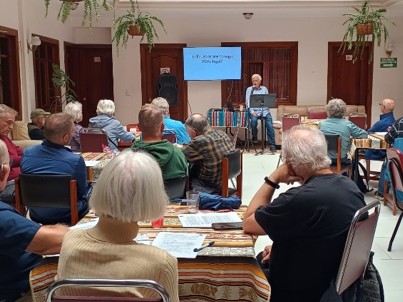
Each Wednesday, Hogar de Esperanza hosts An Afternoon at the Hogar. It is a time where you can meet others, socialize, learn new things and ask questions. This coming Wednesday, August 19 from 2 until 4 our topic will be Bill Payments in Ecuador. These sessions are free to attend.
The Expat Services Center offers many more services. You can find our more information at this session.
To sign up, you can click this link.
Or send an email to Patricia at contact@hogaresperazna.org
________________
Garry Vatcher is president and founder of Foundation Hogar de Esperanza. He has been coming to Ecuador since 1987 and permanently moved to Cuenca 12 years ago. The foundation provides emergency assistance to thousands of people each year. With his guidance, the foundation has forged alliances with some of Ecuador’s major institutions including hospitals, the National Police, Amazon communities, universities, and governments. The foundation has received numerous awards and recognition for its work from local and international bodies. For information about all Foundation Hogar de Esperanza projects, go to https://hogaresperanza.org