











‘That would never happen back home’: When comparison becomes the verdict
“That would never happen back home” is not necessarily an unfair thing for an expatriate to say. Sometimes something really does work better somewhere else. The problem begins when the place we left becomes the automatic standard for judging the place where we now live.
Margaret had been patient for the first half hour.
After 40 minutes, she asked about their food.
The waiter apologized and disappeared toward the kitchen.
Ten minutes later, three plates arrived.
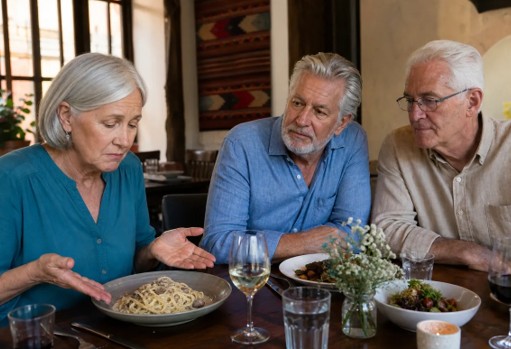
Margaret reacts after the meal delivered to her table is not the grilled chicken she ordered.
Robert looked at his. Correct.
Tom looked at his. Correct.
Margaret looked at hers.
Wrong.
She had ordered grilled chicken. The plate in front of her contained pasta.
She stared at it for a moment and then looked across the table.
“That would never happen back home.”
Tom took a drink.
“Some things do work better back home.”
Robert looked at him.
Tom shrugged.
“But Vancouver wasn’t exactly perfect either.”
Margaret shook her head.
“I’m not saying everything was better. I’m saying we’ve been sitting here almost an hour and they still got my order wrong.”
She had a point.
Can We Admit That Something in Ecuador Is Simply Bad?
Poor service does not become good service simply because it happens in Ecuador.
That distinction matters.
Living in another country does not require us to pretend that every inconvenience is a charming cultural difference. A restaurant can provide bad service. A business can make a mistake. A government office can be inefficient. A contractor can fail to show up.

Margaret, Tom and Robert distinguish a legitimate complaint about poor service from a judgment about Ecuador.
Margaret wasn’t wrong because she was annoyed.
After nearly an hour, she still didn’t have the meal she ordered.
The waiter returned, apologized again and carried the pasta away.
Tom watched him leave.
“I’d be annoyed too.”
“So why are you giving me a hard time?”
“I’m not.”
He smiled.
“I just don’t know where this magical place called ‘back home’ is.”
Margaret laughed despite herself.
Why Do We Compare Cuenca With Back Home?
We compare unfamiliar places with familiar ones because comparison helps us understand what we are experiencing.
When we first arrive in Cuenca, almost everything invites comparison.
What does an apartment cost?
How long should this take?
Is that normal?
Should the doctor have done that?
Why does the bank need another document?
Why hasn’t the repairman arrived?
How much should a taxi cost?
We already have reference points for those questions. Naturally, we use them.
Tom’s reference point was Vancouver.
Margaret’s was the United States.
Robert had his own.
The comparison itself wasn’t the problem.
Something changed when comparison became evidence that one way was the way things were supposed to work.
When Does “Back Home” Become a Verdict?
“Back home” becomes a verdict when remembering how something worked turns into deciding how it should work everywhere.
Margaret wasn’t really doing that intentionally.
She was hungry.
But the phrase was familiar.
They would never do that back home.
Back home, someone would lose their job over this.
Back home, we have a system for that.
Back home, people know how to…
The words often appear when something has frustrated us.
Robert had used versions of them himself.
Sometimes the comparison was useful.
Sometimes, if he was being fair, it was simply a way of saying:
Why don’t they do this the way I’m used to?
Those aren’t quite the same question.
The difference can be easy to miss, especially when a legitimate frustration turns into a judgment about the place itself. https://www.instagram.com/p/DcW3zfRnYCN/?img_index=1
Does Moving to Ecuador Mean We Lose the Right to Criticize It?
Choosing to live in Ecuador does not require expatriates to stop criticizing things that do not work.
The opposite response can be just as unhelpful.
Someone complains about something in Ecuador and another expatriate says:
“If things were so much better there, why did you move here?”
That ends the conversation without answering the complaint.
Margaret could like living in Cuenca and still expect the restaurant to bring the meal she ordered.
Tom could prefer aspects of Vancouver.
Robert could miss something from the United States.
None of that meant they had chosen the wrong place to live.
The question wasn’t whether they were allowed to compare.
It was what they did with the comparison afterward.
What Happens When Everyone Has a Back Home?
Every person who moves somewhere new carries a reference point from somewhere else.
The conversation at the table might have ended there.

Cuencano at the neighboring table offers a mirror image: his brother in New Jersey begins his complaints with ‘In Ecuador…’
Then the man at the next table turned toward them.
He was Cuencano and had apparently heard enough of the conversation to understand what they were discussing.
“My brother lives in New Jersey,” he said in English.
Margaret smiled.
“He likes it?”
“Yes.”
The man paused.
“But he complains all the time.”
Tom laughed.
“About what?”
“Everything.”
The man smiled.
“Except he always starts the same way.”
He lifted one hand as if quoting his brother.
“In Ecuador…”
For a second nobody said anything.
Then Margaret laughed.
Tom followed.
Even Robert had to smile.
The waiter returned with Margaret’s chicken.
It had taken almost an hour.
The service was still bad.
Nothing about the Cuencano’s story changed that.
But somehow “back home” sounded different.
Are We Comparing Reality With Memory?
Sometimes we are not comparing two places at all. We are comparing today’s frustration with yesterday’s edited memory.
We remember the things that worked.
We don’t always remember the contractor who never returned the call, the restaurant that ruined dinner, the insurance company that kept us on hold, the government office that lost the paperwork or the afternoon wasted waiting for someone who never arrived.
That doesn’t make today’s frustration imaginary.
It simply makes the comparison less useful than it first appeared.
Tom had problems in Vancouver.
Margaret had experienced bad service in the United States.
The Cuencano’s brother had apparently discovered plenty to complain about in New Jersey.
Everyone at the table had a “back home.”
And everyone’s back home looked a little better from a distance.
What Should We Do With “That Would Never Happen Back Home”?
Comparison is useful when it helps us understand a problem. It becomes limiting when our old home becomes the verdict on the new one.
The same question follows us beyond Cuenca: when does experience help us judge a new life, and when are we simply measuring it against an old definition of normal? Next Cradle explores that distinction here.

The correct meal finally arrives, and the table’s frustration softens into a more useful perspective on comparison.
Margaret cut into her chicken.
“This is actually pretty good.”
Tom looked at his empty plate.
“Worth waiting an hour?”
“Let’s not get carried away.”
They laughed.
The restaurant had made a mistake.
Margaret had every right to complain about it.
But the problem wasn’t that Cuenca had failed to behave like somewhere else.
The restaurant had simply provided bad service.
That was enough.
Maybe the more useful question wasn’t:
Would this have happened back home?
Maybe it was:
It happened here. What do we think about it?
Because the problem isn’t remembering how things worked back home.
It’s assuming that’s how they were supposed to work everywhere else.
_______________
Author’s note: The characters and events in this article are fictionalized to illustrate common experiences among expatriates living in Cuenca. Any resemblance to actual individuals is coincidental.



Hogar Esperanza News

Property Kuralt

The Cuenca Dispatch

Week of August 23

Ecuador’s economy grew 2% during the first half of 2026 compared with the same period a year earlier, according to new Banco Central del Ecuador data.

Cuenca gets a prime view of next week’s deep partial lunar eclipse.

Ecuador’s economy grows 2% in the first half of 2026.
Fund Grace News

Property Amazon

Nice apartment banner
Fabianos Pizzeria News