














‘That’s not my fight’: Then Tom walked into Cuenca’s Great March for Water
Tom wasn’t looking for a protest.
He was trying to get across town.
He had left home expecting an ordinary Wednesday morning in Cuenca. Instead, somewhere near the historic district, he found the street ahead of him filled with people.
Not a few dozen.
A river of them.

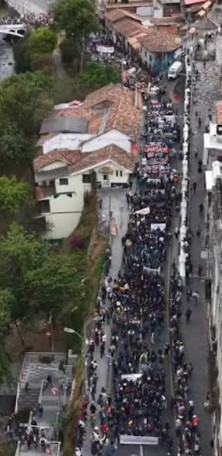
Tom expected an ordinary trip through Cuenca. Instead, he encountered thousands of people filling the streets for the September 16 March for Water.
Flags rose above the crowd. Banners stretched across the street. People carried handmade signs. Somewhere farther ahead, a loudspeaker competed with whistles, horns and voices.
Tom stopped.
“What the hell is going on?”
A man beside him answered in Spanish.
“Por el agua.”
For the water.
Tom looked again at the crowd.
He had heard about the mining controversy. Of course he had. It was difficult to live in Cuenca without hearing something about Quimsacocha, Loma Larga, mining and water.
But he had never paid much attention.
His explanation was simple.
“That’s not my fight.”
Why were thousands of people marching through Cuenca?
The September 16 march marked the first anniversary of the enormous 2025 mobilization commonly called the Great March for Water or the “Quinto Río.”
Last year’s march drew an estimated 100,000 or more people. The 2026 anniversary march was smaller, but thousands again moved through Cuenca’s historic center before gathering at Plaza San Francisco. — CuencaHighLife
 The issue is mining and water.
March organizers are seeking stronger protection of the páramos and water sources and the definitive elimination of mining concessions they believe threaten them. Among the specific demands delivered to the government during this year’s march were the elimination of the environmental license at Quimsacocha and closure of the Río Blanco concession. El Mercurio
Those are political and environmental questions on which people can, and do, disagree.
Tom’s problem was simpler.
He didn’t know enough to disagree with anybody.
He had already decided the issue belonged to somebody else.
Does living somewhere make its arguments ours?
Living in a place doesn’t obligate us to join every argument taking place around us.
That distinction matters.
An expatriate does not need to become an Ecuadorian political activist simply because he rents an apartment in Cuenca. Nor does moving here require adopting the position of the people carrying the loudest banners.
Tom could walk past the march.
He could disagree with it.
He could support it.
He could decide that he didn’t know enough to have an opinion.
All four were legitimate choices.
But there was another choice he had made without realizing it.
He had decided not to understand it.
That bothered him.
What changes when an issue reaches your own street?
See the story visually: Follow Tom’s unexpected encounter with Cuenca’s March for Water in the Instagram carousel, “That’s Not My Fight.”
An abstract issue becomes harder to dismiss when it suddenly occupies the place where you live.
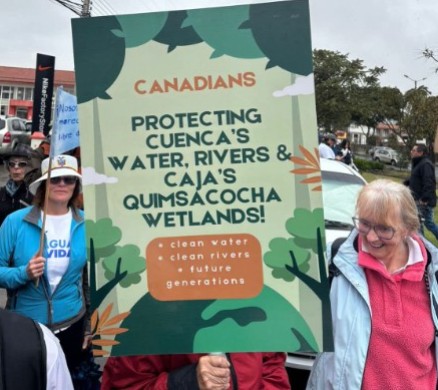
Many expat groups participated in both the 2025 and 2026 water marches.
Later, Tom told Robert what had happened.
“I couldn’t get through anywhere.”
Robert laughed.
“So your objection to mining is traffic?”
“My objection was that I was trying to get somewhere.”
“And now?”
Tom hesitated.
“I started wondering what they were actually marching about.”
That was different.
Not Do I agree with them?
Not Should I march with them?
Just: What do they know that I don’t?
Why does the water issue matter so much in Cuenca?
The argument reaches far beyond a mine itself because Cuenca’s relationship with water begins in the surrounding páramos.
Quimsacocha is a high-altitude páramo and water-recharge area south of Cuenca. Reporting surrounding the dispute has focused on concerns about mining and the headwaters and water systems connected to the region. El Mercurio
That helps explain something Tom hadn’t understood.
People weren’t simply marching against a company.
Many believed they were protecting something on which their communities depend.
Understanding that doesn’t settle the mining argument.
It does explain why people were willing to fill the streets over it.
When does “not my fight” become “not my concern”?
The two aren’t the same.
That may be the distinction Tom had missed.
We make it constantly.
Not my election.
Not my church.
Not my organization.
Not my business.
Not my fight.
Sometimes those boundaries are sensible. Nobody can participate in everything.
But “I don’t need to participate” can quietly become “I don’t need to understand.”
And those are very different decisions.
A person doesn’t have to join a march to wonder why thousands of neighbors are marching.
An expatriate doesn’t have to take a position on Ecuadorian mining policy to understand why water matters to the community where he has chosen to live.
And understanding something doesn’t obligate us to agree with it.
It simply means we know enough to understand the conversation happening around us.
What did Tom actually change his mind about?
Not mining.
That’s important.
By the time Tom got home, he hadn’t become an environmental activist.
He hadn’t researched the technical arguments.
He hadn’t decided whether every claim made by the demonstrators was correct.
He had changed his mind about something much smaller: Whether the issue was worth understanding.
A few days later, Carlos mentioned the march while Tom was buying bread.
Tom could have changed the subject.
Instead, he asked:
“Why is Quimsacocha so important?”
Carlos looked at him for a second.
Then he began explaining.
Tom listened.
He still didn’t know what he thought about mining.
But “that’s not my fight” no longer meant: That’s none of my concern.
And perhaps that is one of the quieter ways a place begins to become home.
Not when we agree with everyone around us.
When we start wanting to understand what matters to them.
We do something similar in our personal lives. Over the years, we hand entire parts of life to a spouse, colleague or expert because “that’s their department.” Usually it works, until circumstances change. In the Next Cradle companion, “That’s Your Department,” we look at the difference between letting someone else handle something and no longer understanding something that affects your own life.
________________
Author’s note: The characters and events in this article are fictionalized to illustrate common experiences among expatriates living in Cuenca. Any resemblance to actual individuals is coincidental. Photographs of the marches document actual events.