











The Batan March of Cuenca where the worst danger is sunburn
There are Saturdays in Cuenca when the city wakes up slowly. The dogs stretch, the buses grumble into life, and everyone has a second cup of coffee before attempting anything strenuous. Then there was Saturday, when Cuenca bounded out of bed like a child on Christmas morning and marched into town wearing every sports uniform known to humanity. If ever the Olympic Games opening ceremony was moved to Parque San Blas, this is exactly what it would look like.
The Federación Deportiva del Azuay was celebrating one hundred years of organized sport, which seems as good a reason as any to take over the historic center and show the world just how many ways a Cuencano can keep fit. I had never seen such a collection of athletes in one place. It felt as though every school, club, dojo, pool, track, ring, court, field, and dusty training hall in the province had emptied itself onto the parade route.
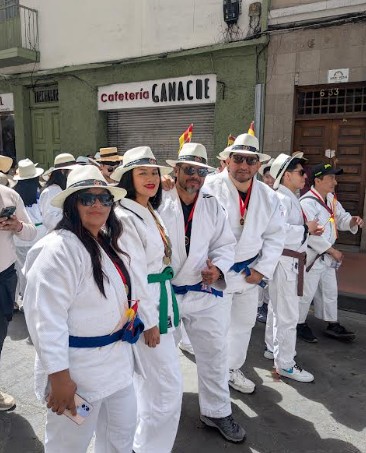 It all unfolded under an azure Andean sky so brilliant that the sun felt as if it had been specially hired for the event and paid a bonus to work overtime. A distinguished woman in the judo delegation, who carried a parcel of gold medals across her neck like a traveling jeweler, told me the uphill march was hard going. Judo is not a sport that usually requires headgear, but her team had wisely adopted those broad-brimmed Andean straw hats to prevent solar head injuries. Martial arts contestants are tough, but even black belts must bow before the strength of ultraviolet radiation.
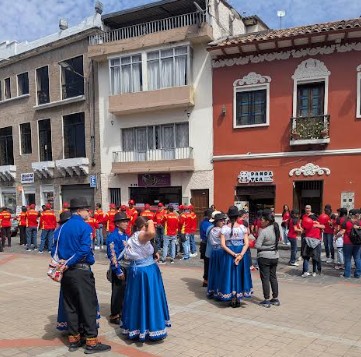
The number of sports represented was frankly astonishing. There was cycling, football, volleyball, table tennis, lawn tennis, racquetball, pickleball, triathlon, boxing, judo, karate, taekwondo, swimming, gymnasts, cheerleading, and everything in between. A baton twirler performed with a confidence that suggested she was unconcerned about the drone hovering nearby, and a drum corps struck their instruments with such synchronized precision that I thought they must have been hired to scare pigeons away from Parque Calderón. although a little later I noticed that the pigeons on the statue were actually unperturbed. If Dariwn had taken a side trip from the Galapagos to Cuenca, perhaps he would have observed that Cuencano pigeons had evolved the knack of ignoring human parades.
 Some teams marched with their trophies held aloft. There were silver cups, golden statues, medals that clinked like wind chimes, and even a few awards whose precise sporting origin was difficult to determine. One football team brought the entire contents of their trophy cabinet. The effect was magnificent. Only Cuenca could turn a parade into a rolling museum of competitive achievement.
And then came the vintage Morris Minis, along with Toyotas and Datsuns from the era when cassette decks were luxury items. Their owners seemed to believe that careful polishing is itself an athletic discipline, and after watching them go by, I am inclined to agree.
A marcher mentioned to me that judo is subsidized by the government but that participants still pay five dollars a month. I do not know how many sports this applies to, although it would not surprise me if several share the same model. Nothing in Ecuador is entirely free except unsolicited advice, political opinions, and the occasional lime. My working theory is that Azuay’s sporting universe is held together with a combination of municipal goodwill, dedicated coaches, and endless raffles, but perhaps readers can enlighten me further.
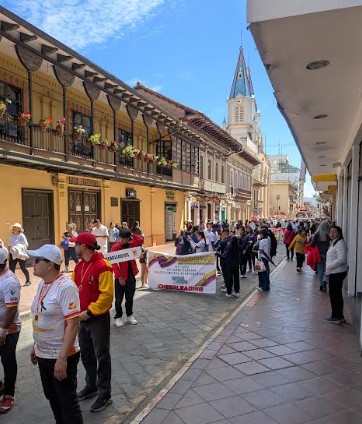 The economic ripple effect was undeniable. Ice cream sellers did a roaring trade and so did people selling small plastic bags of water to marchers. When the hour of almuerzo arrived lunch providers quickly sold out of ham, chicken, trout, sushi, and anything else that once had legs or fins. Taxi drivers enjoyed one of their better mornings with huge numbers of observers compensating for the closed streets in the area, and the Tranvia was as full as it could be. If the Ministerio de la Economia ever needs stimulus ideas, I suggest they fund weekly marching parades to boost Travia ridership.
What struck me most was the age range. There were tiny athletes barely five years old, marching with a seriousness normally reserved for surgeons. There were veterans in their seventies proudly wearing uniforms that had clearly been brought out and laundered for the occasion. A Cuenca football club that reached the national semi finals in 1992 marched in 4-3-3 formation wearing their original numbered shirts, although some of the shirts appeared to have shrunk in the abdominal region.
It makes you wonder how many people in Cuenca actually participate in organized sports. Nobody seems to know. There is no registry, no census, and certainly no database that allows you to sort citizens by VO2 max. A few research papers suggest that perhaps forty percent of young people in Ecuador take part in some form of organized sport, although adulthood tends to whittle the numbers down. My own observation of local children is that if you include soccer and hide-and-seek, the numbers get close to 100%.
Whatever the actual numbers, watching four thousand athletes pass under a sky the color of a tourist brochure convinced me that Cuenca is far more active than anyone realizes.
We do not have the sporting industry of London. There are no football academies the size of shopping malls and no professional scouts lurking on the local lighted courts after dark, but what we have is better. We have families willing to shuttle children between training sessions. We have coaches who give more encouragement than sleep. We have teenagers who prefer karate over TikTok. We have triathletes who train on mountain roads with hairpin bends over precipices. And once in a while, we have a parade that gathers everyone together and reminds us that community is a living thing.
When the last delegation passed and the crowd began drifting home, the city felt a little taller. A century of sport in Azuay is something worth celebrating. If the next hundred years are anything like today, I expect the sun will still be shining, the hats will still be wide-brimmed, and someone will still be polishing a 1970s Morris Mini to a mirror finish.