














The expat who won a Nobel Prize for writing about his travels
When V. S. Naipaul sat down to write The Enigma of Arrival, he was already some distance from where he began. Born in Trinidad, of Indian descent, he left his island and moved to England on the strength of a scholarship to Oxford University, and much later was awarded the Nobel Prize in Literature, having spent much of his life moving between worlds that never quite settled into one another.
The book itself is not a novel in the usual sense. There is no plot to speak of, no grand events, no tidy resolution. Instead, it follows a writer living in the English countryside, observing the place around him and, more importantly, observing how his understanding of that place keeps shifting over time. He arrives expecting something finished. What he finds instead is something that is constantly changing.
 This may come as a disappointment to those who have just signed a one-year lease in Cuenca and are waiting for the sense of arrival to set in sometime between the second alpaca sweater and the third visit to Tía.
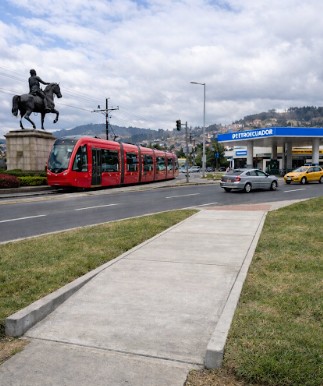
Cuenca, at first glance, looks settled. Churches polished to a postcard finish. Cobbled streets suggesting continuity with the past. A tram that glides along with the confidence of something that has always been there, although obviously it has not.
You arrive, and for a while you think you understand it. Then small things begin to shift, or perhaps more accurately, you begin to notice that they have already shifted.
There is a cottage industry of articles suggesting that living in Cuenca leads to some subtle, almost spiritual turning point, the kind that arrives somewhere between your first merengue lesson and the moment you stop converting prices into Canadian dollars or Euros. In practice, what tends to happen is much simpler. You get used to the place, so you stop thinking about it. And if anything changes, it is usually the street, not your soul.
I was reminded of this recently in a slightly roundabout way. After managing to sprain my ankle while sidestepping a growling dog, I spent several weeks reducing my ambulatory movements to the bare minimum. Shops were visited only when necessary and I was propped up by a supermarket trolley cart, routes were shortened, and anything involving an unnecessary detour or running across a road was postponed.
When the ankle improved, I did something I had not done for a while. I turned left out of my apartment instead of right and walked a few hundred yards to the local shopping parade.
It felt, quite unexpectedly, like entering a different neighborhood.
There was a new Italian center offering language lessons and even the possibility of arranging study at a university in Italy. A car wash had appeared where there had previously been a chicken coop and a vigilante dog. A small almuerzo place had opened, already doing a steady trade with people leaving the local school, as if it had always been there.
And, miracle of miracles, where Avenida de las Americas meets Ordonez Lasso and pedestrians have to skip through the traffic, a little concrete cutting had been carved out through the grass, which made it easier for peatones with sprained ankles to cross the road, although in my case it was a case of too little, too late, but never mind.
All of this had happened since the New Year, during a period when objectively speaking my actual GPS location had hardly changed at all.
Naipaul would not have been surprised, because his central idea, is that the notion of arrival is largely something we construct in advance. We imagine that once we reach a certain place, geographically or otherwise, things will solidify around us and stop requiring our attention.
But places do not stop or stand still. And neither do we.
What changes, often more than anything else, is our attention. We look in one direction and miss another. We establish routines that narrow the field of vision without our noticing. Then something interrupts the routine, and the place reappears, altered not so much in itself as in our perception of it.
This has some bearing on the modern fashion for what is called “slow travel,” which is less a rejection of movement than a rearrangement of it. Instead of passing quickly through many places, one lingers, always with the sense that a more authentic experience is just around the corner. Naipaul would probably have raised an eyebrow at the idea, since lingering does not solve the problem of arrival so much as extend it indefinitely.
Cuenca, for its part, complicates matters further by being a place that invites you to stay. The cost of living is manageable, the climate is mostly mild, and the systems, while occasionally opaque, are not impenetrable. You can build a life here without too much strain.
But even then, the sense of arrival remains provisional.
You can live here for years and still find yourself adjusting your understanding of it. Your Spanish improves, though not always in a straight line. Your habits settle, but then are disrupted by a feria, a paro, or a bureaucratic requirement that seems to have appeared without warning. Even belonging turns out to be something that comes and goes. You may find yourself giving directions to a newly arrived expatriate one day and asking a taxista for clarification the next. Both states can coexist without contradiction.
Naipaul understood this long before the current vocabulary of expatriate life came into fashion. He understood that arrival is not a fixed point but a continuing process, one that involves as much unlearning as learning.
For those who want to follow him further, his travel writing — Among the Believers on Iran just after the revolution and the wider Islamic world, and The Loss of El Dorado on South America and the Caribbean — covers much of the same ground with the same unsettling precision.
In that sense, Cuenca is not a place you arrive at. It is a place you continue to arrive at, often when you are least expecting it, and sometimes simply because you turned left instead of right.



Hogar Esperanza News

Fabianos Pizzeria News

Fund Grace News

The Cuenca Dispatch

Week of September 20
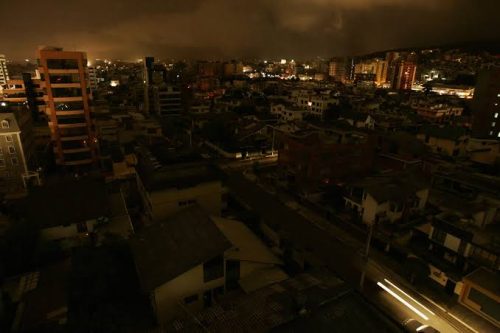
Ecuador turns to industrial power cuts to protect Mazar and keep homes from going dark.
Ecuador raises its 2026 growth forecast, but El Niño could spoil the outlook next year.
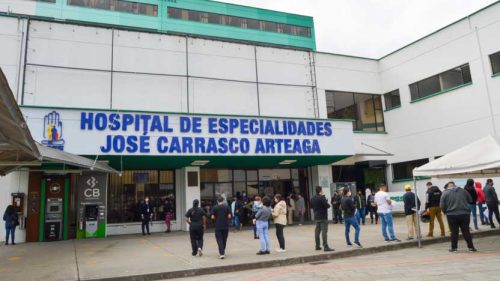
Cuenca retirees challenge medical and therapy changes at IESS senior center.