











The Facebook doctor will see you now
The other day I was scrolling through Facebook when I came across a familiar sort of message. A man, perhaps in his fifties or sixties wrote that he was not actually sick, but he had the uneasy feeling that his body was not working quite the way it did when he was younger.
This is a dangerous thing to confess on Facebook.
Within minutes the remedies began arriving like pigeons at a plaza. One person recommended Tai Chi. Another suggested magnesium. Naturopathy was mentioned. Someone else suggested vitamins, and then the conversation wandered into detoxes, energy alignment, herbal powders, and something about pyramids which I did not fully understand but which apparently helps you to walk like an Egyptian.
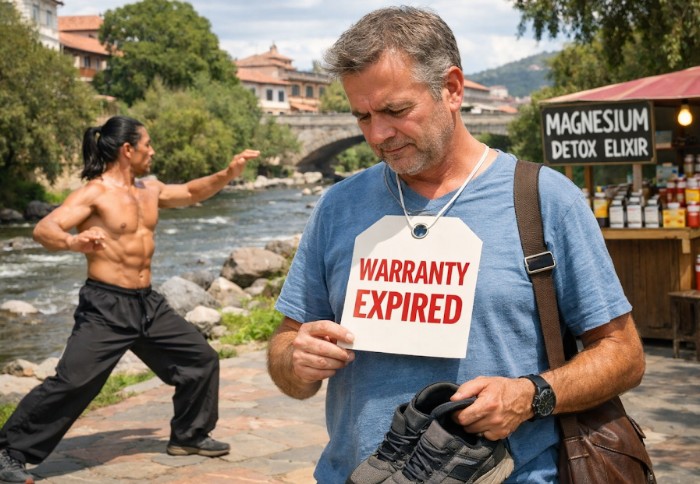 At this point one begins to suspect that the only thing not recommended was seeing a doctor.
I am not opposed to Tai Chi, vitamins, or herbal tea. Gentle exercise is perfectly sensible and a cup of chamomile has never hurt anyone. The problem begins when perfectly ordinary signs of aging are treated as if they were mysterious diseases that require expensive powders, drops, or subscriptions.
Human beings are not machines with a lifetime warranty. The day eventually arrives when you stand up from a chair and something in your knee makes a small noise. This does not mean you need magnesium shipped from the Himalayas. It may simply mean you are fifty.
There are, however, some very sensible things a person can do if they feel that their body is not behaving quite as it used to.
The first is to obtain actual information.
A proper medical checkup with a full metabolic panel will tell you far more than the internet ever will. Blood sugar, cholesterol, liver function, kidney function, thyroid levels, vitamin or electrolyte deficiencies. These are measurable things. They can be tested for a modest cost and interpreted by someone who spent many years learning how the human body works.
This is not nearly as exciting as a pyramid or a detox cleanse, but it has the advantage of being real.
The second thing is to address the three most boring pieces of advice in the world, which are also the three most effective.
Do not be overweight. Exercise a little. Be moderate with alcohol and tobacco.
Nobody has ever made much money telling people this, which is why it rarely goes viral on Facebook.
In Cuenca, the solution does not even require a gym membership. A person can walk along the Tomebamba, climb a few hills, carry groceries home from the market, or simply take the stairs instead of the elevator. The body was designed to move and carry loads which does not require a subscription plan.
What concerns me more are some of the modern health fads that can actually be dangerous.
Magnesium, for example, is widely recommended on the internet as if it were a universal cure for fatigue, anxiety, and insomnia. In small amounts it is harmless and even useful if someone has a deficiency. In large amounts it can interfere with heart rhythm and kidney function, particularly in older adults.
The same applies to testosterone supplements, which are now marketed as if they were the male equivalent of synthetic motor oil. Yes, testosterone production drops off with age. So does the ability to sprint for a bus. That is not necessarily a disease. Artificially increasing hormone levels without proper medical supervision can also increase the risk of blood clots, stroke, and heart problems. The human endocrine system is not something to adjust casually with an online order.
Then there are detox diets, which are one of the most profitable illusions ever invented. The human body already contains a detoxification system. It is called the liver, assisted by the kidneys. If those organs stop working properly, kale juice is unlikely to save the day.
Another popular fad involves enormous doses of vitamins. The public often assumes that if a little vitamin is good, then a lot must be better. Unfortunately, biology does not work that way. Fat-soluble vitamins in particular can accumulate in the body and create their own problems.
None of this means that modern medicine has all the answers or that doctors are perfect. They aren’t, but if you want advice about your metabolism, your heart, or your blood chemistry, it is probably wiser to consult someone who spent years studying medicine than someone who sells herbal powders on Facebook.
To be fair, not every non-medical therapy is complete nonsense.
Massage, for example, can feel extremely pleasant and I have used it myself on occasion. Tight muscles loosen, the back relaxes, and for a while one feels noticeably better and walks more freely. The difficulty is that in my experience the benefits rarely last more than twenty-four hours, which makes it a somewhat expensive way to improve Tuesday evening.
Acupuncture probably occupies a similar territory for some people, particularly where pain relief is concerned, although the elaborate explanations about energy meridians have always struck me as a little theatrical.
Sometimes simple physics works just as well. I once discovered, quite by accident, that if your feet are swollen after a long day, standing in a five-foot-deep swimming pool for an hour is remarkably effective. The water pressure does what elastic stockings are supposed to do, except that it does it better by providing three times the pressure, which is perfectly graduated because the deeper your leg the greater the pressure, is considerably more comfortable and comes with the additional benefit that you are already in a swimming pool where you can exercise your arms, legs, and lungs and do some stretches.
There is also a more philosophical point to consider.
Many people reach their fifties and begin to notice small changes. Recovery from exercise takes longer, sleep patterns shift, and the mirror becomes slightly less cooperative than it once was. It is tempting to interpret these things as failures that must be corrected.
But they are not failures, just part of the perfectly ordinary process of being alive.
A body that has carried you through several decades will naturally require a little more maintenance than it did at twenty, but the solution is rarely a miracle supplement or a mysterious powder that arrives by Servientrega. Far more often it turns out to be a modest collection of habits that doctors have been recommending for generations: eating reasonably, moving regularly, sleeping enough, drinking less than you did at university, seeing a doctor once in a while, and maybe getting a free flu vaccination at the Department of Health or owning a cat or a dog.
It is all terribly unglamorous, which is why nobody on Facebook ever recommends it.
Unfortunately, there is very little profit in telling people that the human body does not require pyramids, detox potions, Chinese calisthenics, turmeric, garlic, or a lifetime subscription to magnesium capsules. What it requires is common sense, a little self-discipline, and occasionally a brisk uphill walk along the Tomebamba, which, in Cuenca, is a medicine that is fairly easy to swallow.