












The modern millers
A medieval monastery needed more than prayer. Its residents needed flour to make bread, clean water, washed clothes, sewerage and, preferably, a way of doing the hardest jobs without diverting another monk from the important business of praying for rain.
Running water was a remarkably useful way of redirecting divine power produced by prayer. At many monasteries, a channel called a mill race or leat took water from a river and directed it past a water wheel before returning it downstream. The wheel could drive gears to turn millstones or drive machinery. Water could also be routed through workshops and latrines. The monks may have renounced worldly luxuries, but they were quite willing to let a water power do the laundry.
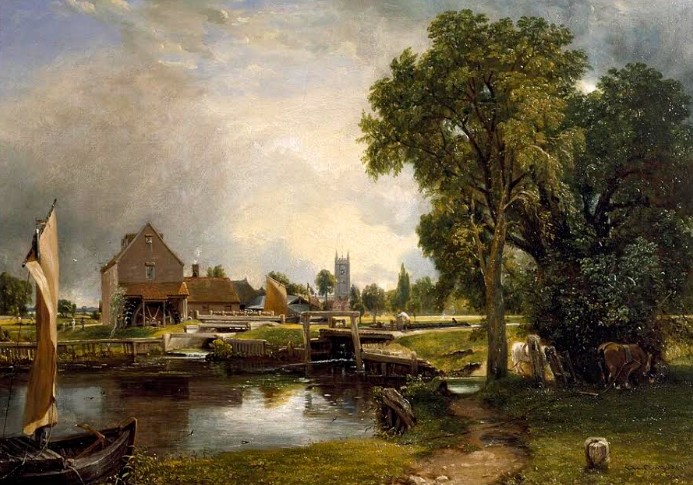 A bend or loop in the river could make a mill race particularly useful. By taking a shorter route across the land enclosed by the bend to build the lete, the water could arrive at the wheel higher than the river beside it. The difference in height supplied the power via gravity which had not yet been described by Sir Isaac Newton, but was in full practical use.
A modern hydroelectric station works on much the same principles. It replaces the leat, the water wheel and the millstones with tunnels, turbines and generators and the water may tumble hundreds of meters before it reaches the machinery. The electricity then travels away on transmission lines while the water goes back into the river.
This is hardly a new discovery dressed up as an answer to today’s energy crisis. Norway was building a hydroelectric industry long before the 1960s. During that decade, major projects were under way in Scandinavia, the Soviet Union, Canada and Iceland. Quebec developed its northern rivers on an extraordinary scale. It is now possible to speak of Iceland’s electricity as almost entirely renewable, although that does not mean it had achieved precisely 100 percent in 1960.
Ecuador has been putting gravity to work, too. Here in Cuenca, we live high in the Andes and watch four rivers leave town and head off towards Azogues. It is tempting to imagine a turbine every thousand feet on the way down until the water reaches the ocean, with a national electricity bill eventually arriving marked “nothing to pay.”
But it is not quite that simple. The first complication is that our rivers join the Paute system and head towards the Amazon basin. The second is that Ecuador has already captured some of their descent. At the Paute complex, water passes through the Mazar, Molino and Sopladora hydroelectric plants in sequence as it tumbles down towards the Amazon basin. It can generate power more than once because it still has farther to fall.
A proposed fourth plant, Cardenillo, would use the water again downstream of Sopladora. Its planned capacity is about 596 megawatts, with an estimated construction cost of $1.3 billion. For a country where labour is relatively inexpensive, that sounds like a spectacular amount to spend to dig a hole in a mountain, but it would be a very elaborate hole. A large hydroelectric project needs an intake, a dam or diversion structure, tunnels big enough to move immense quantities of water, pressure pipes, a powerhouse, turbines, generators, access roads and connections to the national grid. Much of the expense is in excavating and building the works that bring water to the turbines. Specialist equipment made overseas, probably in China, is another substantial bill. Cardenillo’s estimate also envisaged roughly six years of construction.
Elsewhere, Ecuador already generates hydroelectricity on the Jubones River between Azuay and El Oro, on the Zamora River in the southeast, and at Coca Codo Sinclair in the northeast. Near Cuenca, ELECAUSTRO has proposed two much smaller stations on the Yanuncay, with a combined capacity of about 22 megawatts. Their reservoir would also help regulate water for drinking and irrigation.
So the answer to “Why don’t we use the rivers?” is that we do, and there are plans to use more of them. The question is which projects are affordable and cost-effective, where they can be built without unacceptable damage to the environment, and how much electricity they can deliver when rainfall is scarce.
That last qualification matters is rather important, because a fourth turbine on the Paute can extract more energy from water passing through the system, but it cannot make the clouds to open in response to prayers to refill the Mazar reservoir. When drought reduces the flow, all the stations on the same river feel it, and usually the further downstream they are, the more they feel it.
There is another way to save some of that water: generate electricity from sunshine when the sun is out, and hold back the water at Mazar until it is needed. Batteries could then store some of the solar electricity for use after dark.
Puerto Rico is financing solar farms paired with large batteries, while Grenada, Saint Lucia and Saint Vincent and the Grenadines have a World Bank programme that includes battery storage. Ecuador has considerably more hydroelectric power than those islands, but the principle is the same: use one source when it is available and save another for later.
Batteries have become much cheaper than they used to be. The international average cost of a fully installed utility-scale system fell to about $192 per kilowatt-hour of storage in 2024. That can make them useful for moving an afternoon’s solar power into the evening.
Storing enough electricity to replace a major hydroelectric plant through weeks of drought would be a much larger and costlier proposition. Batteries could help Ecuador stretch its water supply, but somebody must still provide the electricity to charge them.
The miller would recognise that problem. His grain store could keep the mill supplied for a while, but it could not make the river flow. The river supplied the power, but the river gods set the terms for when and where the water was delivered. The miller probably wrote letters to the editor and said that the monks needed to pray harder if they wanted their daily bread.
________________
The monastery details are supported by Historic England’s accounts of monastic mill races; the hydro history and Ecuador project figures come from the operators and energy agencies. Historic England