












The mystery of the housemaid who never lit the fire
I had spent much of the day supervising the head of housekeeping at Larga Towers who had today arrived with a five-year-old assistant already surprisingly competent in wielding a broom and a mop.
The child attacked the rugs and the floor with the focused seriousness of an apprentice determined to prove her real worth while her school was closed for a holiday. Watching this operation unfold, it was suddenly revealed to me that one of the greatest literary mysteries of all time had been right under my nose all along.
Who exactly cleaned Sherlock Holmes’s apartment at 221B Baker Street?
 There is a famous moment in the story called Silver Blaze in which Sherlock solves a mystery partly because of “the curious incident of the dog in the night.” The curious thing,of course, was that the dog didn’t bark, which suggested to the great detective that whomever the intruder was, he was well known to the dog.
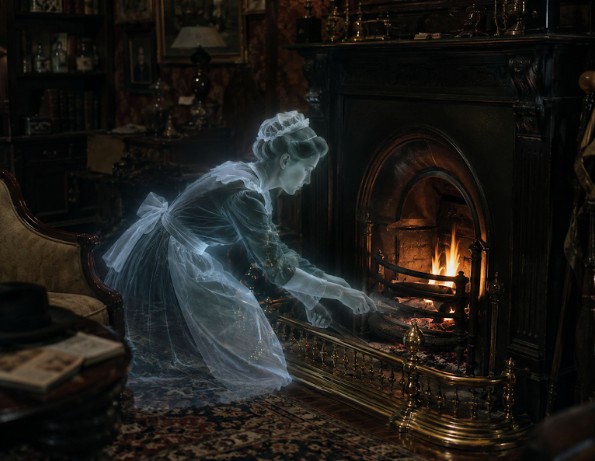
I have lately begun to suspect there is another curious incident in the Holmes stories, namely the invisible servant who never lit the fire. Let me explain.
Like many people of a certain age, I have spent decades imagining Holmes and Watson comfortably installed at 221B Baker Street with the long-suffering widowed landlady Mrs. Hudson drifting gently about in black silk mourning gear, occasionally bringing in a silver-plated tray with a bone china teapot and cups and saucers while Holmes sits back and injects cocaine, fires revolvers into the wall, and stores his loose tobacco in a Persian slipper on the mantelpiece.
Only recently did it occur to me that somebody who we never see or hear of must have been doing an absolutely astonishing amount of housework around the place, and it could not possibly have been Mrs. Hudson in person.
Victorian London was not a clean low-carbon city inhabited by people who smelled faintly of lavender polish and Earl Grey tea. It was a city heated by coal and Holmes himself was a polluter who smoked pipes, cigars, and shag tobacco in industrial quantities. Even the fog had texture. Curtains, rugs, tablecloths, and bed linen absorbed soot and nicotine and someone must have had to deal with all this dirt.
Every morning there would have been ash to empty, grates to blacklead, a brass fender and candlesticks to polish, coal and firewood to carry upstairs, fires to lay, and soot to brush away. Windows would need regular washing because Victorian tobacco smoke coated the glass with a yellow film that eventually made daylight resemble a submarine documentary and Holmes’s chemistry experiments probably added notes of sulphur and burnt varnish to the atmosphere.
And we have not even started on the issue of laundry.
Modern readers often underestimate what laundering meant before washing machines and polyester shirts. Watson and Holmes wore detachable collars, cuffs, waistcoats, wool trousers, socks, and heavy bed linen. Sheets were boiled, wrung out, dried, aired, ironed, folded, and carried back upstairs. Holmes may have solved murders, but I doubt he was standing in the backyard hanging damp sheets with clothes pegs.
And yet Conan Doyle barely mentions servants at Baker Street at all. Meals arrive, fires burn, and muddy boots mysteriously vanish and return polished. Bed linen changes itself without any human intervention at all.
It reminds me of modern discussions about artificial intelligence. People speak admiringly about “frictionless systems” without noticing that there must be thousands of typists hidden in the background, hallucinating away while pounding out ridiculous answers to absurd questions.
Mrs. Hudson herself as a widow and property-owning landlady was probably more of what we would call a condo manager than a maid. In Victorian London, even modest middle-class establishments often employed at least one maid-of-all-work or a daily charwoman, otherwise the whole enterprise would have collapsed under the sheer weight of soot, ash, laundry, and muddy boots.
One suspects Mrs. Hudson ran the place with the iron efficiency of a naval quartermaster while Holmes wandered about playing the violin at two in the morning and pinning correspondence to the mantelpiece with a jackknife.
There is a definite irony in the fact that Holmes maintained a network of street children as intelligence assets, the Baker Street Irregulars, paid sixpence a day for information. He could apparently organize an amateur surveillance network across the whole of London but apparently never thought to recruit one reliable cleaner.
Truth is that if we are honest, Holmes must have been a dreadful tenant, and the evidence accumulates quickly. Tobacco smoke, chemicals, wet overcoats, London fog, coal soot, old books, and occasionally a visiting bloodhound from Dartmoor. Modern landlords in Cuenca complain about tenants with emotional support parrots and air fryers, but Mrs. Hudson was housing a man who once fired patriotic initials into the wall with a revolver and yet she endured for decades.
Perhaps it was because Holmes never seemed to be short of cash and reliably paid the rent on time. Perhaps because famous detectives impress the neighbors. Or perhaps because Victorian landladies were made of sterner material than modern property managers armed only with WhatsApp messages and passive-aggressive emojis.
In any case, the true unsolved mystery of Baker Street is not the Hound of the Baskervilles or even the true identity of Professor Moriarty.
It is who lit the fire every morning at 221B Baker Street.