













The barrio had an emergency plan. David didn’t
David had spent a career preparing organizations for the unexpected. Then a telephone call forced him to choose between his first real commitment in Cuenca and someone who needed him back home.
The Alarm
The new alarm hung from a concrete utility pole at the corner, a gray box beneath a blue strobe light.
David stood in the street looking up at it.
“It doesn’t seem like much,” he said.
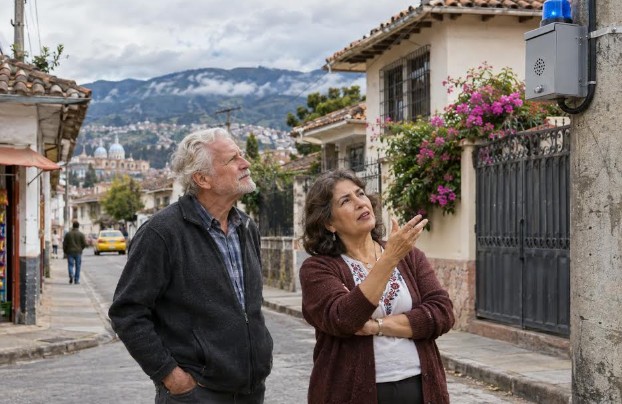
David sees a new community alarm. Lucía sees the relationships that must make it useful.
Lucía followed his gaze. “Wait until they test it.”
As if someone had heard her, the siren erupted.
David flinched. A dog began barking behind a metal gate. Two more answered from farther down the block. A woman appeared at an upstairs window, saw Lucía and waved. Across the street, a shopkeeper stepped outside carrying a broom.
The siren stopped.
For several seconds, the neighborhood seemed unusually quiet.
“Well,” David said, “people will certainly hear it.”
“Hearing it is not the problem.”
Lucía walked toward the corner tienda. David followed.
“What happens after someone activates it?” he asked.
“That is what everyone keeps asking.”
“Has anyone written down the procedure?”
“There was training.”
“That wasn’t my question.”
Lucía stopped walking.
It was not an angry look. David had learned that an angry look usually passed quickly. This was the more dangerous one—the look she gave him when he had said something efficient but incomplete.
“Everyone knows there is an alarm,” she said. “Some people have the application. Some do not. Some attended the training. Others were working. Doña Mercedes cannot hear very well. Don Rafael lives alone. The family in the yellow house is new, and no one has met them yet.”
David looked back at the pole.
In his working life, he had spent years finding the distance between a system as designed and a system as people actually used it. The distance was usually filled with assumptions.
“What you have,” he said, “is equipment.”
Lucía nodded.
“What you need is an operating plan.”
“No,” she said. “What we need is for the neighbors to decide what they will do.”
David started to answer, then stopped.
The distinction was small enough to miss and important enough not to.
Lucía resumed walking.
“There is a neighborhood meeting Thursday evening,” she said. “You can come if you want.”
“To help?”
“To listen.”
David looked once more at the silent gray box.
Listening had never appeared on any of his project plans.
But Thursday evening, he decided, it would.
The Meeting
The neighborhood meeting began twenty-three minutes late.
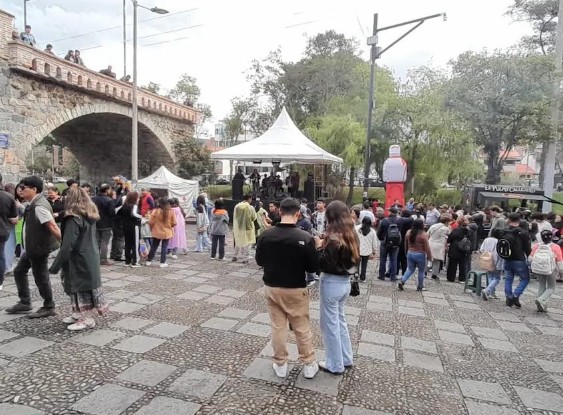
The neighborhood did not need David to supply its answers. It asked him to help organize what its residents already knew.
David knew because he had checked his watch four times.
By seven o’clock, fourteen people had gathered in the small community room behind the church. Plastic chairs formed something resembling a circle, although three people had moved theirs closer to the open window. A toddler pushed a red truck beneath the refreshment table. Someone had brought empanadas.
No one had brought an agenda.
David chose a chair near the back.
Lucía stood in front of the room and held up her phone.
“The community alarm is working,” she began. “But we have not decided how we will work.”
Everyone began speaking at once.
The shopkeeper from the corner wanted to know who was authorized to activate the alarm. A young mother said the application had rejected her password twice. A man in a Deportivo Cuenca cap complained that people would sound the siren every time they saw a stranger.
Someone else said strangers were precisely the reason they needed it.
David felt his fingers searching for a pen.
He had brought a yellow legal pad but left it folded beneath his chair. Lucía had invited him to listen. He intended to honor that instruction, even if the meeting appeared determined to punish him for it.
“An alarm is for a robbery,” the man in the cap declared.
“It is for an emergency,” said the older woman across the circle.
“That is what I said.”
“No. You said robbery.”
She introduced herself as Mercedes, although everyone but David already knew her.
“What if I fall?” she asked. “What if I cannot reach my telephone? Will the alarm help me then?”
The man in the cap looked toward Lucía.
No one answered immediately.
David glanced around the room. The conversation that had seemed disorganized only minutes earlier had begun revealing the actual problem.
They were not debating how to operate a siren. They were trying to define what neighbors owed one another.
A university student named Mateo said he could help residents install the application. The shopkeeper offered to keep a printed list of emergency numbers beside his telephone. A nurse who lived two streets away said she could provide basic first-aid instruction, but warned everyone that knowing she was a nurse did not make her available every hour of every day.
David retrieved the legal pad.
He wrote three headings:
People. Situations. Responsibilities.
Then he listened again.
By the end of the meeting, the page was filled with arrows, names and questions. It was not yet a plan. But it contained the raw material for one.
As people began stacking their chairs, Lucía came over.
“You were very quiet,” she said.
“You told me to listen.”
“And did you?”
David handed her the pad.
She studied it.
Under People, he had listed residents with relevant skills, residents who might require assistance and residents without smartphones.
Under Situations, he had separated crime, fire, medical emergencies, earthquakes and severe weather.
Under Responsibilities, he had left most of the space blank.
“You didn’t assign anyone,” Lucía observed.
“They haven’t decided yet.”
A small smile appeared.
“You can come back next Thursday.”
“To listen again?”
“No,” she said, returning the pad. “Next time, you can help us make sense of what we said.”
David looked down at the crowded page.
For the first time since leaving his career, someone had asked him to do precisely what he knew how to do – and nothing more.
It felt smaller than the work he once managed.
It also felt more important.
Making Experience Useful
David spent the next morning doing what David did when the world presented him with disorder.
He built a spreadsheet.
There were columns for names, addresses, telephone numbers, skills, physical limitations, emergency contacts and access to transportation. A second worksheet listed possible emergencies. A third assigned responsibilities. He added color codes for availability and created a field indicating whether each resident had installed the alarm application.
By lunchtime, it was elegant.
By two o’clock, it was useless.
Lucía studied the screen from across his dining table.
“Doña Mercedes will never use this.”
“She doesn’t need to use it. Her information will be in it.”
“Who gave you permission to collect her information?”
David looked at the screen.
“No one yet.”
“And if the electricity is out?”
“We can print copies.”
“Who keeps them?”
“We can determine that.”
“And who updates your spreadsheet when you are traveling?”
“I can put it online.”
Lucía’s expression returned.
David closed the laptop.
“What would you do?” he asked.
She unfolded a neighborhood map and spread it across the table.
“We begin with this.”
She marked the tienda, the church hall and the house of the nurse. She circled the blocks covered by the alarm and drew a line through a steep passage that would be difficult for an ambulance.
Then she placed the pen in front of David.
“We ask people what they want others to know. We do not decide for them.”
The spreadsheet did not disappear. It simply ceased to be the project.
Over the following two weeks, David and Lucía visited residents who had missed the meeting. Mateo helped people install the application. The nurse demonstrated how to place an unconscious person in a recovery position. The shopkeeper taped emergency numbers beside his telephone.
Doña Mercedes declined to provide her medical history.
“I have lived seventy-eight years without putting my blood pressure in a computer,” she said. “I see no reason to begin now.”
But she agreed that if her curtains remained closed after ten in the morning, the shopkeeper could knock on her door.
Don Rafael volunteered to check the narrow passage after heavy rain. The family in the yellow house turned out to include an electrician and a teenage daughter who could translate between Spanish and English better than David could.
At the next meeting, the neighbors assigned their own responsibilities.
David recorded their decisions, tested the sequence and pointed out what had been overlooked. He did not lead the meeting.
He made it possible for the meeting to produce something that could be used.
A practice exercise was scheduled for Saturday morning.
“I’ll be here,” David said.
Lucía looked at him. “Are you certain?”
David did not understand the question.
“Of course I’m certain.”
The Call
Patricia found him Friday evening arranging printed instruction sheets into folders.
“You realize this is a practice drill,” she said.
“That is why we practice. You find the problems before the real emergency.”
“You have reorganized those folders three times.”
“The first arrangement was alphabetical. This one follows the sequence of responsibility.”
“Naturally.”
David heard the amusement in her voice but continued working.
Two years earlier, he and Patricia had arrived in Cuenca with twenty-seven relocation categories, a detailed budget and three possible exit strategies. David had been prepared to live here.
He had not been prepared to become necessary here.
The distinction mattered.
“This is the first thing I’ve committed to that has a date beyond dinner,” he said.
Patricia sat across from him.
“You have committed to things.”
“Spanish lessons?”
“You stopped going.”
“The walking group?”
“You complained that they walked too slowly.”
“They called it a walking group.”
Patricia smiled.
David placed the last instruction sheet into its folder.
“This is different.”
“Yes,” she said. “It is.”
His telephone rang.
The screen showed his niece’s name.
David answered cheerfully. Less than a minute later, he was no longer standing.
He sat at the table, one hand pressed against his forehead.
His older sister, Ellen, had suffered a stroke in Florida. She was conscious but confused. The doctors needed decisions about a procedure. Ellen’s husband had died three years earlier. Her daughter was trying to manage the hospital, her own children and questions she did not know how to answer.
David was Ellen’s medical representative.
“There’s a flight tomorrow morning,” his niece said. “I’m sorry, Uncle David. I didn’t know who else to call.”
After the conversation ended, the folders remained between David and Patricia.
The first neighborhood exercise was scheduled for ten.
The flight departed at eight fifteen.
Two Legitimate Obligations
“I could leave Sunday,” David said.
Patricia was already checking the airline website.
“Your niece needs you tomorrow.”
“The doctors have her number.”
“Ellen chose you.”
“The exercise will take less than two hours.”
Patricia looked up from the screen.
“David.”
“I gave them my word.”
“And your sister?”
He stood and walked to the window.
Below, a bus released a cloud of dark exhaust as it pulled away from the corner. A woman hurried across the street carrying a bag of bread. The neighborhood alarm was visible above the tiled roofs.
He had spent two years wondering when Cuenca would stop feeling like a place in which he was temporarily living.
Now that it had made a claim on him, another life was calling him back.
“I cannot be in both places,” he said.
“No.”
“If I go, I let them down.”
“Possibly.”
He turned toward Patricia.

Leaving without preparing anyone would be disappearing,” Lucía told him. “This is a handoff.
She did not rescue him from the truth.
“And if you stay?” she asked.
David looked at the folders on the table.
For most of his career, commitment had meant remaining until the work was finished. Leaving was what people did when something else became more important.
He had never considered what happened when both things were important.
“I need to speak with Lucía,” he said.
The Handoff
Lucía was in the tienda when David found her.
The shopkeeper was showing her the emergency telephone list he had taped beside the register. They both looked pleased with it.
David told them about Ellen.
“I have to leave tomorrow morning,” he finished. “I can reschedule the exercise.”
“No,” Lucía said.
“I should be back within a week. Two at the most.”
“We will do it tomorrow.”
“I haven’t briefed Mateo on the observer checklist.”
“You can brief him tonight.”
“The emergency scenarios are in my laptop.”
“Then send them.”
“The final instructions haven’t been distributed.”
Lucía pointed toward the folders David was carrying.
“They are in your hands.”
David stopped.
One by one, he placed the folders on the counter.
Lucía opened the first. Inside were the neighborhood map, the responsibility list and a plain-language sequence for each scenario. Every page had a date and a place for revisions.
“You made this so other people could use it,” she said.
“Yes.”
“Then let us use it.”
“I told you I would be here.”
“And now your sister needs you somewhere else.”
David looked toward the alarm outside.
“I don’t want people to think I made a promise and disappeared.”
Lucía closed the folder.
“Leaving without preparing anyone would be disappearing.”
She pushed it toward the shopkeeper.
“This is a handoff.”
The shopkeeper nodded as if the distinction were obvious.
Lucía turned back to David.
“If this plan works only when you are standing beside us, it is not a neighborhood plan.”
David had built redundancy into organizations for most of his adult life. No important process was supposed to depend upon one person.
He had never applied that principle to being needed.
“What if something goes wrong?” he asked.
“Then we will learn what you said practice was for.”
Lucía picked up the second folder.
“Go to your sister, David.”
The matter was settled – not because his commitment to the neighborhood did not matter, but because it had mattered enough to produce something the neighborhood could carry without him.
Leaving and Returning
At seven the following morning, David sat beside Patricia in the taxi to the airport.
The city was just beginning to open. Metal shutters rose over storefronts. Buses collected the first passengers of the day. A man washed the pavement outside his bakery.
David checked his telephone again.

For the first time, leaving Cuenca did not make David’s life there feel provisional. People were expecting him back.
No new message from the hospital.
No message from Lucía.
At the airport entrance, Patricia embraced him.
“Call me from Quito,” she said.
“I will.”
“And from Miami.”
“I will.”
“And do not attempt to manage the hospital from the airplane.”
David almost smiled.
Inside the terminal, the agent examined his passport.
“How long will you be away?” she asked.
David hesitated.
“A week,” he said. “Perhaps two.”
He had given similar answers before. On previous trips, the uncertainty had made Cuenca feel provisional, as if every departure carried the possibility that he might not return.
This time, people were expecting him back.
That changed the meaning of leaving.
The neighborhood exercise began while David was waiting for his connection in Quito. His phone vibrated at ten twelve.
Lucía had sent a photograph.
Mateo stood beneath the alarm holding a clipboard. The nurse was speaking to a small group beside the church. The shopkeeper had closed his store long enough to participate. Doña Mercedes sat near the open window, watching all of them.
Beneath the photograph, Lucía had written:
We found three problems. Mateo has already made a new list.
A second message appeared.
Your system worked. Our plan needs work.
David read it twice.
Then he called his niece.
“I’m on my way,” he said.
Through the terminal windows, the mountains surrounding Quito were partly hidden by clouds. Beyond them was his sister, a hospital and a life that had known him much longer than Cuenca had.
Behind him was Patricia, Lucía and a neighborhood conducting an exercise without him.
For years, David had assumed that choosing a new home required loosening the obligations of the old one. Otherwise, he believed, he would never completely belong anywhere.
But perhaps belonging was not measured by having only one place that could claim you.
Perhaps it was measured by answering honestly when either one did.
David put the telephone in his pocket as boarding began.
He was leaving Cuenca.
He was also coming back.
See the central dilemma unfold in nine frames in our Instagram carousel: When two places need you, which one is home?
For a broader reflection on divided belonging, family responsibility and the meaning of home, read the Next Cradle companion: When Two Places Have a Claim on You
_________________
Author’s Note: This fictional story was inspired by Cuenca’s expanding community-alarm and neighborhood-preparedness initiatives. In October 2026, the municipality reported that more than 80 community alarm systems were serving over 12,000 residents. The alarms combine technology with resident training, organization and cooperation. Read the municipal report.