

















The other Galapagos that nobody wants to visit, but everyone wants to own
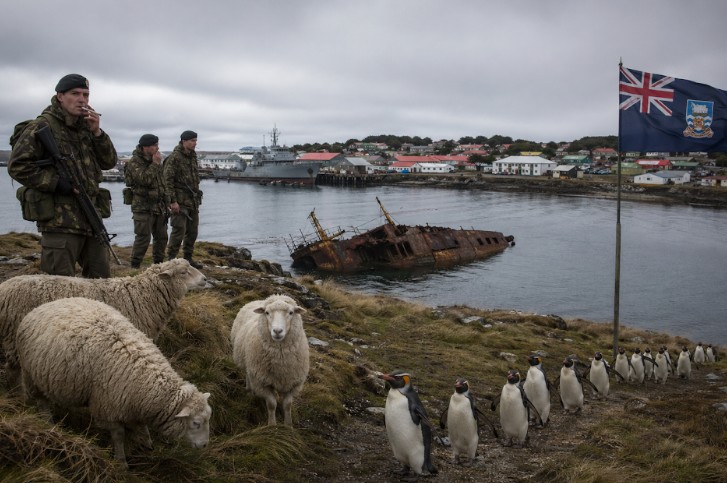
There are certain places in the world that acquire an importance entirely out of proportion to their size, population, or apparent usefulness, and the Falkland Islands fall into that category. About thirty-five hundred civilian inhabitants, too many sheep to count, penguins with better posture than most diplomats, and a prevailing wind that comes in directly from the South Pole.
And yet, for reasons that are partly historical, partly legal, partly economic, and occasionally emotional, two nations continue to take the matter very seriously indeed. A third nation has now re-entered the picture in a way that would have startled one of its own former presidents.
 An internal Pentagon memo, leaked this week, has floated the idea of reassessing American diplomatic support for British sovereignty over the islands as a form of pressure on NATO allies who declined to participate in US-Israeli strikes against Iran. The memo refers to the Falklands as an “imperial possession,” which is the kind of language that would have produced a chilly silence in London around 1983.
The Thatcher-Reagan alliance was the cornerstone of American support for Britain during and after the 1982 war. Ronald Reagan was not, initially, in a hurry to take sides. His administration had interests in Argentina, relationships with the military junta, and a general preference for not choosing between friends. It was the force of Margaret Thatcher’s conviction, combined with the sheer fact of Argentine aggression, that eventually brought Washington firmly into the British corner. Reagan gave intelligence support, satellite data, and diplomatic cover while Thatcher sent an armada to the South Atlantic. The alliance held, the war was won, and the islands remained British.
What the current White House appears to be suggesting is that this alignment was always a matter of circumstance rather than principle, and that circumstances have now changed. It is an arguable position and a useful one to keep in mind when evaluating any subsequent claims about principles.
If you read the British press, for example the always jingoistic Daily Mail, the issue is presented in a way that would be immediately understandable to anyone who has ever filled out a ballot paper in a parish hall. The islanders have voted, overwhelmingly, to remain British. Case closed. A simple matter of self-determination, like choosing between tea and coffee, except with rather more at stake.
If you listen to Argentina, the tone changes. The islands are described not as a quaint community of wind-hardened sheep farmers but as a lingering colonial anomaly, a piece of territory that ought, by rights and by history, to form part of the Argentine state. The people living there are, in this view, rather like tenants who have grown comfortable in a house whose ownership is disputed.
Neither side is entirely wrong, which is why the argument continues.
The British position rests heavily on effective control, which is a wonderfully practical concept dressed up in legal language. Who is actually running the place? Who maintains the roads, enforces the laws, issues the fishing licenses, and generally keeps things going when the weather turns unpleasant? On that measure, the United Kingdom has a strong hand, having done precisely that since 1833 without interruption.
Argentina is less interested in who is currently collecting the parking fines and more concerned with how the situation came about in the first place. There was, for a brief and somewhat chaotic period in the early nineteenth century, an Argentine administration on the islands under a man named Luis Vernet, who attempted to regulate sealing and establish a degree of order. This arrangement did not last long, but it lasted long enough to form the basis of a claim that has never entirely gone away.
From there, the discussion takes on a distinctly legal flavor, involving doctrines with Latin names designed to discourage casual participation. One of these, uti possidetis juris, holds that newly independent states inherit the boundaries of their former colonial rulers. Argentina argues that it inherited the islands from Spain. Britain replies, in effect, that inheriting something requires it to have been mentioned in the will.
What is worth noting is the irony that Argentina, which describes the Falklands as a “colonial possession” deserving liberation, is using language that fits the Caribbean territories far more precisely than it fits the Falklands. The islands were not acquired through the displacement of an indigenous population, were not worked by enslaved labor, and were essentially uninhabited when Britain arrived. The colonial critique is legitimate in general terms, but would be more relevant elsewhere.
One might reasonably ask why the matter is not simply referred to a court. Both sides would have to agree to such a process, and neither seems eager to gamble on the outcome. It is worth noting, in this context, that Britain offered to take the dispute to the International Court of Justice three times in the late 1940s and 1950s, and Argentina declined on each occasion. The court option, it turns out, is an instrument both sides are happy to propose and equally reluctant to accept.
The waters around the islands are rich in fish, and there is persistent evidence of oil beneath the seabed. Control of a small group of islands can, by a quirk of international law, translate into control of a very large area of ocean. It is one thing to argue about history; it is another to argue about revenue.
There is also the slightly awkward fact that the number of British military personnel stationed on the islands is not vastly different from the number of civilians who live there. This may be strategically understandable, given past events, but it raises questions about cost and proportion. Defending a place with taxes raised elsewhere can be more expensive than governing the place itself, which suggests that principles, once adopted, have a habit of becoming commitments.
From the vantage point of Cuenca, where the principal territorial dispute concerns whether the neighbor’s dog belongs on your side of the wall, the whole affair has a slightly theatrical quality.
Ecuador, after all, possesses the Galápagos Islands, a remote and ecologically priceless territory that sits hundreds of miles from the mainland, yet whose sovereignty is not seriously questioned by anyone. No international committee convenes to ask whether the residents might prefer to be governed from somewhere else, nor is there much appetite for revisiting which colonial power first took an interest in the place. Distance is not considered a defect, and history is permitted to settle into the background without comment.
One is left with the impression that principles such as self-determination and territorial integrity are not so much universal rules as instruments brought out selectively, depending on who is holding them and what they wish to prove.
It is worth noting that not all British overseas territories carry the same history. Places such as Bermuda, the Cayman Islands, and the British Virgin Islands have long histories tied up with plantation economies and, inevitably, slavery. Their populations are larger, more deeply rooted, and have at various times been offered a genuine choice between remaining British or becoming independent nations.
In those cases, self-determination has meant choosing between two reasonably practical futures, but the Falklands are different. There is no comparable history of slavery, no large post-colonial population with a longstanding claim to independence, and no economic base that would sustain a fully independent state. Independence is, in theory, an option, but in practice it resembles offering someone the chance to open a store in a town with no customers.
If the islands were to change hands, there would undoubtedly be a treaty, drafted with great care, promising that life would continue much as before. The language would remain English, the laws would remain familiar, and the sheep would continue to go about their business without regard to sovereignty. Experience elsewhere in places like Hong Kong suggests that such arrangements have a tendency to evolve over time.
In the end, the Falklands remain what they have always been: a remote, windswept place that has acquired significance not because of what it is, but because of what it represents. For Britain, a question of self-determination and continuity. For Argentina, a matter of history and unfinished business. For the current American administration, apparently, a bargaining chip. For the rest of the world, an issue to be acknowledged, discussed, and whenever possible, avoided.
And for the penguins, one suspects, an excellent place to live, provided nobody asks them to vote.