













The price of admission to the global shopping mall
Donald Trump recently claimed that the European Union is robbing the United States.
 The alleged robbery consists of requiring American technology companies to obey European law while doing business in Europe. Google has just been fined €890 million, split between €460 million for favoring its own services in search results and €430 million for restricting how app developers steer customers to cheaper options outside Google Play.
Apple and Meta have received similarly itemized bills, while Amazon has also contributed generously to the regulatory coffers.
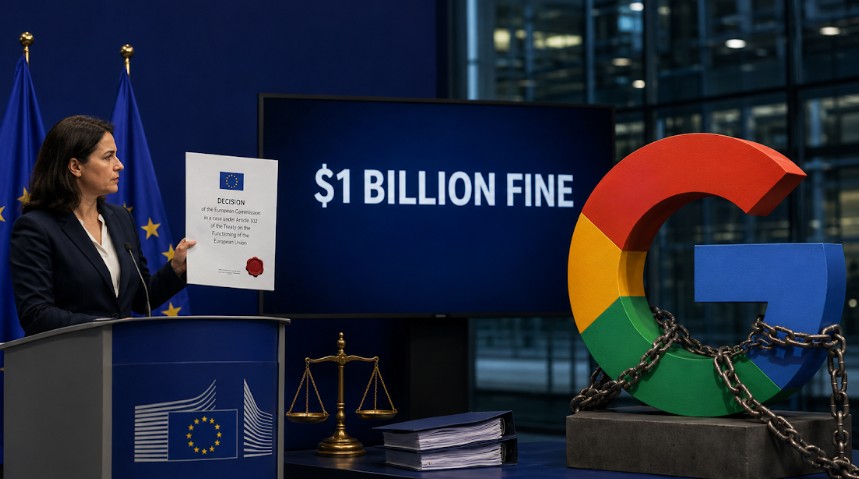 Trump sees this as Europe shaking down successful American companies. European regulators say they are preventing a handful of enormous corporations from controlling the marketplace, competing in it, and writing the rules for everybody else.
The argument sounds complicated until you imagine it happening at a shopping mall in Cuenca.
Grupo Ortiz owns Mall del Río and the new Mall del Alto. It also owns Coral, the enormous hypermarket chain that serves as an anchor at both malls.
There is nothing improper about that. Coral attracts customers, the mall supplies customers to Coral, and the other stores in the building benefit from the resulting traffic. Everybody knows where Coral is. It is difficult not to know, because you could probably enter Mall del Río blindfolded and find Coral by listening for the squeaking wheels of overloaded shopping carts.
But suppose the mall owner also controlled every sign, directory and inquiry desk in the building.
You enter looking for a television. The directory immediately directs you to Coral, although several independent electronics shops sell TV sets. You ask where to buy a washing machine, and the information desk sends you to Coral. You search the mall’s website for household appliances, and Coral appears in a large colored box at the top, complete with photographs and prices. The competing stores appear farther down as small blue names.
The mall owner might explain that it was only trying to make shopping more convenient. Coral carries almost everything, so why make customers walk around?
The independent retailers might give a different answer. They are paying rent to compete in a shopping center whose owner controls the directions and owns their largest competitor.
To be clear, I have found no evidence that Mall del Río or Mall del Alto does anything of the sort. The example is purely hypothetical. The relationship between the malls and Coral merely helps us understand the European case against Google.
Google does not simply search the commercial world. It owns businesses within the world it searches.
If someone looks for a hotel, flight, product or sporting result, Google can display its own service at the top of the page with photographs, prices, maps and filters. Competing services may appear below as ordinary links. Most users naturally select the large, convenient result in front of them.
The European Union calls this “self-preferencing.” Google calls it providing a better search experience and indeed both descriptions may contain some truth.
Google’s integrated results can be genuinely useful. If I want to know the score in a football match, I would rather see it immediately than spend ten minutes fighting my way through a sports website covered in advertisements and videos that start playing without permission.
But convenience does not make the competitive problem disappear. Google controls the road, the road signs and several of the destinations. It can improve its own services while gradually making competing services irrelevant.
The European Digital Markets Act does not require every search result to be impartial, which would obviously be impossible. A search engine has to decide which results are useful, reliable and relevant. The law is aimed at designated “gatekeepers,” companies so large that other businesses cannot realistically avoid them.
The EU says that a gatekeeper must not use control of the entrance to favor businesses it owns inside the building.
This explains why Google has found compliance so remarkably difficult, despite employing enough lawyers and consultants to populate a small European country.
The problem is not that nobody has translated the rules into English, but that full compliance may require Google to give up the commercial advantage on which parts of its business were built.
Google has already made some changes. It has altered displays, tested new formats and negotiated with the European Commission. Regulators have acknowledged substantial progress. But Google also argues that the EU is forcing it to remove useful features and weaken safety protections.
What Google means by compliance may therefore be: change the system sufficiently to satisfy the regulator while preserving as much of the business as possible.
What the regulator means is: stop doing the thing the law was designed to stop.
There is considerable territory between those two positions, much of it occupied by highly paid lawyers.
Apple’s problem is similar. Apple controls the normal route through which applications reach an iPhone. It also collects commissions on purchases made through its App Store.
Music services and other application developers could sometimes sell subscriptions more cheaply on their own websites because they would not have to pay Apple’s commission. Apple restricted their ability to tell customers about those alternatives or provide a convenient link to them.
Imagine renting a shop at Mall del Río and being told that you may not tell a customer that your other branch in el Centro sells the same item more cheaply. You may not display its address or even silently point toward the exit. If the customer independently discovers the other branch, that is permitted, but you must not assist in the discovery.
The EU fined Apple more than €1.8 billion in one competition case involving music-streaming applications and another €500 million under the Digital Markets Act.
Apple says it built and maintains the App Store, supplies security and brings developers their customers. It is therefore entitled to be paid, which sounds like a reasonable position. The more difficult question is whether being entitled to payment also entitles Apple to prevent customers from learning that other purchasing arrangements exist.
Meta, the owner of Facebook and Instagram, found another way to attract European attention, but presenting its users with a choice. They could either consent to extensive use of their personal data for targeted advertising or pay for an advertisement-free version. European regulators concluded that this did not offer a proper alternative using less personal data.
This was advertised as “consent or pay,” but the EU questioned how freely a person consents when the alternative is paying to retain access to a social network that has become part of everyday life.
Meta was fined €200 million under the Digital Markets Act.
It was also fined almost €798 million in a separate competition case involving Facebook Marketplace. Marketplace was automatically attached to Facebook, giving it immediate access to a huge population of users. Regulators said Meta had also imposed unfair conditions on competing classified-advertising businesses that used Facebook and Instagram.
The shopping mall comparison returns.
Suppose everybody entering the mall automatically received a free Coral catalogue, while rival shops had to pay the mall owner to hand out flyers. Suppose the information obtained from those advertisements could also help the owner understand their businesses and compete against them.
Amazon has faced precisely that type of concern.
Amazon is both the owner of an online marketplace and a retailer within it. Independent sellers provide Amazon with prices, sales figures and other commercially valuable information. European regulators investigated whether Amazon used non-public data from those sellers to benefit its own retail operation and whether access to the prominent “Buy Box” and Prime program was distributed fairly.
That case ended with legally binding commitments rather than a large fine. Amazon agreed to restrictions on the use of sellers’ data and changes intended to provide more equal access.
Amazon’s €746 million privacy fine was a different matter. It concerned the legal basis for using personal information in behavioral advertising. Meta has also received very large privacy penalties, including €1.2 billion over transferring European users’ information to the United States without safeguards that regulators considered adequate.
These are not identical offenses. Politicians lump them together because “Europe fines American technology companies” is easier to understand than a discussion of data transfers, app-store steering and market dominance.
It is nevertheless possible to see a common theme.
Google owns the search engine and services appearing in its results. Apple owns the operating system, the App Store and competing digital services. Amazon owns the marketplace and sells products within it. Meta owns the social network, the advertising machinery and Marketplace.
Each company began as a participant in the digital economy and later became part of its infrastructure.
Trump’s description of the fines as robbery of the American taxpayer is peculiar. Google pays a Google fine. The US Treasury does not receive an invoice from Brussels. American shareholders may ultimately bear part of the cost, just as shareholders bear the cost when a pharmaceutical company, bank or automobile manufacturer breaks the law.
One may reasonably ask whether EU regulations are too intrusive or whether the fines are disproportionate. European bureaucracy does not become infallible merely because Donald Trump dislikes it. Companies also have the right to challenge decisions in court.
But that is different from claiming that an American company should be protected from European law because it is American.
If a European supermarket group opened a chain across the United States, Washington would not allow it to ignore American competition, employment or food-safety rules on the grounds that enforcement was an attack on European taxpayers.
The technology companies can comply. What they cannot necessarily do is comply fully while preserving every advantage created by owning the mall, the directory, the information desk and the largest shop inside it.
All this is not a failure to understand the rules, but an understanding of the rules, followed by a calculation of how much obedience will cost. After all, any of these companies could simply stop offering their services in Europe altogether if it was unprofitable, or sell off their European businesses, but so far they have not, because actually leaving would hand 450 million European consumers over to rivals for a much higher cost than just paying the fines.



Hogar Esperanza News

Fund Grace News

Nice apartment banner

Fabianos Pizzeria News

Property Manabi

Property Amazon

Property Kuralt

The Cuenca Dispatch

Week of August 23

Ecuador’s economy grew 2% during the first half of 2026 compared with the same period a year earlier, according to new Banco Central del Ecuador data.

Cuenca gets a prime view of next week’s deep partial lunar eclipse.

Ecuador’s economy grows 2% in the first half of 2026.