












The question that tells you whether you’re beginning to belong in Cuenca
The turning point in expat life is not when Cuenca changes. It is when the questions you ask begin to change.
Beginning to belong in Cuenca often starts when the questions we ask begin to change.
Margaret knew what the next sentence was going to be before anyone said it.
It was late morning at her favorite neighborhood café. She came often enough that Carlos no longer asked what she wanted. He simply smiled, brought her coffee, and asked how her week had been.
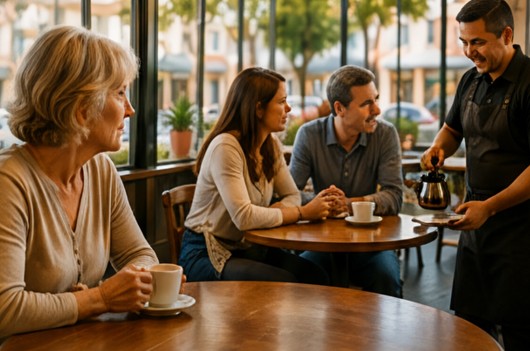
Margaret knew what the next sentence was going to be before anyone said it.
From her usual table near the window, she watched the neighborhood move through its morning. Office workers hurried past. A delivery truck blocked part of the street for a few minutes. Two women stopped on the sidewalk to talk. Someone across the room called Carlos by name.
At the next table, a newly arrived couple had been comparing Cuenca with the place they had left behind. The restaurant they tried the night before had taken too long. A store had not carried something they considered ordinary. A simple errand had required an extra stop and a second explanation.
None of the complaints was outrageous. Margaret understood most of them. In fact, that was what made her smile. She remembered how quickly unfamiliarity could turn into a judgment when she first arrived.
Then came the sentence she had been expecting.
“Why don’t they just do it the way we do back home?”
Carlos looked toward the table. Not with irritation. Almost with curiosity. He topped up their coffee cups and started to turn away. Then he paused.
“I hope you don’t mind,” he said. “May I ask you something?”
We All Arrive Looking for Familiarity
Everyone arrives carrying expectations shaped by the life they left behind.
Comparison is one of the most natural ways we make sense of a new place. We compare buses, banks, doctors, restaurants, customer service, traffic, government offices and even the way people greet one another.
We also compare smaller things. How long lunch takes. What is available at the neighborhood tienda. Whether a repair person arrives at the hour we expected. How much explanation seems necessary to accomplish something that once felt routine.
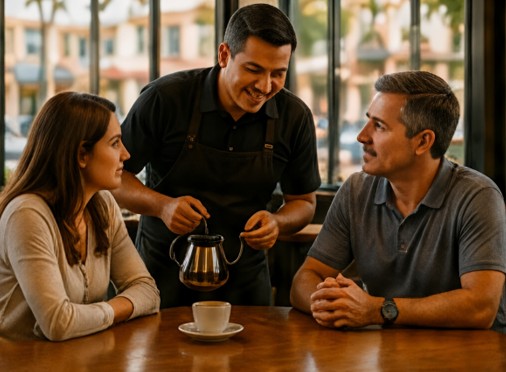
Some questions change more than the conversation. They begin changing the person asking them.
Comparison itself is not the problem. Familiar experience gives us a reference point. It helps us recognize differences and decide what matters to us.
The problem begins when the reference point quietly becomes the standard by which everything else must be judged. Then “different” starts sounding like “wrong” before we have learned enough to know why something works the way it does.
Margaret remembered doing exactly that. During her first months in Cuenca, she sometimes entered an ordinary situation already knowing how she thought it should work. Only later did she realize that she had been asking a new country to explain itself in terms of an old one.
The Questions We Ask Reveal Where We Are
The questions we ask often reveal whether we are judging a place or trying to understand it.
Carlos did not answer the couple’s complaint. He did not defend Ecuador, and he did not tell them they were wrong.
Instead, he asked one simple question.
“What makes you think it doesn’t already make sense?”
The couple looked at one another. For a moment, nobody spoke.
Carlos was not suggesting that every system in Cuenca was efficient, sensible or beyond criticism. Some things work well. Some do not. The same is true almost everywhere.
His question was about something else: Had they understood the situation before deciding what it meant?
That distinction matters. Curiosity is not the same as approval. Understanding why something is done a certain way does not require us to like it. It simply gives us more information before we reach a conclusion.
There is a large difference between asking, “Why don’t they do this properly?” and asking, “How does this work here?” One arrives with a verdict. The other leaves room for an answer.
Questions become mirrors. Sometimes they tell us as much about the expectations we brought with us as they do about the place we are trying to understand.
The carousel below captures the moment when a familiar complaint becomes a better question, and that question opens the door to belonging. https://www.instagram.com/p/DbyXaqDkUB0/
The Moment Curiosity Replaces Comparison
Beginning to belong in Cuenca happens when curiosity becomes stronger than certainty.
Margaret could remember when that shift began for her, although there had been no single dramatic moment.
Instead of wondering why a familiar product was missing from a neighborhood tienda, she began asking what people bought instead. That question led to products she had walked past without noticing.
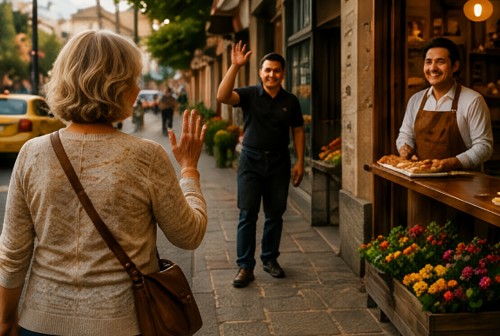
Belonging rarely arrives all at once. It usually appears one familiar greeting at a time.
Instead of treating an unfamiliar procedure as proof that something was badly organized, she began asking someone who used the system regularly how it worked. Sometimes she still thought the process was cumbersome. At least now she understood what she was criticizing.
She noticed the same change elsewhere. A bus route became easier once she stopped expecting it to behave like transportation back home and asked a local rider where to get off. A market became less confusing when she stopped searching only for familiar things and began asking vendors what was good that day.
Those were small changes, but small changes are often how a place becomes part of everyday life.
Cuenca did not become more familiar because it became more like the place Margaret had left. It became familiar because she learned how to live inside its rhythms.
What Locals Notice Before We Do
The people around us often recognize our belonging before we recognize it ourselves.
Belonging rarely announces itself. There is no ceremony and no particular day when someone declares that we have crossed from newcomer to neighbor.
Instead, familiarity accumulates.
Carlos no longer needs to ask Margaret whether she wants coffee. The baker remembers which loaf she usually buys. The woman at the fruit stand recognizes her and mentions what looks especially good that morning. A taxi driver who has driven her before asks about something they discussed on the last trip.
These exchanges are easy to overlook because none of them seems important by itself. Together, they reveal something larger.
Margaret is no longer moving through the neighborhood entirely as a stranger. People remember her because she has also begun remembering them.
That last part matters. Belonging is not simply being recognized. It is reciprocal. We learn names. We notice routines. We ask questions. We begin caring about the people and places that have become part of our own daily life.
The Real Question
The most important question eventually changes from “Do I belong?” to “What kind of neighbor am I becoming?”
Margaret finished her coffee. Carlos was already moving toward another table, the brief conversation with the newcomers folded back into the ordinary rhythm of his work.
She stepped outside.
Nothing about the street suggested that an important lesson had just been discussed inside. A bus moved through the intersection. Someone unlocked a storefront. Two neighbors stopped to greet each other. A familiar face farther down the block lifted a hand when Margaret passed.
She returned the greeting without thinking.
That was when the larger question seemed almost obvious.
For a long time, newcomers can wonder whether a city will accept them, whether they will make friends, whether they will understand the culture, whether this new place will ever feel like home.
But belonging is not only something a community gives us. We participate in creating it.
The question eventually becomes less about whether Cuenca is making room for us and more about how we are showing up in Cuenca.
Are we curious? Do we listen? Do we learn people’s names? Can we recognize the difference between something being unfamiliar and something being wrong?
Those questions do not require us to surrender our judgment. They ask us to earn it.
Beginning to Belong in Cuenca Starts with Better Questions
Beginning to belong in Cuenca has less to do with finding familiar answers than learning to ask better questions.
Every newcomer compares. Every newcomer wonders. Every newcomer carries expectations from the life that came before. There is nothing unusual about that.
The turning point comes when comparison stops being the destination and becomes only the starting point.
Margaret had once spent more time asking why Cuenca was not like the place she knew. Now she was more likely to ask how something worked, why it mattered, or what she had not yet understood.
The city had not changed to accommodate her expectations.
Her questions had changed.
Sometimes that may be one of the clearest signs that we are beginning to belong. Not that a new place has finally become more like home, but that we have become curious enough to let it become its own kind of home.
The same shift happens far beyond relocation. In the companion Next Cradle article, “Starting a New Chapter in Life: When It Stops Feeling Temporary,” I explore how changing questions can reveal that an unfamiliar chapter is quietly becoming your own.
And perhaps the most useful question is no longer, “Why don’t they do it our way?”
It is, “What might I understand if I ask why they do it theirs?”
_______________
Author’s Note: Some characters, conversations, and situations in this article are fictionalized or drawn from composite experiences to illustrate the ideas being explored. Unless specifically identified as factual, names and identifying details should not be understood as referring to actual individuals or events. Any resemblance to real people is coincidental.


Hogar Esperanza News
Fund Grace News

Property Manabi

Fabianos Pizzeria News

Property Kuralt

Nice apartment banner
The Cuenca Dispatch

Week of August 23

Ecuador’s economy grew 2% during the first half of 2026 compared with the same period a year earlier, according to new Banco Central del Ecuador data.

Cuenca gets a prime view of next week’s deep partial lunar eclipse.

Ecuador’s economy grows 2% in the first half of 2026.