
















The recline and brawl of airline seating
There are several ways to start an argument on an aircraft, but reclining your seat is probably the best way. One small button press, a slight backwards tilt, and you have started an international border dispute somewhere near the knees of the passenger in the seat behind yours.
A recent Daily Mail article described an American traveller (a TikToker, of course) whose disagreement with a woman seated behind him on a journey to Germany started such a row. According to his account, the cabin lights had been dimmed, he began reclining his seat to sleep, and a German lady in the row behind objected because he had not asked permission.
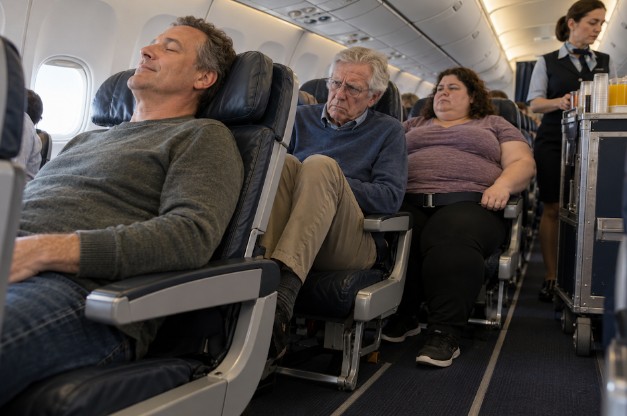 A flight attendant reportedly confirmed that he could recline, then asked whether he would consider sitting upright because the woman was uncomfortable. He declined and reclined. He said she subsequently kicked the back of his seat–several times.
We have his account, rather than both passengers’ versions, possibly because her side only came in German. Nevertheless, the comments beneath the article provided enough competing principles to keep an airborne constitutional convention occupied until landing.
The seat reclines, therefore you may recline it. Reclining is selfish. Objecting to reclining is selfish. Ask permission. Never ask permission. Buy business class. Stay at home.
As usual, everyone appeared to have found a universal rule that perfectly fitted their own circumstances without satisfying anyone else.
The case for reclining seems reasonable when considered in isolation. Airlines install the mechanism and sell seats equipped with it. Someone boarding an overnight flight can reasonably expect to use it when not taking off or landing. A modest change of position may make sleeping a bit easier or relieve discomfort. The person reclining may have chronic back problems that are no more visible than the difficulties of the passenger behind.
Demanding that everybody remains bolt upright throughout a long flight would impose considerable discomfort amounting to torture, as I once experienced on a midnight Spirit Airlines flight from Guayaquil to Miami.
Passengers with back problems, of whom the Daily Mail comments section appears to contain a substantial contingent, might also consider what preparation could make the journey easier. A familiar lumbar cushion, memory foam seat cushion, neck support, pillow, wooden bead seat cover, or other suitable support aid may help some people, particularly if tried beforehand rather than purchased hopefully at the airport.
An adequate supply of their usual, medically appropriate analgesia, or a prescribed muscle relaxant where indicated, may also belong in their travel preparations, used as directed. For some travellers, a support that suits their particular problem may prove more useful than the few inches of recline available. None of this guarantees comfort or removes the case for reclining, but the button need not carry the entire burden of managing a painful back condition.
The opposing case is also reasonable. The reclining seat on many airlines tips into space occupied by somebody else. Depending on the aircraft, the seat design and the length of the passenger’s legs, that movement may be barely noticeable or distinctly unpleasant, because two inches can be a small distance until your knees are occupying them and being crushed.
A laptop screen, a drink or a meal may also be involved. Reclining suddenly introduces an element of surprise into activities that seldom benefit from it.
One common answer is that the passenger behind the recliner should follow suit and recline too. Sometimes that helps. It changes their position and may restore a little breathing room.
It does not shorten their legs, move the row ahead further away, or necessarily make a tray table easier to use. Someone in a seat with restricted recline may not even have the same option.
Nor is everybody trying to sleep simultaneously. One passenger may be resting after an overnight connection while the next is having breakfast.
For those of us living in Cuenca, this is particularly relevant. A journey overseas may involve a domestic flight, a connection through Bogota, Panama, or El Salvador, and a further flight at the far end. The short flight on which you feel no need to recline may be the final stage of somebody else’s exhausting journey from Argentina or Chile, so the person behind you has boarded the same aircraft, but they have not necessarily had the same day.
Age adds another complication. An older passenger may need more room to lean forward before standing, turn stiff knees towards the aisle, or negotiate a way out from the window seat to the aisle. A reclined seat can make that manoeuvre considerably harder.
Returning upright briefly so someone can get out seems a modest accommodation. Equally, an older passenger in front may need to recline to remain comfortable. Age does not allocate all the sympathy to one row.
There is also a medical reason why airlines should make getting out of a seat reasonably easy. Prolonged immobility during long journeys can increase the risk of deep vein thrombosis, a blood clot usually forming in a leg, which can become dangerous if it travels to the lungs. The overall risk is small, but increases with factors including older age, previous clots and recent surgery. Moving the legs, exercising the calf muscles and walking periodically when safe are recommended precautions. Reclining itself is not the established culprit; prolonged immobility is. But temporarily raising your seat so somebody can stand and move around is a useful contribution to their chances of surviving the flight.
Younger people can have mobility limitations too. Nobody should have to deliver a medical dossier to a stranger before requesting a little cooperation.
Children complicate the calculation further. A small child whose feet scarcely reach the floor may be much less affected by a reclining seat than a tall adult. But children eat, use trays and travel in approved child seats. Parents may be holding a baby or helping a child with a drink when the seat ahead moves, so a backward glance tells you more than an assumption about how little space children require.
Courtesy also travels forwards and parents should discourage juvenile seat kicking, just as adults should resist pushing, jamming or repeatedly striking a seat because they dislike its position. Discomfort deserves attention; retaliation makes a crowded cabin worse.
Then comes the grand solution offered by many commenters: buy business class. Excellent! While we are solving financial problems by recommending more money, perhaps we could address housing. Yes, of course business class can be a worthwhile purchase for someone who can afford it, or has it paid for by their employer, particularly on a long overnight flight. But its existence does not settle the question of reasonable conditions in economy class.
For a family, the additional cost multiplies by the number travelling. On a complicated itinerary, buying better seats or upgrading cabins across several flights can become a substantial expense. Some journeys are undertaken for family obligations, medical appointments or emergencies, rather than because someone has spare money and an irresistible desire to visit an airport.
There are intermediate options in this part of the world, although these need examining carefully. Copa offers Economy Extra with additional legroom and recline. LATAM offers LATAM+ seating, with the extra space available depending on the seat and aircraft. Neither label should replace checking what the particular seat actually provides.
Personally, I like flying with Copa when possible. That is a preference based on my own experience, not any kind of claim that every seat on every Copa aircraft will suit every cranky passenger.
For travel involving Ecuador, compare the actual aircraft and seating options on Copa, Avianca, LATAM or whichever carrier operates each part of the journey. An airline name alone does not describe the space around your knees or the hardness of the seat.
Exit rows are another frequently proposed answer, but they come with responsibilities. Passengers must be capable of helping in an emergency. They are therefore not a universal solution for someone who struggles to stand, and children and accompanying carers face restrictions. On US flights, children under 15 cannot occupy exit rows.
The airlines also have some responsibility here. They choose cabin layouts and the type of seats they install. Where one passenger’s ordinary use of a seat causes another significant difficulty, the design deserves scrutiny alongside the passengers’ manners.
Passengers with larger bodies face another version of the same problem. For someone with severe obesity, the available space may already be fully occupied before the seat ahead moves at all, and reclining their own seat may do little to help. The passenger beside them may also be struggling for room to breathe.
Neither person’s discomfort should be dismissed, and making someone’s size a public spectacle solves nothing. Here again, airlines need clear seating policies and discreet arrangements made before passengers board, rather than leaving neighbouring passengers to negotiate a problem that neither can resolve by moving an armrest.
Personally, I hate the seats on American Airlines in recent years which push your shoulders forward without providing any lumbar support, giving a particular flavour to the announcement: “Thank you for flying with American. We know you have a choice.” I laugh bitterly when this is delivered on a route where American is the only airline offering a direct flight. Certainly, there is always a choice, provided you count changing planes twice, sleeping on the floor at Chicago O’Hare, and arriving the following afternoon, then flying via Amsterdam on the return journey. I always suspect a fair number of my fellow passengers would happily choose another airline if one were available. Thanking us for our loyalty on a monopoly route seems like a cynical interpretation of our predicament.
More generous spacing has commercial consequences, of course. Fewer seats can mean less revenue per flight, and passengers shopping primarily on price help shape what airlines offer. We cannot expect to demand unlimited room, or even moderate comfort, at the lowest possible fare.
But clearer information about space, recline and restrictions would help customers understand what they are buying. Clearer guidance during the flight would also spare cabin crew some improvised diplomacy.
Removing recline altogether on flights of less than 3 hours would settle one argument, while depriving passengers who value it of a useful comfort. That might be acceptable on some short services. It would be a less cheerful proposition for those who regularly cross the Atlantic.
So where does that leave the passenger with a finger on the nuclear seat button? With a little judgement, maybe.
Look behind before reclining. Give some warning and move slowly. A partial recline may provide enough comfort. Sit upright for meals when asked, and cooperate when someone else needs room to stand or get past. Follow the crew’s instructions.
The passenger behind can also make a specific, courteous request. Explaining that you need room to get out is more useful than announcing that nobody has permission to recline. If there is a genuine difficulty that the two passengers cannot resolve, ask the crew for help.
A warning need not become an application for permanent permission. An entitlement to use the seat need not become a refusal to accommodate anyone else.
The great reclining debate probably persists because both passengers have bought something reasonable: one a seat that reclines, the other a seat in which they hope to sit comfortably and the airline has left them to discover how well those two purchases fit together.
Until that improves, a brief chat over the back of the seat may accomplish more than a firm declaration of ownership of the space occupied by somebody else’s knees.
The medication wording reflects CDC guidance to choose suitable treatment and use it as directed; muscle relaxants can cause drowsiness and dizziness. NHS



Hogar Esperanza News

Fabianos Pizzeria News

The Cuenca Dispatch

Week of October 25

Ecuador heads into a four-day November holiday built around Cuenca’s Independence Day.

El Niño’s early rains have already affected more than 30,000 people across Ecuador.

Exporters press Constitutional Court to move three major trade agreements forward
Manabi property

Fund Grace News