














The South American country that hit the jackpot
There was a time when Guyana rarely appeared in conversation unless someone had a personal reason to mention it. It was not a place that intruded itself into headlines or travel brochures, and if it did appear in the news, it was usually for reasons that did not encourage tourism, including the occasional episode when followers of Jim Jones drank the Koolaid in the jungle, which for many years seemed to stand in for any broader understanding of the country even though it was entirely an expatriate phenomenon that had nothing to do with the Guyanese people.
Charlie Larga has never lived there, but a friend has been married for more than forty years to a woman from Guyana, and over the decades that has provided a steady trickle of stories, meals, opinions, and occasional corrections about how things are done in that part of the world. Through that route, Guyana existed not as a concept but as something more practical, involving family ties, curry and roti, and a certain insistence on doing things properly.
 Georgetown, as it was described, was a place of wooden houses, wide canals, and a sea wall that did a job most days but not always. New Amsterdam sounded quieter and more provincial, with Berbice carrying the weight of older histories that were not always visible to visitors.
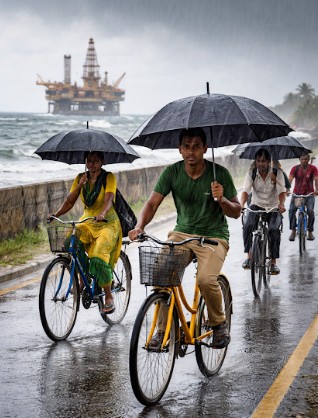
The Essequibo, which is less a river than a system of water and islands, seemed to exist in a category of its own, large enough to give the impression that the country itself had not quite finished forming. There were also stories, repeated often enough to feel reliable, of people going to work in heavy rain on bicycles while holding an umbrella in one hand, a method that combines determination with a certain disregard for balance.
For a long time, Guyana had the reputation of being one of those places where many people left and few arrived. It produced teachers, nurses, engineers, and civil servants who could be found in London, New York, Toronto, and increasingly in Florida, where entire communities formed around shared origin and memory.
It is sometimes said that Guyana has more of its people living abroad than at home, which may not be strictly measurable, but feels true in the way that such things are often understood.
This outward presence has been disproportionately visible. Writers, teachers, cricketers, and professionals of all kinds have carried Guyana into the wider world, often with more impact than one might expect from a country whose total population is smaller than that of the Cuenca metropolitan area.
One of the more recognizable examples is E. R. Braithwaite, whose experiences as a teacher in London became To Sir, with Love, later adapted into a film starring Sidney Poitier. The story resonated far beyond Guyana, but at its core it was about an expatriate who had left his country and discovered that the world had its own ideas about who he was supposed to be.
The same outward movement can be seen in cricket, which has long served as a kind of informal record of Caribbean talent and migration. Players such as Clive Lloyd, Alvin Kallicharran, and Shivnarine Chanderpaul carried Guyana onto international fields, often representing not just their own country, but the West Indies, whose identity is shared, negotiated, and occasionally misunderstood.
That pattern did not arise by accident. Guyana was shaped first by slavery and later by the importation of indentured labour from India, producing a society that is both diverse and, at times, uneasy with its own history. Forbes Burnham, who dominated the country’s political life for many years, presided over a period that did not encourage economic optimism, and the result was a slow but steady outward movement of people who could find better prospects elsewhere.
The territory itself has always been slightly unsettled, even when maps suggest otherwise. The Spanish claimed it early, but it was the Dutch who built the first colonies along the rivers, followed later by the British, who consolidated the area into what became British Guiana.
Borders drawn in that period have proved durable, though not entirely beyond dispute. Venezuela has long claimed the land west of the Essequibo River, and although an international tribunal in 1899 awarded most of that territory to the British colony, the argument has never quite gone away. It has recently returned with renewed enthusiasm, which may or may not be connected to the discovery of vast amounts of excellent quality offshore oil.
All of which made the recent transformation rather unexpected.
In the past few years, Guyana has been described, with increasing enthusiasm, as the fastest growing economy in the region and, more ambitiously, as the Dubai of South America, a phrase that tends to reveal more about the speaker than the subject.
Oil has been discovered offshore in quantities sufficient to change the national balance sheet, and with it the country’s position in the world, in a manner that faintly recalls those old television stories in which someone strikes oil in their backyard and moves to an address in Beverly Hills conveniently close to the TV studios.
From the outside, this appears to be a simple story. A poor country finds oil and becomes rich. The narrative writes itself, and it is tempting to assume that the consequences follow automatically.
From the inside, things are less straightforward.
Countries do not change at the same speed as their headlines. A place that has spent decades exporting its people does not suddenly reverse that habit because of a favourable report in the financial press. Infrastructure, expectations, and the daily routines of life tend to move more slowly than oil revenues.
One imagines that Georgetown still wakes up in much the same way, with people going to work, children going to school, and conversations taking place about matters that have little to do with global energy markets. The Essequibo continues to flow at its own pace, which is not influenced by quarterly earnings reports.
What may change, and what is harder to observe from a distance, is the sense of possibility. A country that was once regarded as peripheral becomes, almost overnight, strategically interesting. That tends to attract attention, investment, and advice, not all of it useful.
It also raises a question that applies more widely than Guyana.
Many people choose to live in places like Cuenca because they offer stability, predictable costs, and a certain insulation from the more aggressive forms of economic change. Prices are manageable, routines are reliable, and life can be conducted without constant reference to global volatility. This is often described as a form of escape, though it is perhaps more accurately a form of selection.
Guyana, by contrast, is moving in the opposite direction. It is becoming more connected, more exposed, and more subject to the forces that make some countries grow quickly and others less so.
Whether that constitutes improvement depends on where one stands.
From the point of view of someone who left Guyana decades ago, the change may appear overdue and welcome. From the point of view of someone living there, it may be experienced as opportunity, disruption, or some mixture of the two. From the point of view of an outsider reading headlines, it is simply another example of a country that has suddenly become much more interesting than it used to be.
Charlie Larga’s acquaintance with Guyana remains second-hand, filtered through friendship, marriage, and the long persistence of connections that stretch across continents. It is enough to suggest that whatever the economists may say, the reality will be more complicated than the phrase “Dubai of South America” allows.
Countries, like people, do not change character simply because they acquire money. They adjust, they adapt, and they carry forward much of what they were before.
Which is perhaps just as well.
Because if there is one thing that experience suggests, it is that the most reliable measure of a place is not its GDP, but whether, on an ordinary morning, people can get up, make coffee, and proceed with the business of living without undue complication.
And on that measure, most countries, whether among the nouveau riche nations or comfortably settled, continue to perform much as they always have.