












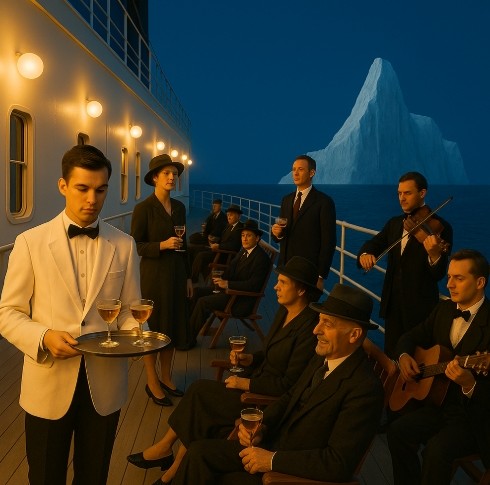
The Titanic and the unasked question: What was the crew drinking?
By Charlie Larga
When the Titanic went down in April 1912, it took with it more than 1,500 souls and left behind a century of questions. Some are technical—about rivets, watertight doors, and binoculars. Others are moral—about class, lifeboats, and cowardice. But one question is almost never asked, and certainly never answered: what state was the crew in that night?
Were they sober?
That is not a flippant question. It is a journalist’s question. It is also the kind of question one avoids asking in polite society, because the answer may be awkward. Yet in a century of inquiry, memoir, and mythologizing, the drinking habits of the crew—particularly those with direct responsibility for navigation and safety—have remained curiously untouched.
 Mythical Dignity and Missing Questions
The Titanic has been preserved in formaldehyde. Its story is told in hymns of nostalgia and indignation, with stewards handing out blankets, bands playing on, and officers going down nobly with the ship. But the moment one steps outside the official narrative and asks whether a helmsman might have been drunk—or whether alcohol was part of routine shipboard life among firemen and officers alike—one has committed a faux pas/
One must be careful, of course, not to malign the dead without reason. But there are reasons.
British maritime culture in the Edwardian era was soaked in alcohol. The Royal Navy had abolished the daily ration of rum only a few years earlier. On merchant ships, drink was part of the pay. Onshore, it was part of the union. Firemen and stokers often worked in boiling conditions for sixteen hours at a stretch, and when they came off shift, drink was their sedative, reward, and religion.
Nor was this unknown to White Star Line. Crews were not searched when they came aboard. Drinking on duty was theoretically forbidden, but officers looked the other way unless it became dangerous or disobedient. Many stokers were known to smuggle gin or rum aboard in flasks, boots, or coal sacks. Even some stewards carried hip flasks—though theirs were usually filled with port or brandy.
And as for the officers?
What We Know, and What We Avoid
First Officer William Murdoch—who is said to have shot himself on deck that night—had a reputation as a serious man. But he also had a Scottish taste for whisky. Captain Edward Smith was revered as a calm, pipe-smoking figure with a beard like a Greek god’s. But in the month leading up to the voyage, he had already had one incident aboard Olympic, involving a collision. Some speculated he had slowed too late. No one dared ask if he had been drinking.
When Titanic sailed from Southampton, there were saloons and smoking rooms for every class. Liquor was everywhere, and prohibition was nowhere. Yet historians treat the ship as if it were a floating chapel. The word “alcohol” appears more often in modern Titanic movies than it does in official inquiries.
To be clear: there is no smoking bottle. No tipple found in the wheelhouse. No sworn testimony of drunk stokers tripping on the gangways. But we do have context, and context is everything. Inquests after the Lusitania sinking in 1915 revealed widespread drinking among stokers. British naval reports from the same period complained that merchant crews were often “liquored up before departure.” No one claimed it was exceptional. It was normal.
And yet, when applied to Titanic, the question is not only unasked—it is forbidden.
The Moral Cost of Mythmaking
What we have done with the Titanic is not history but mythology. We treat it as a morality play, with evil rich men and noble bandsmen who played on, cowardly millionaires and brave telegraph boys. But we do not look too closely at the fallibility of the working man. We want the crew to be heroic by default: steadfast, sober, sacrificial.
Yet if a few of them were drunk—just one or two—what then?
What if a steersman delayed turning the wheel? What if a watchman misjudged the shape of the ice? What if a junior officer froze not from shock, but from drink?
These are questions worth asking, not because they lead to scandal, but because they lead to truth. A society that cannot question its own myth is not serious. And a historian who skips the most likely explanations is not writing history. He is writing bedtime stories.
Titanic was a technological marvel, yes. But it was also a British merchant vessel, crewed by working men, many of whom had been unemployed for months. The voyage was a lucky break. The trip across the Atlantic was long. The work was brutal. The night was cold. And the bottle was never far away.
To ask if they were drinking is not to disrespect them. It is to remember them as they were—human, capable of error, and vulnerable to all the same temptations as men ashore.
It is also to say that tragedy does not require malice. Sometimes it just requires foggy minds and slow reflexes.
And that, perhaps, is the most uncomfortable truth of all.
________________
Follow Charlie Larga on Substack.