












‘The water disappeared’ and then the tourists stopped coming
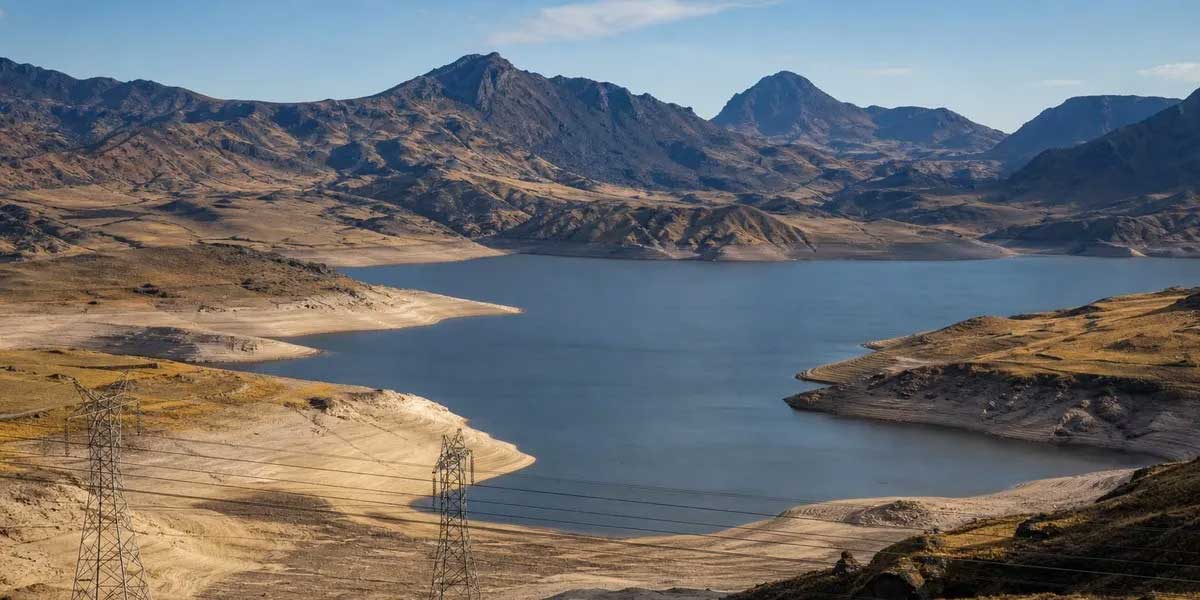
At Ecuador’s Mazar reservoir, stranded boats and threatened crops reveal another side of the electricity crisis. Now, emergency conditions at the Amaluza reservoir show why the problem reaches far beyond tourism.
“Elaine, Ecuador has invented a new tourist attraction.”
Elaine looked up from her book.
“What is it?”
“A boat you can visit without getting your feet wet.”
“That doesn’t sound particularly exciting.”
“Apparently, you don’t even have to buy a ticket.”
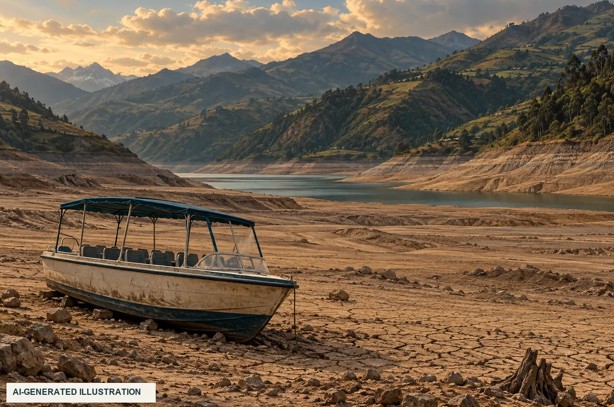
AI-generated editorial illustration of a tourist boat stranded beside a depleted Andean reservoir. Illustrative interpretation of reporting about Mazar; not a photograph of a documented boat or location.
Tom turned his phone toward her. The illustration showed a tourist boat sitting on exposed ground beside Ecuador’s Mazar reservoir.
“Tom, that boat is supposed to be in the water.”
“I thought that was the unusual part.”
“The unusual part is that the water isn’t there.”
Tom looked at the picture again.
He had been following Ecuador’s electricity problems for weeks. He knew about hydroelectric plants, reservoir levels, and the government’s efforts to keep electricity flowing.
He had even begun using the phrase generating capacity in ordinary conversation.
Elaine had asked him to stop.
But this was different.
Until now, Tom had thought of Mazar as a place that stored water for electricity. He hadn’t thought much about the people who lived and worked beside it.
Some Relief for Ecuador’s Electricity System, but Not for Everyone
By October 16, there was some encouraging news. Colombia had resumed supplying electricity to Ecuador. At 11 a.m. that Friday, Ecuador was receiving 132 megawatts from its northern neighbor.
The following morning, the government reported completing 54 preventive maintenance operations across electricity networks in 15 provinces.
Both developments offered some relief. But electricity imports and network maintenance could not immediately refill the reservoirs or restore the incomes of families who depended on them.
“So Colombia can send us electricity,” Tom told Elaine, “but apparently nobody has figured out how to send the lake some water.”
“Perhaps the people who own those boats would settle for customers,” Elaine replied.
That was the part the electricity reports could not measure.
When the water disappears, the customers do too
In Palmas, a community in Sevilla de Oro, tourist boats once carried visitors across the Mazar reservoir.
Some excursions covered routes of approximately 31 kilometers.
Now, falling water levels have left boats stranded on exposed ground.
An October 14 report by Ecuavisa described how the falling reservoir has disrupted livelihoods connected to tourism.
According to the report, 20 families have been affected. Twelve are associated with boat excursions. Eight others depend on restaurants and businesses serving visitors.
Local tourism entrepreneur Diego Chimbo described a substantial decline in the water level over the preceding 15 days.
The consequences are easy to understand.
When the water retreats, the boats cannot operate normally. When the boats stop carrying visitors, fewer people may come to the area.
And when visitors disappear, businesses that depend on them lose opportunities to earn money.
Tom studied the illustration.
“Couldn’t they move the boats closer to the water?”
Elaine gave him a look.
“Do you know how far the water has moved?”
“No.”
“Do you know what it would cost to move the boats?”
“No.”
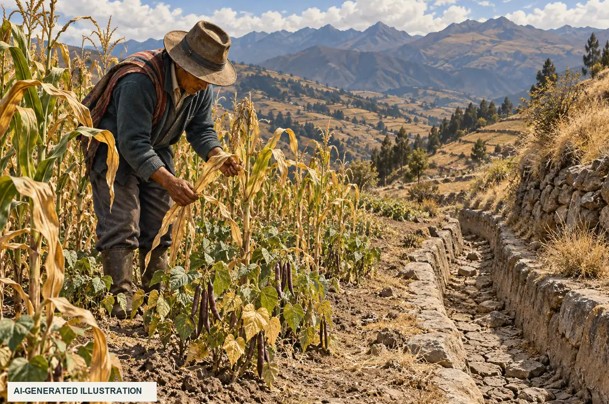
AI-generated editorial illustration of an anonymous Azuay farmer examining drought-stressed crops beside a dry irrigation channel. Not a portrait of a reported individual or a documented farm.
“Or whether they could operate safely afterward?”
Tom put down his phone.
“I was going to suggest putting wheels on them.”
“Of course you were.”
A farmer can’t postpone the growing season
The water shortage doesn’t end with tourism.
In nearby Guachapala, approximately 80 agricultural producers face water shortages threatening some 458 hectares of crops.
The affected agriculture includes tree tomatoes, ordinary tomatoes, corn, and beans. Livestock producers are also confronting reduced water availability.
Luis Torres, a resident interviewed by Ecuavisa, described how disappearing water sources were reducing agricultural production.
These are reported risks, not confirmation that all the threatened crops have been lost.
But farming operates on a schedule that cannot always be changed.
A tourist may postpone a boat excursion until the water returns.
A farmer cannot necessarily postpone the moment when corn needs water.
A tomato plant doesn’t understand that the government is working on an electricity plan.
Tom considered that.
“So the farmer needs rain, the boat operator needs the reservoir to fill, and the electricity company needs enough water to generate power.”
“Yes.”
“Everyone needs the same thing.”
“Not necessarily in the same place, at the same time, or for the same purpose.”
Tom sighed.
“You’re making this considerably more complicated than my original boat story.”
“Wait until you hear about Amaluza.”
“Is that another boat?”
“No, Tom. It’s another reservoir.”
The night Ecuador’s hydroelectric plants had to stop
While tourist boats sat stranded at Mazar, another water problem was developing farther along the Paute hydroelectric system.
The Amaluza reservoir, which supplies the Molino hydroelectric plant, was falling toward its minimum operating level.
On October 13, Molino’s nine turbines continued generating electricity even after the reservoir reached its minimum reference elevation of 1,975 meters above sea level.
The control room declared an emergency because of the operating conditions.
As the situation worsened, operators temporarily shut down Molino and Sopladora during the early hours of October 14.
Both plants remained offline for approximately five hours.
The shutdown allowed Amaluza to recover about 2.4 meters of water, reaching approximately 1,974.42 meters.
By around 10 a.m., both facilities were generating again.
But the recovery was short-lived. As generation resumed, the water level began falling again.
On October 16, Amaluza remained below its 1,975-meter reference level.
Tom stared at the figures.
“Let me see if I’ve got this straight.”
Elaine closed her book.
“They need water to make electricity.”
“Yes.”
“But to keep making electricity later, they sometimes have to stop making electricity now.”
“Exactly.”
“And when they start making electricity again, the water starts going down.”
“That’s what happens when the incoming water isn’t enough to replace what’s being used.”
Tom shook his head.
“I think I’ll go back to understanding the boat.”
The episode revealed a difficult choice for electricity operators.
Generating power helps meet today’s demand. Preserving water helps protect tomorrow’s supply.
Neither need disappears simply because the other becomes urgent.
The number everyone is watching
By 9 a.m. on October 16, the Mazar reservoir had fallen to 2,123.09 meters above sea level, according to figures reported by Expreso.
That was just 8.09 meters above the reported minimum safe operating elevation of 2,115 meters.
The reservoir had lost approximately 97 centimeters in 24 hours.
This doesn’t mean only eight meters of water remained. Nor does it establish how many days Ecuador has before another electricity interruption.
But it shows how quickly the operating margin was shrinking.
Mazar, Molino, and Sopladora form part of the Paute Integral hydroelectric complex. The facilities use water moving through the river system in sequence.
Together, they provide a substantial share of Ecuador’s electricity.
On October 16, the Paute basin’s reported inflow was approximately 38.5% below the historical October average cited by Expreso.
Recent rainfall had not reversed the broader shortage.
Tom read the latest figure aloud.
“Two thousand, one hundred and twenty-three point zero nine.”
Elaine waited.
“That’s Mazar.”
“I gathered that.”
“It’s just over eight meters above the minimum safe level.”
“And?”
Tom hesitated.
“I was hoping you’d be impressed that I knew the number.”
“I’m more interested in what it means for the people living there.”
That was becoming an uncomfortable habit of hers.
The electricity order that lasted only hours
Meanwhile, some of Ecuador’s industrial electricity customers were dealing with another kind of uncertainty.
On October 14, designated industrial customers received instructions requiring some of them to disconnect from the national electricity grid for seven consecutive days.
The government subsequently reversed the instruction, explaining that it had been issued incorrectly.
Shorter restrictions remained for certain industrial customers.
The correction mattered. But so did the confusion.
Imagine being responsible for a factory.
You receive notice that your electricity supply will be interrupted for a week.
You begin rearranging production, deliveries, employee schedules, and customer commitments.
Then the instructions change.
Even when a mistaken order is corrected, the planning problem doesn’t necessarily disappear.
Tom shook his head.
“Seven days without electricity. Then never mind.”
“For the affected industries,” Elaine reminded him.
“Right. Not everybody.”
“And the people running those businesses still have to make decisions.”
Tom looked toward the kitchen.
“At least Carlos can keep baking bread.”
“Perhaps. But what happens if one of his suppliers can’t operate?”
Tom considered the flour, refrigeration, transport, and other businesses involved in getting food to a neighborhood bakery.
“I suppose having electricity doesn’t guarantee that everyone you depend on has it.”
“Exactly.”
Carlos’s bakery was an illustration, not a report of an actual supply interruption.
But the business problem was real enough. A company can be affected by disruptions elsewhere in its supply chain, even when its own lights remain on.
A problem you can’t see from your apartment
Tom switched on the lamp beside Elaine’s chair.
It worked.
The refrigerator was running. Their internet connection was fine.
From inside their Cuenca apartment, Ecuador’s electricity system appeared to be doing its job.
“Maybe that’s why people think the problem is over,” he said.
“Because their lights are on?”
“Exactly.”
Elaine pointed toward his phone.
“And the boat?”
“Still on dry ground.”
“The farmers?”
“Still waiting for enough water.”
“And the hydroelectric operators?”
“Trying to decide how much electricity to make without running out of the water they need to make it.”
“And the businesses?”
“Trying to figure out what happens next.”
Tom sat down.
He had begun the conversation thinking he had found an amusing picture.
Now he was thinking about families whose incomes depended on conditions they couldn’t control.
There was an important distinction.
The falling reservoir directly affects boat tourism. The agricultural difficulties reflect wider water scarcity in the region. The operating problems at Amaluza involve another part of the hydroelectric system.
We cannot assume the power plants caused every water problem farmers face.
But the problems have something in common.
They all make tomorrow harder to plan.
Who pays while everyone waits?
Tom picked up his phone again.
The boat was still there.
“Suppose it rains next week,” he said.
“That would help.”
“And the reservoir starts filling.”
“That would help too.”
“And Molino and Sopladora don’t have to stop generating to save water.”
“That would certainly be welcome.”
“So eventually the boats can operate again.”
“Hopefully.”
“And the tourists come back.”
“Perhaps.”
Tom nodded.
Then he looked at Elaine.
“But who’s going to pay the bills while they’re waiting?”
For once, Elaine didn’t have an answer.
And somewhere beside the Mazar reservoir, a boat was waiting for water that had not yet returned.
The disappearing water at Mazar tells a larger story about what happens when the systems we depend on suddenly stop working. In our companion article at Next Cradle, we explore how people and communities adapt when the assumptions behind everyday life no longer hold true. [Read the Next Cradle companion article →]
What happens when the water disappears, the tourists stop coming, and an entire community must rethink its future? Explore the human side of Ecuador’s water crisis in our Instagram carousel. [View the Instagram carousel →]
Author’s note: Tom and Elaine are fictional characters used to explore real events. The reported effects on tourism, agriculture, reservoir levels, and electricity generation are based on published Ecuadorian news coverage. Any accompanying AI-generated images are editorial illustrations, not documentary photographs. The reservoir measurements are dated observations and may change.
Reporting sources: Ecuavisa, October 14 and 16, 2026, reporting on the Mazar and Amaluza reservoirs, temporary shutdowns at Molino and Sopladora, and the effects of water shortages on tourism and agriculture; Expreso, October 15 and 16, 2026, reporting on reservoir elevations, hydroelectric generation, and water inflows; Primicias, October 16, 2026, reporting on the resumption of Colombian electricity deliveries to Ecuador; and Metro Ecuador, October 17, 2026, reporting on the government’s completion of 54 preventive electricity maintenance operations across 15 provinces. Reservoir measurements reflect the reported dates and times and may subsequently change.