










Things that trip up expatriates in Cuenca
If you have lived in Cuenca for any length of time, you have almost certainly had at least one close encounter with its sidewalks, pavings, steps, or street furniture, and if you have not, you are either very new here or unusually nimble, and the odds on the second option shorten considerably with each passing month.
Charlie Larga has a folding metal walking stick that instantly collapses into four short sections. This handy weapon fits easily into carry-on luggage, and has accompanied him on enough overseas trips to justify its existence several times over.
 He also recently acquired a metal cane with a tripod base and a folding seat, for which he has fashioned a small cushion from foam and spandex, because if you are going to stand in a bank queue or wait for a parade to pass on Benigno Malo, you might as well do it with somewhere to sit down.
These are not affectations, but the conclusions a person reaches after a fractured wrist, a sprained ankle, and a growing awareness that Cuenca, in spite of having a certain degree of altitude, does not grant its residents the kind of immunity to gravity available to man on the Moon.
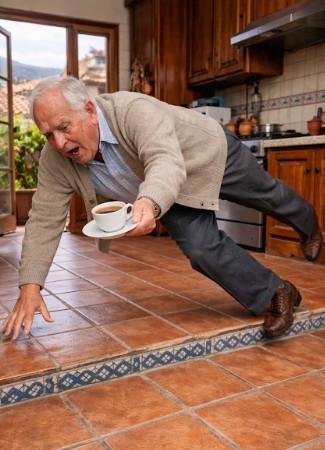
The wrist came first. A foot catching a step-up in the kitchen, misjudged by a matter of millimeters, introduced Charlie’s left hand to the floor with considerable force, resulting in a few metal nails, six weeks in plaster, and a permanent slight weakness that allows touch typing, but has never quite resolved itself enough for pushups, pullups, or military calisthenics.
The ankle problem came later, courtesy of a dog that decided to push its head through a gate and growl on a narrow downhill sidewalk causing Charlie to sidestep to avoid its gnashing teeth. The ensuing sprain healed, but the fear of falling did not. Neither incident required extraordinary carelessness on Charlie’s part, only the ordinary inattention that any resident can drift into after walking thousands of familiar streets.
The sidewalks here are a study in geological variety. Some sections have been recently replaced with concrete and are smooth, level, and reassuring. Others appear to have been installed during the first Inca administration and left largely undisturbed since, with drains and driveways interrupting the walking surface at irregular intervals.
The metalled road edges near the gutter are frequently uneven, making the act of stepping off a curb risky when wearing bifocals, and cobbled streets that are scenic and atmospheric in dry weather become something closer to a skating rink when wet. Cuenca is a city where the sunshine frequently arrives in liquid form with only a quick thunderclap as an advance warning.
A blogger whose work Charlie follows has observed that fractured ankles on exiting from taxis are a recurring fate among expatriate acquaintances, and this will surprise few long-term residents.
The step up from the back seat of a small Kia taxi into a puddle in an uneven gutter with the body already in a twisting motion, is precisely the kind of transition that catches people off balance, and the correction is simple enough: pause, locate your footing, and treat the exit as a separate event from the journey. Expatriates arriving from countries where pavements are maintained to a more forgiving standard often take longer than expected to build this habit, and the cost of not building it is disproportionate if it is followed by a month hopping around on crutches.
Building codes in Cuenca appear to have been drafted by people with excellent balance and no interest in sharing it. Staircases in older buildings frequently have a handrail on one side only, which works well enough until people are coming up on one side and you are descending on the other side and you need something to hang onto.
Outdoor steps in public spaces like markets sometimes have no handrails at all, and the steps that do exist are often chipped, cracked, or worn in ways that suggest decades of use without maintenance. The city is also poorly configured for wheelchair users, given its steep slopes and precipitous curbs and crossings, though this is a structural problem so native to the city that it should be mentioned in all the guide books.
Charlie once spotted online a useful-looking battery powered device that appeared to combine the attributes of a wheelchair, shopping cart, and a Segway, but immediately realized that it would be completely impractical, and probably suicidal, for use anywhere in Cuenca, though perhaps useful enough if you lived in a Florida retirement community with flat ground and kerb cuts.
What, then, is the practical response? The tripod cane with its folding seat has already proven its worth in bank queues, which in Cuenca can be tiresome affairs requiring stamina as much as patience, and it would serve equally well at the roadside during a feria or a weekend parade.
A personal shopping cart of the kind that older residents have used for decades as a matter of practicality, when hauling potatoes, plantains, or bottles of rum can double as a useful balancing aid on longer outings without announcing itself as a medical device. The folding walking stick, for those who travel, takes up almost no space and adds a meaningful third point of contact on any surface that gives you reason to doubt the other two.
None of this is about frailty or defeat. It is about the statistics of falls, which are straightforward enough: they happen quickly, they heal slowly, and the second one tends to frighten you more than the first. Many expatriates arrive in Cuenca at an age where the possibility of future falls and prevention thereof should be taken seriously.
Cuenca rewards pedestrians who ambulate around the city very carefully. The same city that trips you on a cracked tile in the rain will offer you, two minutes later, a colonial facade turning gold at sunset, but the views are invariably better if you are vertical than if you are horizontal.