

















Time and tide
Airports are temples of precision, or at least they present themselves as such, which is why it remains faintly astonishing to discover how much confusion can bloom inside a building devoted entirely to measuring minutes, assigning gates, and launching humans across continents with algorithmic confidence.
A few months ago, arriving absurdly early for a flight to Quito at Cuenca airport, I encountered a polite American woman seated with the composed patience of someone who believed she had mastered the day, only to learn that the day, like an uncooperative mule, had already wandered off without her.
Her husband, it transpired, had booked a ticket for seven in the morning. She, with equal sincerity, believed the flight departed at seven in the evening. Whether this misunderstanding arose from optimism, marital diplomacy, or that distinctly modern faith that “the phone will sort it out,” I cannot say, although the glowing rectangle almost certainly played a supporting role.
 There followed the gentle drama of verification, reinterpretation, and recalculation, during which I performed the modest civic duty of translating between English, Spanish, and the universal dialect of dawning alarm. Eventually, a new ticket was secured at the airport travel agency, and equilibrium was restored, provided, as we all fervently hoped, that the revised booking involved not merely the correct hour but also the correct date.
This episode was not unusual. It was merely modern.
There was a time when domestic accuracy, that elusive alignment between mechanical truth and human expectation, resided not in satellites or servers but in the tall, dignified presence of the longcase clock, later romanticised as the grandfather clock, whose extended pendulum traced a generous arc often measuring eight to twelve inches from side to side and whose stately beat, typically one oscillation per second, established a rhythm so dependable that entire households organised their lives around it.
These were not appliances but obligations, housed in wooden cases that demanded dusting, polishing, and a certain respectful acknowledgement of their authority, while the mechanisms themselves, intricate assemblies of wheels, pivots, escapements, and weights, were frequently serviced in situ by visiting clock technicians who arrived with tools, loupe, and the specialised oils without which precision quietly decayed into friction.
Early clock oil was no trivial matter. Before the age of synthetics, horologists relied on carefully refined animal and vegetable oils, including porpoise oil, neatsfoot oil, and later highly purified mineral oils, selected not for abundance but for stability, viscosity, and resistance to gumming.
The wrong oil, too thick, too volatile, or prone to oxidation, could transform a delicate pivot into a brake, increasing wear, degrading timekeeping, and inviting the slow mechanical misery of creeping inaccuracy. Proper lubrication reduced friction, limited metal fatigue, and preserved amplitude, ensuring that the pendulum’s swing, that patient negotiation with gravity, remained consistent rather than languid.
The longcase clock itself embodied a small ecosystem of related industries.
Clock mechanisms, for efficiency and consistency, were commonly mass produced in metalworking workshops where brass plates were cut, wheels machined, and pinions formed with disciplined regularity, while the wooden cases were often crafted locally by cabinet-makers who adapted style to regional taste, architectural fashion, and available timber. A third trade flourished around dial production, yielding faces of engraved brass or painted metal, executed with varying degrees of artistry ranging from charming crudity to exquisite finesse.
Even the economics of winding entered the hierarchy: the cheaper thirty hour clocks required daily attention, whereas the more expensive eight day clocks demanded only weekly winding by turning a crank that lifted the descending weights which powered the movement, and some clocks carried additional weights dedicated to the chiming mechanism, allowing the hours to announce themselves without a visual scan of the dial.
Clocks used to be objects one wound, adjusted, listened to, and occasionally distrusted. Now time arrives invisibly from satellites, networks, and systems such as GPS, GLONASS, and Galileo so abstract that questioning them feels like arguing with astronomy. The phone declares the hour with serene authority, and we comply, rarely asking how the number materialised or whether it agrees with the oven, the wristwatch, the car dashboard, and the ageing wall clock that has been running five minutes fast since the Clinton administration.
Into this technological confidence creeps an older ambiguity: the coexistence of twelve hour and twenty four hour worlds. Airline tickets, hospital charts, military schedules, and European timetables speak fluently in twenty four hour notation, while much of daily life, especially in the Anglo American sphere, continues its comfortable attachment to A.M. and P.M., those modest suffixes that once prevented catastrophe but now occasionally generate it. “07:00” is perfectly clear until it meets a brain expecting “7,” at which point morning and evening become rival claimants to the same numeral, each entirely plausible and only one correct.
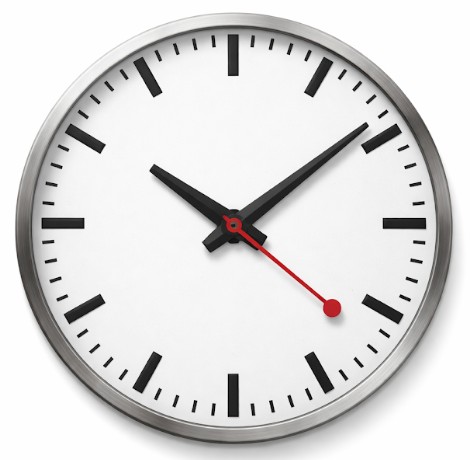
Analog clocks, meanwhile, remain stubbornly diplomatic. Their hands sweep through twelve hours with elegant indifference to digital reform, offering angles instead of declarations and positions instead of statements, which is why a dial with Roman numerals, Arabic numerals, minimalist markers, or no numerals at all can still convey the essential truth that matters in ordinary life: the hand is pointing somewhere between “late” and “I should already be moving.”
Roman numerals, those aristocrats of the dial, lend ceremony and balance, Arabic numerals bring clarity with a hint of the kitchen wall, and marker dials, like my beloved Pragotron, project institutional composure, suggesting that time is not a story but a system, not a narrative but a measurement.
Yet none of these designs, however elegant or efficient, can fully protect us from the most durable human habit of all, which is assumption. We assume the phone is correct, we assume the ticket is understood, we assume morning and evening are self-evident, and then, from time to time, reality clears its throat at Gate 3.
The woman made her connection in Quito, the husband one hopes survived the debriefing, the satellites continued their indifferent orbit broadcasting seconds with flawless detachment, and Cuenca’s airport resumed its choreography of departures, arrivals, and passengers confidently misreading something.
Time, and tide, we are often reminded, wait for no man.



Hogar Esperanza News

The Cuenca Dispatch

Week of September 20
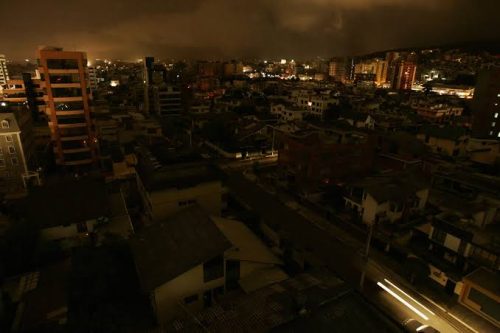
Ecuador turns to industrial power cuts to protect Mazar and keep homes from going dark.

Ecuador raises its 2026 growth forecast, but El Niño could spoil the outlook next year.

Cuenca retirees challenge medical and therapy changes at IESS senior center.
Fabianos Pizzeria News

Fund Grace News