













Traffic noise in the Galapagos Islands makes songbirds more aggressive, study shows
By Shreya Dasgupta
Traffic noise isn’t just unpleasant; in the Galápagos Islands, it can also make songbirds aggressive, a recent study has found.
Once famed for their undisturbed natural ecosystems, the Galápagos Islands have seen a rise in road infrastructure and traffic in recent decades. Researchers wanted to understand how birds react to the increased noise. So they picked the Galápagos yellow warbler (Setophaga petechia aureola), a territorial bird that uses loud songs, and sometimes physical fights, to ward off intruding individuals.
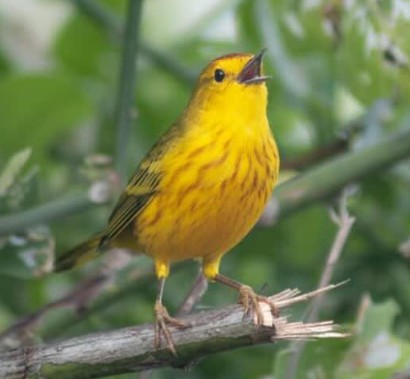
Galapagos yellow warbler
The warbler is also a common songbird in the archipelago that can be found anywhere from pristine forests to urban settlements, said Çağlar Akçay, study co-author and a behavioral ecologist at Anglia Ruskin University, U.K.
For the study, the researchers focused on 38 male Galápagos yellow warblers on two islands: Santa Cruz, home to more than 15,000 people and 1,000 vehicles, and Floreana, with about 100 people and 10 vehicles. Twenty of the birds lived near roads, and the rest lived farther away.
For every warbler, the authors used a speaker to play two different kinds of audio recordings: one with the song of a male Galápagos yellow warbler along with traffic noises, and a second one with only a male warbler’s song call, but no traffic noise. They then observed how the birds responded.
“We measured aggressive behaviour as various physical approach measures to the speaker that played the warbler songs, such as flights around the speaker, crosses over the speaker, and closest approach to the speaker. These approach measures are good predictors of attacking in songbirds,” Akçay told Mongabay by email.
On both islands, male warblers with territories near roads displayed more physical aggression when the speaker played another warbler’s song and traffic noise compared to when it only played the song. “It shows us that when noise prevents efficient communication, experienced birds may engage in physical aggression to resolve conflict,” Akçay said.
However, warblers with territories far from roads on both islands were less aggressive when the speaker played traffic noises alongside another male’s calls. Akçay attributed this to the birds’ relative lack of experience with traffic sounds, which might make them hesitant to approach the vicinity of the noise.
These findings suggest that “prior experience with noise by living near the road affects how birds respond to noise,” Akçay said. “Even little but chronic experience, e.g. roadside territories on Floreana island, which has much less traffic than Santa Cruz, seems to be enough for this experience to matter.”
The study also found that birds on Santa Cruz Island, but not Floreana, sang for longer durations when the speaker played traffic noise. This suggests the bird may be increasing its chances of being heard over pulses of high traffic noise, Akçay said. “The study shows that how wildlife responds to noise is not necessarily simple and previous experience of the individuals also matters.”
________________
Credit: Mongabay



Hogar Esperanza News

Fabianos Pizzeria News

The Cuenca Dispatch

Week of September 20

Ecuador turns to industrial power cuts to protect Mazar and keep homes from going dark.

Ecuador raises its 2026 growth forecast, but El Niño could spoil the outlook next year.

Cuenca retirees challenge medical and therapy changes at IESS senior center.
Fund Grace News
