













Trusting doctors in Ecuador: The question that changed the conversation
Trusting doctors in Ecuador can feel difficult when the healthcare system is unfamiliar, even when our doubts rest more on fear than evidence.
The restaurants along Remigio Crespo were filling with people grabbing a quick lunch before returning to work.
Margaret and her friend had found a small table near the window. At another table, three recently arrived expats were finishing their meals.
Across the room, Dr. Alejandro Álvarez was eating a hurried lunch between appointments at a nearby medical office complex. His white medical coat remained draped over the back of his chair.
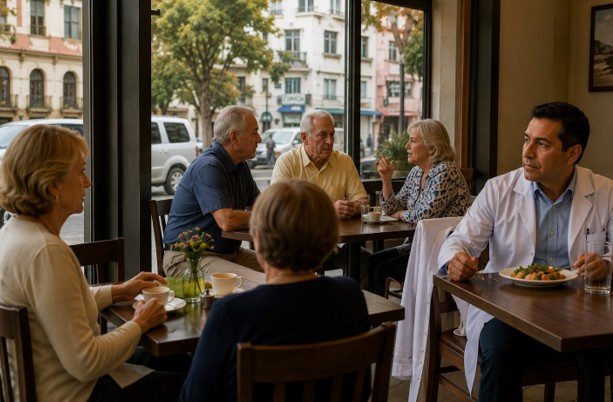
One sentence made the doctor put down his fork.
He was not paying attention to the nearby conversation.
Then one sentence made him stop.
“I don’t trust doctors here.”
Another man nodded.
“If anything serious happens, I’m flying home.”
A woman leaned forward.
“The hospitals just aren’t as good.”
Margaret quietly stirred her coffee. She had heard similar conversations before.
Dr. Álvarez continued eating.
Then another comment drifted across the room.
“They probably mean well, but they just don’t have the same training.”
He slowly placed his fork on the plate.
Not because he was offended.
Because he realized they were talking about people like him.
Why Does Familiar Healthcare Feel Safer?
Familiar healthcare often feels safer because we understand its routines, language, and expectations.
That comfort does not necessarily tell us which system provides better care. It tells us which one we already know.
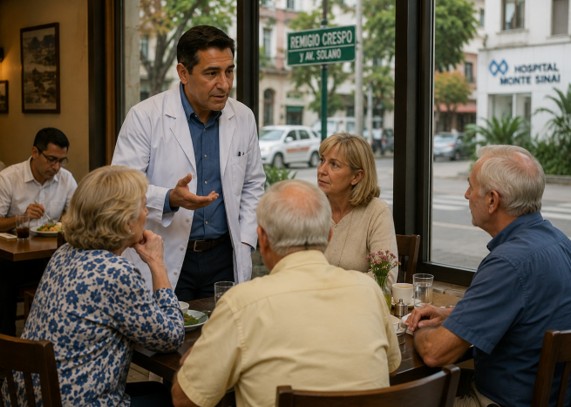
He did not defend the system. He asked them to examine the assumption.
Most of us spent decades learning how healthcare worked in the country we left. We knew how to choose a doctor, schedule an appointment, describe symptoms, fill prescriptions, and question a diagnosis.
Moving to Ecuador removed much of that familiarity.
Different procedures can look less professional when they are simply less recognizable. Language barriers may feel like evidence of limited expertise. A smaller hospital can appear less capable because it does not resemble the medical centers we remember.
Fear often fills the space where understanding is missing.
What Made the Doctor Join the Conversation?
Dr. Álvarez spoke because one assumption had turned an unfamiliar system into a judgment about the people working inside it.
He stood, picked up his coffee, and headed toward the door.
As he passed the expats’ table, he stopped.
“I hope you don’t mind,” he said with a warm smile. “I couldn’t help overhearing your conversation.”
The table became quiet.
“I would like to ask one question, if I may.”
Everyone nodded.
“Before moving to Ecuador, did any of you ever ask where your family doctor went to medical school?”
Nobody answered.
Dr. Álvarez smiled.
“I didn’t either.”
He paused before continuing.
“I trusted my doctor because of the care I received, not because I knew where they trained.”
Then he glanced around the table.
“I hope one day you will feel the same about us.”
He wished them a pleasant afternoon and walked back toward the hospital.
No lecture.
No argument.
No attempt to prove that every Ecuadorian doctor or hospital was excellent.
Just one question that changed the direction of the conversation.
Recognition Break
This short visual story explores the assumption Dr. Álvarez quietly challenged.
Does Trusting Doctors in Ecuador Require Blind Faith?
Trusting doctors in Ecuador does not mean ignoring questions, accepting poor care, or abandoning good judgment.
Patients should still research physicians, ask about qualifications, seek second opinions, and understand their treatment options.
Some doctors are better than others in every country. Hospitals vary in resources, specialties, communication, and quality. Serious medical decisions deserve careful consideration wherever they occur.
The problem begins when caution turns into a conclusion before we have gathered any evidence.
A foreign accent does not reveal medical competence.
An unfamiliar process does not automatically signal poor standards.
Likewise, a modern building, familiar language, or prestigious address does not guarantee excellent care.
Trust should be earned through communication, competence, follow-up, and the quality of treatment received.
What Are We Really Comparing?
Expats sometimes compare Ecuador’s healthcare system with an idealized memory rather than the system they actually left.

The conversation ended, but the question continued working.
Back home, appointments were not always immediate.
Doctors sometimes rushed.
Insurance rules limited choices.
Emergency rooms involved long waits.
Medical bills could create another crisis after the original one had ended.
None of this proves that Ecuador offers better care in every situation. It simply reminds us that familiarity can soften our memory of past frustrations.
The system we know often receives the benefit of the doubt.
The unfamiliar system must prove itself before the first appointment begins.
That is not entirely unreasonable. Health concerns create real vulnerability.
Still, fear deserves examination before it becomes certainty.
How Does Curiosity Change Medical Decisions?
Curiosity helps us replace broad assumptions with useful questions.
Instead of asking whether Ecuadorian doctors are as good as doctors back home, we can ask:
What experience does this physician have with my condition?
Where did the doctor train?
Which hospital handles this procedure most often?
Can I speak with another patient?
Would a second opinion help?
What would make me comfortable proceeding here?
These questions do not dismiss concern. They give concern somewhere productive to go.
Comparison says, “This is not what I know.”
Curiosity asks, “What do I need to understand?”
That small shift can lead to better decisions.
What Did Margaret Recognize?
Margaret recognized that the doctor had not defended Ecuadorian healthcare. He had challenged the assumption behind the conversation.
The expats did not continue complaining after he left.
Nobody had been embarrassed.
They were thinking.
Margaret watched through the restaurant window as Dr. Álvarez crossed the street toward the hospital.
Then she smiled.
She had not watched someone win an argument.
She had watched familiarity lose some of its authority.
That was different.
Trusting Doctors in Ecuador Begins with Better Questions
Trusting doctors in Ecuador begins neither with blind confidence nor automatic suspicion, but with the willingness to replace assumptions with evidence.
Experience tells us what felt safe before.
Fear warns us when something seems unfamiliar.
Curiosity helps us determine whether the danger is real.
Sometimes the most useful question is not whether healthcare here resembles what we left behind.
It is whether we have taken enough time to understand the care available where we now live.
The question of trust reaches beyond healthcare. Moving abroad also changes how we judge banks, lawyers, contractors, government offices, and other unfamiliar services. I explore that broader challenge in “Adjusting to Life Abroad: How to Trust Unfamiliar Systems”.
What assumption about healthcare in Ecuador changed after your own experience with a local doctor or hospital?
________________
Author’s note: The restaurant encounter and its characters are fictionalized to illustrate a common conversation among expatriates. Any resemblance to actual individuals is coincidental.