












U.S. Congressmen demand that Trump end military alliance with Noboa over human rights abuses
By Carolina Mella
Thirteen Democratic congressmen in the United States have demanded in a letter addressed to Secretary of State Marco Rubio that he immediately suspend all security assistance and cooperation with Ecuador. The petition includes military operations in the country, until democracy and the rule of law are restored, according to the document. The letter sent to the head of U.S. diplomacy also contains a warning: if Donald Trump’s administration does not change its policy toward Daniel Noboa’s government, Congress will use its powers to force a break in military cooperation.
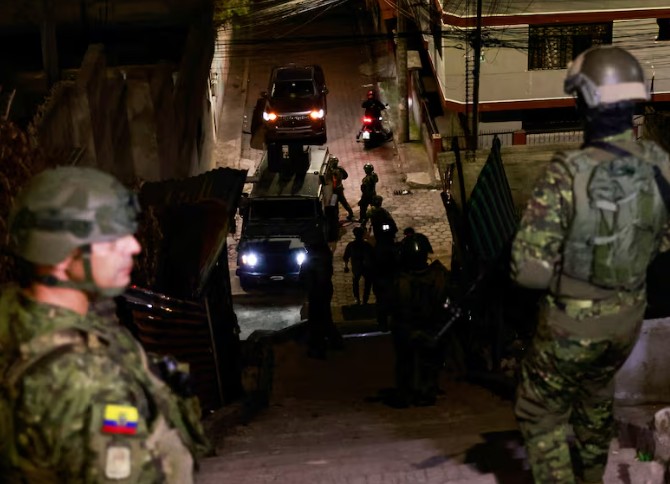
Ecuadorian armed forces in an operation against drug trafficking, in the La Lucha de los Pobres neighborhood, Quito, on October 14. (Karen Toro, Reuters)
The lawmakers are proposing to block arms sales to Ecuador, suspend any U.S. security assistance, prohibit the use of funds approved by Congress for military operations and investigate U.S. involvement in abuses against civilians in operations at a farm on Ecuador’s northern border and bombings of fishing boats. “If your Administration does not end its complicity in the authoritarian actions of the Noboa government, Congress will use the tools at its disposal to force a change in policy,” the congressmen write.
The letter is signed by Jesús Chuy García, Jonathan Jackson and Greg Casar along with Jasmine Crockett, Delia Ramirez, Jan Schakowsky, Rashida Tlaib, Adelita Grijalva, Nydia Velázquez, Summer Lee, Hank Johnson, Eleanor Holmes Norton and Ro Khanna. The congressmen denounce a democratic deterioration in Ecuador and question Washington’s deepening of its military alliance with a government they accuse of persecuting political adversaries, weakening judicial independence and restricting civil liberties.
The congressmen point to the arrest and imprisonment of Luisa González, former presidential candidate and leader of the opposition party Revolución Ciudadana, as a first point. This is one of the most recent episodes of what they describe as “an offensive against the opposition” in Ecuador. Gonzalez was arrested on Oct. 22 for a tax investigation into alleged financial irregularities during her 2023 presidential campaign. There is also an arrest warrant for his running mate, Andrés Arauz.
The accusations against González were publicly exposed by the Secretary of the Administration of the Presidency, José Julio Neira, in a video broadcast on social networks, while the former candidate and her defense were at the arraignment hearing, knowing the elements of the accusation. For U.S. lawmakers, that element raises serious concerns about the separation of powers and judicial independence. The congressmen also question the role of the attorney general in charge, Carlos Alarcón, whom they consider an “ally of Noboa.” They maintain that he has acted to protect the president and his allies while pushing for prosecutions against opposition figures.
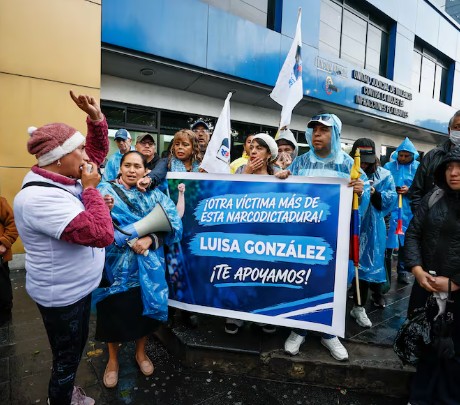
Supporters of Luisa González protest in front of the Flagrancy Unit in Quito, on October 22. (EFE)
The letter also includes the raids on the offices of the mayor of Quito, Pabel Muñoz, and the situation of the mayor of Guayaquil, Aquiles Álvarez, imprisoned in a maximum security prison inspired by Nayib Bukele’s CECOT since February 2026, without a final sentence. The lawmakers consider that these cases show a “broader offensive against Noboa’s opposition, both from the left and the right, on the eve of the November elections.”
“We have many other concerns regarding the Noboa government’s open attacks on democracy, human rights and the rule of law in Ecuador,” the congressmen warn. Another of the central arguments of these legislators to demand the suspension of U.S. assistance is joint military operations and air strikes against ships in the Pacific.
The letter notes that the United States has provided the South American country with tens of millions of dollars in equipment and military training, in addition to participating in joint operations, without that being reflected in the results. “There is no evidence that Noboa’s presidency or his operations with the U.S. government have significantly reduced drug trafficking,” the letter explains. “Homicide rates have continued to rise and Ecuador continues to be one of the most violent countries in the world,” it adds.
The demand comes when Ecuador has been under a state of emergency for a thousand days since the beginning of the Noboa government. During 2026, the Executive has decreed four curfews to facilitate joint operations with the United States in Ecuadorian territory. However, the military escalation has not managed to reverse the violence: 23 people are murdered every day in the country and projections suggest that the year could close with about 50 homicides per 100,000 inhabitants.
The lawmakers also question air strikes on fishing vessels carried out in cooperation with Ecuadorian authorities, which constitute “unlawful and extrajudicial executions,” the letter condemns. In Ecuador, operations against fishing vessels have affected more than a hundred fishermen. The crew members have been arrested and accused of alleged links to illicit activities, although the Ecuadorian justice system has declared all the fishermen innocent for lack of evidence to prove their participation in crimes.
The letter does not limit itself to questioning the legality of the operations. The congressmen argue that the Trump Administration has strengthened its security ties with Noboa without demanding accountability for human rights violations attributed to Ecuadorian security forces, which “include torture, extrajudicial executions, forced disappearances, arbitrary detentions and sexual abuse in women’s prisons.” It also points to government pressure on the courts, systematic attacks on press freedom and the prolongation of the state of emergency.
The United States and Ecuador have signed 123 agreements between 2018 and 2026, as documented by the Ecuadorian Observatory of Conflicts of the Central University of Quito. 55% of these commitments were signed during the government of Daniel Noboa. Most are related to security policy, which after the declaration of an internal armed conflict in January 2024, served as a catalyst to consolidate the relationship with Washington.
The letter recalls Rubio’s statements in Ecuador when he described the Ecuadorian president as someone who was “doing an incredible job.” For the congressmen, this closeness commits the United States to the actions of the Noboa government, which “is rapidly consolidating its authoritarian grip on power.”
_______________
Credit: El Pais