













U.S. military attacks on suspected drug boats are having no effect on the cocaine market
By Sam Sifton
The videos are eerily similar. There’s a small go-fast boat on a sun-dappled sea. Then there’s a soundless explosion of light. When it fades: The boat’s in splinters, burning, about to sink, gone.
American forces have been attacking small boats in the Caribbean Sea and eastern Pacific Ocean for nearly nine months in black-ops missions that surface on social media when they’re done. Secret attack planes and armed MQ-9 Reaper drones have hit more than 60 boats. They’ve killed at least 200 people. The Trump administration says, without providing evidence, that the boats were smuggling drugs.
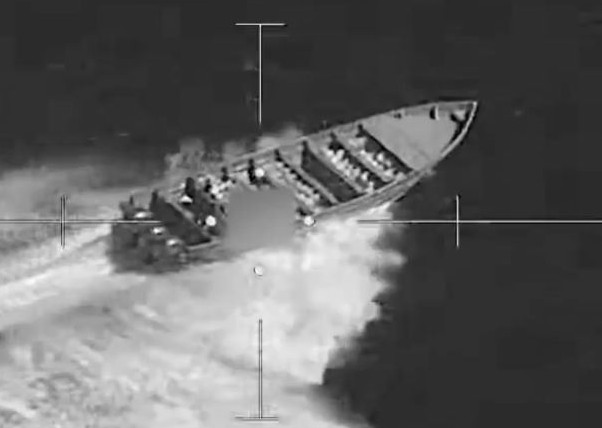
A suspected drug boat off the coast of Colombia seconds before it was destroyed by a U.S. military drone.
Specialists in the laws of conflict have called the strikes illegal extrajudicial killings — Gustavo Petro, Colombia’s president, called them “murder” — because the military is not allowed to target civilians, even criminals, if they don’t pose an imminent threat of violence.
The White House says the killings are lawful. It says that the United States is in a legally recognized armed conflict with drug cartels — and that the crews of the boats are “combatants” in that conflict.
Increasing pressure
The boat strikes are just part of an expanded military campaign that the administration is pursuing in the region, backed by the largest U.S. military deployment in Latin America in decades. The White House has designated more than a dozen Latin American and Caribbean groups as terrorist organizations and has enlisted Guatemala and Ecuador to assist the United States in striking them.
Eric Schmitt, who covers national security, said Honduras may be next. He and Maria Abi-Habib reported that the moves were part of a broader strategy: “to normalize an American military presence across Latin America.” Trump also wants boots on the ground in Mexico, which has refused to cooperate.
The whole campaign comes in part from Stephen Miller, Trump’s homeland security adviser, Eric said. Miller has a bimonthly meeting, called a “wins” meeting, where government agencies report on recent successes. The Pentagon’s death toll from boat strikes is a regular “win.”
The White House, for its part, denied the characterization of the meeting and released a statement to The Times: “The administration continues to work to carry out the president’s agenda.”
Supply and demand
Is the idea that blowing up boats thousands of miles away from the United States will keep the drugs they’re purportedly carrying out of this country? If so, it’s not working. Cocaine is just as easy to get in the U.S. as it was before the strikes began, reports my colleague Simon Romero.
“Cocaine remains highly available, highly prevalent and relatively inexpensive,” one professor of public health told him.
Epidemiologists and public-health researchers said that if the boat strikes were actually slowing the flow of cocaine into the United States, street prices for the drug would have gone up. That hasn’t happened. They also said there’d be a decline in the drug’s purity, as dealers added fillers to stretch their supply. That hasn’t happened either.
“Boat strikes aren’t the answer,” the head of the military’s Southern Command told the Senate Armed Services Committee in March.
Cartels are also finding new ways to smuggle drugs. Evidence of that lies in large cocaine shipments recently uncovered by U.S. Customs and Border Protection.
According to Simon: “While large seizures might initially look like a sign that law enforcement is successfully stopping the flow, researchers view seizures as a proxy for tracking the total volume of trafficking. If border agents were to find significantly less cocaine, that could imply less cocaine flowing to the United States.”
But that isn’t happening. Instead, C.B.P. seized 47,808 pounds of cocaine in the eight months since the strikes began, more than the 43,227 pounds the agency seized in the eight-month period before the campaign, according to official data.
“They’re not moving the needle at all,” one researcher said. “Is that worth killing all these people?”
__________________
Credit: New York Times Morning Letter