













Voters head to the polls to elect a president and Assembly; What are the campaign’s biggest surprises?
Ecuador voters go the polls Sunday to elect a president and new National Assembly. The election comes only 17 months after the cross death election ordered by former president Guillermo Lasso.
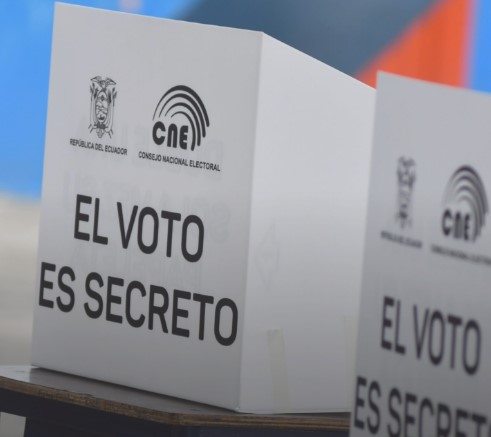 Voters will choose from a record 16 presidential candidates, including incumbent President Daniel Noboa. They will also vote for members of the new National Assembly, which increases in size from 137 seats to 151, and for five members of the Andean Parliament.
Unless a presidential candidate wins a majority or receives 40% of the vote with a 10% advantage over the second-place candidate, there will be runoff on April 13. All Assembly seats will be determined Sunday, with no runoff.
Both the newly elected president and the Assembly assume their duties in May.
According to all presidential polls, Noboa and Citizens Revolution’s Luisa González lead other candidates by a wide margin. A composite of six polls compiled by the University of San Franciso-Quito, gives Noboa a 44% to 38.5% lead over Gonzalez although other polls show Noboa winning in the first round while two put González in the lead.
Most analysts expect Noboa and González to meet in the April runoff, according to a survey taken Friday by the Ecuavisa news service.
In races for the National Assembly, a composite of polls shows a tight race between Citizens’ Revolution candidates and those from Noboa’s National Democratic Action party.
When asked about the “biggest surprise” in the presidential race, the survey consensus was how the end of electric blackouts benefited Noboa, putting him in the lead when it appeared he was headed for defeat. The meteoric rise of Andrea González (Patriotic Society) after the presidential debate was another big surprise, the experts said. Polling less than 1% before the debate, she currently stands at more than 6%. Another surprise, according to the Ecuavisa survey, is the poor showing of Pachakutic’s Leonidas Iza, currently polling just over 1%.
Asked by Ecuavisa for an “overall appraisal” of the election, several analysts said the lack of interest stands out. “The level of voter apathy is unprecedented in recent elections,” Ecuavisa said following its survey. “Despite the crises of organized crime, power generation and lack of employment, most Ecuadorians have indicated they would not even go to the polls if it was not mandated by law.”
First election results
The National Electoral Council announced Friday that the first official results will be announced at 6 p.m. Sunday, an hour after polls close. The CNE had originally said first results would not be released until 8:30 but said confidence in the vote reporting system allowed earlier release of totals.
Several organizations will provide exit poll projections, but CNE cautions that these are often unreliable.
The CNE expects more than 13.5 million Ecuadorians to show up at the polls Sunday, including more than 400,000 voting overseas.
The presidential and vice-presidential tickets
Popular Unity (UP) with Jorge Escala and Pacha Terán
Patriotic Society Party (PSP) with Andrea González and Galo Moncayo
Citizen Revolution Alliance (RC)-Challenge with Luisa González-Diego Borja.
National Democratic Action (ADN) with Daniel Noboa and María José Pinto
Ecuadorian Socialist Party (PSE) with Pedro Granja-Verónica Silva
CREO Movement with Francesco Tabacchi-Blanca Sacancela
Movimiento Construye with Henry Cucalón-Carla Larrea
People, Equality, Democracy Movement (PID) with Víctor Araus-Cristina Carrera
Independent Mobilizing Action Movement Generating Opportunities (Amigo) with Juan Cueva-Cristina Reyes
Democracy Yes Movement with Iván Saquicela-Luisa Coello
Social Christian Party (PSC) with Henry Kronfle-Dallyana Passailaigue
Partido Avanza with Luis Felipe Tillería-Karla Rosero
Pachakutik Movement with Leonidas Iza-Katiuska Molina
Democratic Center Movement with Jimmy Jairala-Lucía Vallecilla
Democratic Left (ID) with Carlos Rabascall and María Alejandra Rivas
Sociedad Unida Más Acción (SUMA) with Enrique Gómez and Inés Díaz