













‘We don’t need a backup plan.’ Then Elaine opened the refrigerator
Tom was drinking his morning coffee when Elaine opened the refrigerator.
“Tom, how long will the food last if the power goes out?”
“Depends.”
“On what?”
“How often you open the refrigerator.”
He was rather pleased with that answer. It was concise, technically plausible, and required him to do nothing.

A refrigerator question gives Tom and Elaine a new way to look at an ordinary day.
Elaine left the door open long enough to suggest that the conversation was not finished.
“We don’t need a backup plan,” he said.
Tom had survived Vancouver winters. He had scraped ice off windshields before sunrise and waited for buses in weather that made him reconsider the benefits of employment. Surely he could manage a little power interruption in Cuenca.
Besides, he had a sweater.
“What about your Internet?” Elaine asked.
Tom looked at his laptop.
That was different.
He had been thinking about electricity as something that illuminated rooms. Elaine had introduced the possibility that it also delivered his newspaper, connected him to family, and allowed him to look up things he already suspected were true.
“The laptop has a battery,” he said.
“And the router?”
Tom glanced toward the small box beside the window. Until that moment, he had regarded it as part of the furniture.
Elaine continued.
“And the coffee grinder?”
Tom went quiet.
She waited.
“Now you’re just trying to frighten me.”
A small problem with the filing system
They might have left the discussion there if Tom had not decided to contribute a practical question of his own.
“Where are our insurance documents?”
“On my computer.”
“And the password?”
“On your computer.”
They looked at each other.
Their household had developed a sophisticated system in which each person held something the other needed to reach something neither could immediately find.
It had evolved naturally. Elaine handled certain documents because she was better at keeping them organized. Tom handled certain passwords because he had once announced that he had a system.
The system depended heavily on Tom being available to explain it.
Elaine’s filing arrangement, meanwhile, included a folder called “Important,” another called “Important New,” and a third whose importance neither wished to challenge.
“So,” Tom said, “we both have a system.”
“Yes,” Elaine said. “Together, we may have almost one.”
For the first time that morning, they were laughing at the same problem.
Robert had already bought the solution
Tom mentioned the conversation to Robert.
Robert had bought a backup battery.
And another battery.
He also had enough cables to launch a satellite, although he could not immediately identify which one charged his phone.
“This gives me options,” Robert explained.
Tom surveyed the equipment.
It certainly did. There were options for connecting things, options for carrying things, and several options for tripping over things.
Robert began explaining capacity. Tom nodded in the attentive manner of a man hoping the explanation would eventually include coffee.
It did not.
He went home with three possible purchases in mind and no clearer idea of what he needed them to do.
Elaine asked whether he had learned anything.
“Robert is prepared.”
“For what?”
Tom considered this.
“A fairly demanding afternoon.”
Carlos asked a cheaper question
At the bakery, Tom explained the situation to Carlos.

Carlos offers a starting point: understand the need before buying the solution.
The refrigerator. The Internet. The documents. Robert’s equipment. The coffee grinder, which Tom felt deserved particular attention.
“What should we buy?”
Carlos thought for a moment.
“Maybe first find out what you need.”
Carlos’s question reaches beyond backup batteries. Before choosing where to retire, it helps to ask how everyday life would work when a few familiar arrangements fall through. I explore that question in Next Cradle’s Before You Retire Somewhere, Ask What an Ordinary Bad Week Looks Like.
Tom had expected a recommendation. A brand, perhaps. Something with a handle.
Instead, Carlos had given him homework.
That afternoon, Tom and Elaine sat at the kitchen table with a notebook.
They began by walking through an ordinary day, from morning coffee to bedtime.
Who needed to be called? Where were the numbers? What information lived only on a computer? What could they manage without electricity, and what had they simply never tried?
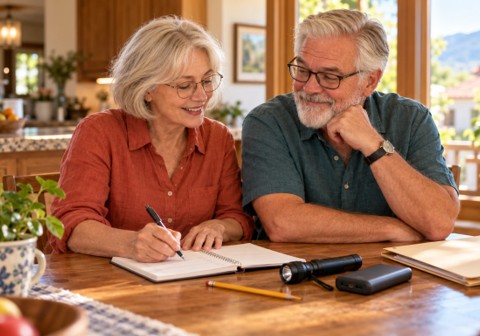
Tom and Elaine compare routines, documents, and the people they might call.
The list grew.
They did not need to prepare for the end of civilization. They needed to understand how breakfast, medication, messages, documents, and the rest of their day actually worked.
Apparently, an ordinary day had quite a few moving parts.
Names in a phone are a beginning
The notebook also raised a question about people.
Tom knew plenty of people in Cuenca. There were names in his phone, familiar faces at cafés, and friends with whom he could discuss almost anything over lunch.
But “Who do we know?” turned out to be easier to answer than “Who would we call?”
Who lived nearby? Who might need a hand? Who knew how something worked? And had they ever talked about any of this, or were they assuming friendship came with an invisible instruction manual?
They were.
Knowing Carlos well enough to ask a slightly embarrassed question had already helped more than an afternoon of comparing equipment.
They began writing down a few numbers and making a few ordinary arrangements. They also considered what they could offer. Elaine knew where to find useful information. Tom was good at making calls once someone supplied the correct number.
Neither skill required an additional battery.
Their list became shorter and more useful.
There are limits
Tom bought a flashlight and a modest power bank. They made copies of important information and put the phone numbers somewhere both could find them.
Elaine was impressed.
Suspiciously impressed.
Then she looked inside the small box they had set aside for their supplies.
There was one more item.
Instant coffee.
She lifted the jar.
“Really, Tom?”
He looked at it with the solemn expression of a man who had made a difficult but necessary concession.
“I’m willing to face adversity, Elaine. But there are limits.”
“What is the ONE thing you’d hate to be without?”