











Quito firefighters rescue Venezuelan boy after five days; Optimism for Cuenca-Peru flights; Drug ring busted; City prepares rental and motorcycle rules
Bored? –
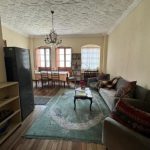
(De El Mercurio del domingo, 5/7) Casa Museo La Condamine (La Condomine House Museum) – Manuel Valle Chávez and his son, Matías, administer La Condomine House Museum in the traditional barrio of El Vado. It is a family business that started when Manuel was a teenager and started discovering the value of antiques, although he prefers to call them “historic memory.” He was a public servant, and continued to collect while he was working. Upon retirement, he went back to his passion. The Casa Museo La Condamine is an 18th century house that belonged to Graciel Vintimilla who shared his joy for art galleries and antiquities. Today, the Casa offers collectors, visitors, and lovers of history an ample variety of objects with patrimonial value. All the pieces in the collection are for sale including wrist watches, wall clocks, tableware, pieces of bronze and wood, crystal, oil paintings, watercolors, cross stitched pieces, furniture, jewelry, games and more. Hours are from lunes a viernes from 10-18:00, sábados until 16:00 and domingos until noon.

The municipality of Cuenca is debating new landlord-tenant rules, including new requirements for short-term rentals and additions to contract requirements.
(De El Mercurio del lunes, 29/6) En Nabón se alista nueva edición del festival del cafe (Nabón getting ready for a new edition of its coffee festival) – The 5th Edition of the Festival del Café will be el domingo, 5/7 in the central plaza of the canton. Coffee producers from different sectors of the canton will present products for you to learn about and to try.
(De El Mercurio del miércoles, 1/7) La época para avistar ballenas (Whale watching season) – The season to watch humpback whales has started on the coasts of Ecuador and will last until septiembre. Each year, these animals travel close to 7,000 kilometers from Antarctica to give birth in Ecuadorian waters, making it one of the main natural tourist attractions in the country. The best sites to observe from are Salinas and Ayangue in Santa Elena; Puerto López and Manta in Manabí; and Atacames in Esmeraldas. There are 42 authorized operators and 115 specialized guides that offer this service in Ecuador. The main national tourists come from Pichincha, Guayas, Azuay, Chimborazo and Cotopaxi and international tourists from China and Japan.
(De El Mercurio del viernes, 3/7) 13 provincias exponen en CIDAP (13 provinces are exhibiting at CIDAP) – The Museo de las Artes Populares at CIDAP (Escalinatas Francisco Sojos y Paseo Tres de Noviembre in the El Barranco sector) opened a show and sale “Saber hacer / Saber haciendo” which brings work of various craftspeople, collectives and startups from different provinces of Ecuador. The public can learn the processes, crafts and stories that give life to each piece as well as purchase those pieces in the show. The show will be open through julio with hours from lunes a viernes from 8-17:00, and sábados from 8-16:30.
Hungry? –
(De El Mercurio del jueves, 2/7) Una cecina de carne de 21 metros, en el Carbon Fest (A beef cecina 21 meters long at the Carbon Fest) – A 21 meter long cecina to be prepared with close to 600 kilograms of meat will be the main attraction at the Carbon Fest 2026, held el 4 & 5/7 in Sayausí. The cecina, which the organizers believe is the largest in the country, will be made in the parking lot of the Saya Hotel & Suites. Other cuts of meat such as tomahawk steak, ribs, T-bones, ribeye and more will be accompanied with a variety of salsas. As part of the event, calle García Moreno, the main road of the parish, lined with patrimonial houses and the parking lot of the Saya Hotel, will be decorated with banners. The programming started today (sábado) at 9:30 and will include dance and musical performances, and the election of the Mini Cholita Sayausí. Tickets are available by calling 098 396 2378 and at the Saya Hotel & Suites.
Curious? –
(De El Mercurio del lunes, 29/6) Un tercer intento para vuelos transfronterizos (A third try at cross-border flights) – This isn’t the first time that authorities have tried to establish a direct air connection between Cuenca and northern Perú. There were attempts in 2006 and 2010, neither of which was successful. José Luis Aguilar, current director of Corpac (Corporación Aeroportuaria de Cuenca) said this time is different. On Peru’s side, it has long wanted a Cuzco-Chiclayo-Cuenca-Galápagos connection to join the major tourist destinations of the two countries. At first the Cuenca-Chiclayo route will be covered with charter flights. If there is a demand, A319 or A320 planes with a 120 to 180 passenger capacity will fly the route. These are the same planes that Aviance and LATAM use to fly the Cuenca-Galápagos route. There is a Peruvian business that wants to manage the cross-border flights; it will use 15-30 passenger planes at first with the fare depending on the demand.
Aguilar said that the Mariscal La Mar airport is ready to support cross-border flights. Adapting a space for migration was the only need, and offices for migration and customs are ready and only lack permanent staff from the Servicio Nacional Aduanas (SENAE) and Agrocalidad. Pablo Calle, a retired flight operations technician, said that the runway is too short for these types of flights. <Why, if they will use the same planes as are currently used?> He also mentioned the narrowness and that the airport is surrounded by an urban area. He said that the best guarantee to operate these flights is with a new terminal, and a runway 2,500 m. long and 50 m. wide.
(De El Mercurio del lunes, 29/6) En julio prevén licitar segundo intercambiador (Call for bids for 2nd interchange planned for July) – There are 3 interchanges planned for the Cuenca-Azogues autopista. The Monay-IESS interchange is 40% complete and will be partially ready this year. The interchange at av. 12 de Octubre will start the precontractual process in julio. The contractor for the (fiscalización) audit process has been selected and the contract will start when the retainer is paid. The audit process for the Gapal interchange has been contracted out.
(De El Mercurio del martes, 30/6) Autoridades sellaron acuerdos por Cuenca (Officials signed agreements for Cuenca) – Marisol Peñaloz, substitute mayor of Cuenca, met with the 6 national assembleístas and one alternate for Azuay to establish a roadmap between the City of Cuenca and the legislators for the province to address priority concerns. She argued the political differences should be set aside to build agreements that benefit Cuenca and Azuay with permanent coordination. <I hope that other politicians are paying attention to this way of doing things. It would be especially welcome in the country in the northern hemisphere currently paralyzed by political differences.>
The main concern was security. One of the agreements was to follow up on the Unidad de Vigilancia Comunitaria (UVC) de Yanuncay, which was one of the projects most important in strengthening security. Another request was to review the integration of the CSC (Consejo de Seguridad Ciudadana) cameras with those of the Servicio Integrado de Seguridad (SIS) ECU 911 system. Peñaloza reported that an ordinance regulating 2 riders on a motorcycle, and another to control rental contracts were being worked on. Other topics included those related to health, education and help for the Hormiguitas who are the workers who clean the parks and streets, and who want to form an association.
(De El Mercurio del martes, 30/6) 12 toneladas de ayuda han recolectado (12 tons of aid has been collected) – Priscila Rodríguez, a native of Venezuela and responsible for the Cuenca collection center, reported that between 10 and 12 tons of aid has been collected with support from neighboring cities, civil society, organizations and foundations. 8 collection centers have been set up nationally, and the one in Cuenca is on the Yanuncay campus of the U. of Cuenca on la Av. 12 de Octubre with hours 7 days a week from 8-18:00. Froilán Salinas, zone coordinator for the Gestión de Riesgos (Risk Management), said they need bar soap, sanitary napkins, diapers, reusable kitchen utensils, mats, sheets, blankets, and non-perishable foods with 6 months before they expiration. The center will not take clothing, perishable goods or medicines. He said that Ecuador is responding the way that Venequelans did after the 2016 earthquake in Manta. <How about adding a few bags of staples and some canned goods to your next shopping trip?>
(De El Mercurio del miércoles, 1/7) 774 delitos con motos en 6 años (774 crimes with motorcycles in 6 years) – Coronel Pablo Inga reported that between 2020 and el 26/6/2026, the National Police registered 774 criminal acts in Cuenca that involved motorcycles. Of those, 435 were in the Southern District, and 339 in the Northern. The report was made during the 2nd technical workshop to analyze the proposed ordinance to regulate the circulation of 2 people on a motorcycle in Cuenca canton. Police Major Peñaloza said the reports needed to be submitted before el 3/7 ahead of a new workshop before the 2nd debate on the ordinance.
(De El Mercurio del jueves, 2/7) Cae red de venta de droga en delivery (Drug delivery network busted) – An organization that was using commercial “delivery” methods of selling drugs was busted by the Policía Nacional in operation Apolo 16 in different sectors in Cuenca and Santa Isabel. The operation took place in San Joaquín, Feria Libre, Turi, Tres Puentes, Yanuncay, Ricaurte and Santa Isabel where officers entered properties identified as distribution centers. 12 people were arrested, 10 who had outstanding arrest warrants, and 2 who were caught red handed. Ángel Arturo Esquivel, a coronel in the Azuay subzone, explained the suspects used motorcycles fitted with boxes similar to legal delivery boxes for home deliveries of drugs. <You can order your pizza topped with red pepper flakes, oregano, or pot?> He said that the properties used as distribution centers were usually rented or subleased, and recommended that landlords check the identities and histories of applicants for their rentals.
(De El Mercurio del viernes, 3/7) IESS paga USD 69 millones a los prestadores externos (IESS pays $69 million to external providers) – In junio, 2026, the IESS paid over $63 million to 195 outside health providers in several provinces. From diciembre, 2025 to junio, 2026, IESS paid over $616 million to these providers on a national scale including dialysis centers and oncological units.
(De El Mercurio del viernes, 3/7) Cuyes azuayos regresan a los EE.UU. (Azuayan cuyes return to the U.S.) – <I’m imagining millions of guinea pigs scurrying along the Darian gap, heading north.> A new shipment of vacuum packed cuyes from the Mcuy Ecuador Azuay brand, also known as Mister Cuy, was exported to the US to be sold in Long Island, Queens, and Patchogue. The brand sent its first 800 cuyes in marzo, 2024, followed by a 2nd shipment of 740 in mayo, 2024. After other shipments, export were suspended due to temporary sanitary restrictions imposed on selling cuyes and rabbits.
The cuyes were processed in a slaughterhouse in Gualaceo and raised in the traditional manner on local farms. They were fed mostly grass which contributes to conserving the typical flavor and characteristics. <Who knew that cuyes were affected by terroir?> The goal is to export 5,000 cuyes per month due to the high demand in the US, especially in the immigrant community. <I imagine the non-immigrant community has the same reaction to eating cuy that the immigrant (or ex-pat) community here does.>
(De El Mercurio del sábado, 4/7) Planta de Guangarcucho en 12% (Guangarcucho Plant at 12%) – The Guangarcucho sewage treatment plant is at 12% completion. A report by Verónica Polo, the general manager of ETAPA EP, said that the project will increase the capacity for wastewater treatment to meet the demand until 2050. The $68.08 million project is projected to be finished in noviembre, 2027 with a testing period of 1 year. The plant will have the capacity to treat 2,000 liters of wastewater per second and will benefit more than a million residents of the urban and suburban areas of Cuenca. This is the biggest investment that ETAPA has ever made, and the state-of-the-art technology will allow the return of cleaner water to the rivers. The plant occupies 7.4 hectares and includes pretreatment systems, biological reactors, settling tanks, ultraviolet light disinfection, and units to treat sludge.
(De El Mercurio del sábado, 4/7) “Fuimos testigos de verdadero milagro” (“We witnessed a true miracle”) – Danilo Mendoza, chief of operations of the Urban Search and Rescue (USAR)del Cuerpo de Bomberos Quito, called the rescue of Carlitos, a 12-year-old Venezuelan boy, a miracle. The boy was buried for 5 days in the debris of a 9-story building. The firefighter said it was a miracle, since when the earthquake hit, the boy was on the 2nd floor. 7 floors above fell and he was in a small space that would only accommodate a child. An adult wouldn’t have fit. The rescue was even more unheard of since it was believed that there couldn’t be any survivors and heavy equipment was used. It passed within a few centimeters of where the boy was. The only one looking for the boy was his uncle who directed rescufers to the area without knowing if anyone in the family had survived.
The Quito Firefighters who were part of 53 international USAR units who went to Venezuela and rescued 2 people of the 14 that were rescued by the international USAR units. Esteban Cárdenas, Quito Fire Department chief, said that even though the number of rescues seems small, each life is valuable, and they were deployed only after national teams had categorized the sites as low probability of finding people still alive. The rescues were done in extremely difficult conditions where the firefighters had to drill, cut and shore up the rubble to protect the person. Cárdenas said that the Chilean team worked for 36 hours to free one person. It took the Quito team 6 hours to rescue Carlitos. For Gabriel Rodríguez, the team field manager, the work in Venezuela allowed them to return all the help provided by international groups that came to Ecuador in 2016 after the earthquake in Manabí. <Is this what solidarity looks like in action?>



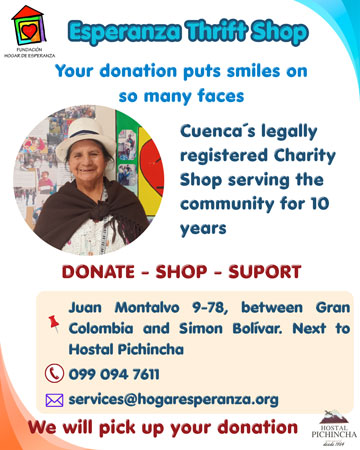
Hogar Esperanza News
The Cuenca Dispatch

Week of September 20
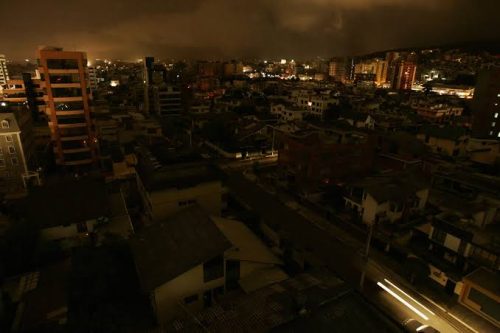
Ecuador turns to industrial power cuts to protect Mazar and keep homes from going dark.

Ecuador raises its 2026 growth forecast, but El Niño could spoil the outlook next year.
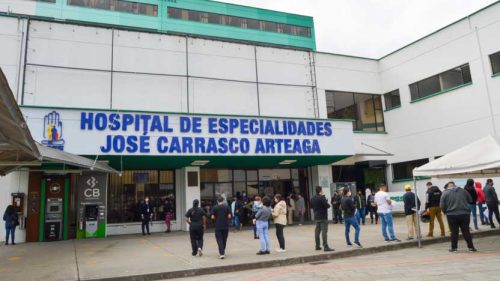
Cuenca retirees challenge medical and therapy changes at IESS senior center.
Fabianos Pizzeria News

Fund Grace News