








When Cuenca stops being a checklist
Living in Cuenca, Ecuador, begins with practical decisions. But for some expatriates, becoming part of the community begins when they stop asking what the city offers and start asking what they can contribute.
David had a spreadsheet for almost everything.
When he and Patricia decided to leave St. Augustine, Florida, for Cuenca, he built one with 27 categories. Climate, healthcare, housing, transportation, food costs, taxes, insurance, and several items Patricia suspected he’d invented just to make the columns line up.
Two years later, he still had it.

A carefully researched move brought David and Patricia to Cuenca. Two years later, they began discovering something their retirement checklist had overlooked: becoming part of a community. AI-generated illustration.
“Do you ever think we missed something?” Patricia asked one morning.
David looked up from his computer.
“On the spreadsheet?”
“About moving here.”
“We’re happy, aren’t we?”
“Of course.”
“Then what did we miss?”
Patricia thought for a moment.
“Maybe nothing. But we’ve spent two years figuring out how to live in Cuenca. I’m wondering when we start doing something with the people who live here.”
David closed the laptop.
“That sounds suspiciously like another project.”
As it turned out, it was.
A Meeting at Inca Bar & Lounge
The following afternoon, David and Patricia joined three neighbors at INCA Bar & Lounge, overlooking the Tomebamba.
Lucía, a Cuencana who had lived in the neighborhood most of her life, had invited them. She was concerned about unwanted graffiti appearing on several walls along a nearby street.
Not the colorful murals that have become part of Cuenca’s urban landscape. These were mostly hurried markings across storefronts and residential facades.
“Every time someone cleans one wall, another gets marked,” she explained. “A few of us have been talking about doing something together.”
Jorge, another Cuencano, nodded.
“Some property owners would probably welcome help. Others might not want anyone touching their buildings.”
Abdul Rahman, a retired Canadian civil engineer originally from Toronto, spread several photographs across the table.
“Six volunteers, a few gallons of paint, and one Saturday morning. We could make a good start.”
David examined the pictures.
“You’re an engineer, Abdul. Haven’t you forgotten something?”
“Yes. Coffee. I should have ordered coffee.”
Lucía picked up one of the photographs.
“Have you asked who owns these walls?”
“Not yet.”
“And whether we’re allowed to paint them?”
Abdul leaned back.
“I was hoping we could paint something before forming a committee.”
Patricia laughed.
“Well, I think we’ve just discovered why we’re having this meeting.”
When a Good Idea Meets a Complicated City
The group had started with a simple assumption. If graffiti was making the street unattractive, removing it would be helpful.
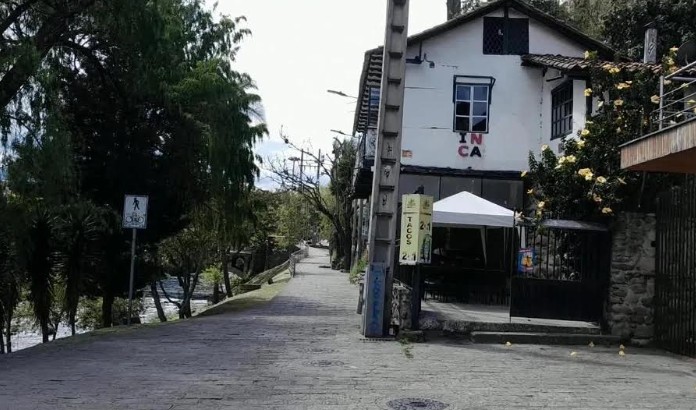
At INCA Bar & Lounge, Cuencano residents and expatriates discuss a neighborhood graffiti cleanup project. AI-generated illustration based on photographs of Inca.
But Cuenca isn’t a blank canvas.
Buildings belong to people. Some have historical significance. Certain walls display authorized artwork. Even ordinary facade painting can involve municipal requirements, particularly within protected areas.
Cuenca has an ordinance governing graffiti and mural art in public spaces. It recognizes different categories of spaces, including private properties where owners authorize artistic work and areas where special permissions apply.
The municipality also publishes a procedure for facade painting in historic and heritage areas. Applicants may need to document the existing appearance and proposed work, while colors must respect the surrounding architectural environment.
The precise requirements depend on the location and the type of intervention.
“So we need permission,” David said.
“We need to find out which permissions,” Lucía corrected.
Jorge pointed toward the photographs.
“First, let’s identify the owners. Then we can ask the municipality what applies.”
Abdul looked at his proposed Saturday schedule.
“I suppose I should move the paint purchase to page two.”
“Maybe page three,” Patricia suggested.
Nobody disagreed.
Whose Neighborhood Is It Anyway?
Living in Cuenca can be surprisingly comfortable for expatriates who have done their research.

Removing unwanted graffiti may seem straightforward, but protecting Cuenca’s neighborhoods also means respecting property ownership, existing artwork, and municipal requirements. AI-generated illustration.
There are familiar restaurants, established expatriate communities, modern healthcare services, and convenient transportation. Many newcomers quickly develop routines that make everyday life manageable.
But comfort and participation aren’t necessarily the same thing.
David and Patricia had learned where to shop, which buses to take, and how to arrange medical appointments. They knew their neighborhood well enough to navigate it without thinking.
Yet they had never attended a meeting about improving it.
Now they were sitting with people who had different experiences of the same streets.
For Lucía, the marked walls were part of a neighborhood she had known since childhood.
For Jorge, the immediate concern was whether property owners would cooperate.
For Abdul, the problem suggested a manageable volunteer project, provided someone could establish the rules.
David saw organizational work. Patricia saw an opportunity to bring neighbors into the conversation.
Nobody had the complete answer.
And nobody needed to.
The project would require all of them.
The Difference Between Helping and Taking Over
There was another question the group hadn’t considered.
What if some residents didn’t want the walls repainted?
“What do you mean?” Abdul asked.
“Maybe they like some of the artwork,” Patricia said. “Or perhaps they have other priorities.”
Lucía nodded.
“That’s why we should talk to people before deciding what we’re going to do for them.”
It was an important distinction.
Expatriates sometimes arrive in another country with useful experience, resources, and a sincere desire to help. Those qualities can benefit a community.
But a good intention doesn’t automatically make someone the right person to decide what a neighborhood needs.
Cuenca has its own residents, organizations, institutions, and ways of handling local concerns.
Participation means working within that community, not assuming responsibility for directing it.
The group began revising Abdul’s original proposal.
Lucía and Jorge would speak with residents and property owners.
David would prepare a list of the affected locations and organize the information.
Abdul would investigate materials, costs, and volunteer safety.
Patricia would help coordinate a follow-up discussion once the neighbors had expressed their views.
Only then would they decide whether a painting day made sense.
See how David, Patricia, Abdul, Lucía, and Jorge turn a simple idea into a neighborhood conversation in our illustrated Instagram carousel, “When Cuenca Stops Being a Checklist.”
What Does It Mean to Belong in Cuenca?
Belonging in Cuenca doesn’t require abandoning the country you came from or becoming someone you’re not.
It can begin with ordinary relationships, shared responsibilities, and a willingness to participate in matters that don’t directly benefit you.
That doesn’t mean every expatriate must join a committee or organize a neighborhood project.
Some contribute through friendships, volunteering, supporting local businesses, or helping a neighbor with an everyday problem.
Others may still be learning the language or finding their place in a culture they don’t fully understand.
There is no official timetable for becoming part of a community.
The experience of settling into a new place raises a larger question about life changes: What happens when you’ve made the right practical decision, but still haven’t found the life you hoped to build? We explore that question in our Next Cradle companion article, “You Chose the Right Place. Why Doesn’t It Feel Like Your Life Yet?”
But something changes when people stop seeing their surroundings only as services and conveniences.
A street becomes more than a route to the supermarket.
A shopkeeper becomes more than the person behind the counter.
And neighbors become people whose concerns matter, even when those concerns aren’t your own.
For David, that change was happening over a table at INCA Bar.
The Spreadsheet Gets Another Column
As the meeting ended, Abdul gathered his photographs.
“So when do we buy the paint?”
Lucía smiled.
“When we know we’re allowed to use it.”
“Fair enough,” Abdul said. “But I’m keeping Saturday open.”
Outside, David and Patricia began walking home.
“Well,” David said, “that was more complicated than I expected.”
“Most worthwhile things are.”
“We haven’t painted anything.”
“No.”
“We don’t even know whether we can.”
“Not yet.”
David considered that.
“But we have a plan.”
Patricia smiled.
“Of course we do. You were there.”
Later that evening, David opened the spreadsheet he’d created before they moved to Ecuador.
He looked through the familiar categories. Healthcare. Transportation. Housing. Monthly expenses.
Every item had helped them decide whether Cuenca was a sensible place to retire.
He added another line at the bottom.
What can we contribute to the community?
Patricia looked over his shoulder.
“How are you going to score that?”
David stared at the empty cell.
For once, he didn’t have an answer.
And for once, he didn’t need one.
The checklist had helped them choose Cuenca.
Now they were beginning to discover what living here might mean.
________________
Author’s note: David, Patricia, Abdul, Lucía, and Jorge are fictionalized characters used to explore recognizable experiences of expatriate and neighborhood life in Cuenca. Their meeting and proposed project are illustrative, not a report of an actual organized cleanup.