














Why Ecuador’s sierra gets the sun while most of the coast sits under clouds
By Christoph Wackher
A few weeks ago, editor David Morrill sent me a satellite screenshot with a simple observation attached: on an awful lot of days, the Andean central valley — Cuenca, Quito, the whole sierra corridor — sits under open sky while a thick gray lid of cloud sits over the coast. It’s the kind of thing you notice living here but rarely see quantified. So I pulled thirty years of climate-normal data for Guayaquil, Quito, and Cuenca and checked whether the satellite picture holds up as a pattern, not just a lucky screenshot.
It does, and by a wider margin than I expected.
Sunshine hours, month by month
Guayaquil averages 1,447 hours of sunshine a year. Quito averages 1,947. Cuenca averages 1,971 — narrowly the sunniest of the three, and 36% ahead of the coast on an annual basis. What’s more interesting than the annual totals is that the gap isn’t seasonal — it holds in every single month of the year:
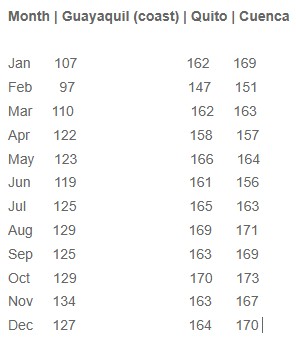
(All figures in hours of sunshine for the month.) Guayaquil never once catches either sierra city, and the gap is widest in the coast’s rainy season — January through March — when Guayaquil trails Cuenca by 52 to 62 hours a month. That lines up with the mechanism behind Mr. Morrill’s screenshot: the coast sits under a marine cloud layer driven by the cold Humboldt Current offshore, which suppresses cloud burn-off at low elevation. The sierra, sitting above most of that layer at 2,500m+, looks out over the top of it.
What it means for a day outdoors
Sunshine hours are a nice curiosity, but what actually matters if you’re deciding where to sit outside is comfort — and here the gap turns into something closer to a chasm. Using GeoRank’s usable-outdoor-hours model (details on the method below), Guayaquil offers about 1,829 comfortable outdoor hours a year. Quito offers 2,874. Cuenca offers 3,415 — nearly double the coast.
The reason isn’t really the extra sunshine; it’s what the sunshine is landing on. Guayaquil’s daytime highs sit around 28-29°C essentially year-round, and the model charges the coast roughly 2,460 hours a year lost specifically to heat. Cuenca and Quito, by contrast, lose zero hours to heat in this model — their daytime highs cluster in the mid-to-high teens Celsius, which is about as close to “always comfortable on the thermometer” as a climate gets. Cuenca’s real cost is 777 hours lost to cold (mostly in the shoulder mornings and evenings) plus 235 to rain; Quito loses 1,001 to cold and 555 to rain. Either way, that’s a smaller bill than Guayaquil’s heat tax alone.
The counterintuitive part: the coast isn’t the wet one
Given the sierra’s reputation for drizzle and the coast’s reputation for tropical downpours, you’d expect Guayaquil to come out wetter. It doesn’t. Guayaquil gets about 1,331mm of rain a year. Quito gets about 2,139mm — well over half again as much. Cuenca, meanwhile, is the driest of the three at roughly 827mm a year, less than either of the other two. Guayaquil’s rain is concentrated and intense — about 1,091mm, or 82% of its annual total, falls in just January through April — while Quito’s 2,139mm is spread more evenly across a longer wet season. Different rainfall regimes producing very different totals than the “coast = wet, mountains = dry” intuition would suggest.
Method and honest limitations
A quick note on where these numbers come from and where they don’t fully hold up. All of it is 30-year climate normals — the long-run average character of a place, not a live forecast, so it will not tell you whether next Tuesday is sunny. The “usable outdoor hours” figure is GeoRank’s own comfort model: it starts from daylight hours and subtracts time lost to heat, cold, rain, and wind based on thresholds I set as reasonable defaults for outdoor comfort, not an official meteorological or building-code standard. Someone who runs hot, or who’s fully acclimated to Guayaquil’s climate, would draw the heat threshold differently and get a smaller gap than the one shown here. Treat the outdoor-hours numbers as a consistent way to compare places against each other, not as an absolute count of good days.
________________
Christoph Wackher builds GeoRank (georank.place), an open climate and cost-of-living dataset covering 478 cities.
Verification table
Figure in column | Value | JSON field | City slug
Guayaquil annual sunshine | 1,447 h | `sun` | guayaquil-ec
Quito annual sunshine | 1,947 h | `sun` | quito-ec
Cuenca annual sunshine | 1,971 h | `sun` | cuenca-ec
Monthly sunshine table (all 12 months, all 3 cities) | see table | `sunMonthly` | guayaquil-ec, quito-ec, cuenca-ec
Guayaquil usable outdoor hours/yr | 1,829 h | sum of `out` | guayaquil-ec
Quito usable outdoor hours/yr | 2,874 h | sum of `out` | quito-ec
Cuenca usable outdoor hours/yr | 3,415 h | sum of `out` | cuenca-ec
Guayaquil hours lost to heat/yr | 2,460 h | `outBreak[0]` | guayaquil-ec |
Quito/Cuenca hours lost to heat/yr | 0 h | `outBreak[0]` | quito-ec, cuenca-ec
Cuenca hours lost to cold/rain/wind | 777 / 235 / 2 h | `outBreak[1..3]` | cuenca-ec
Quito hours lost to cold/rain | 1,001 / 555 h | `outBreak[1..2]` | quito-ec |
Guayaquil daytime highs | ~28-29°C year-round | `tempHigh` | guayaquil-ec
Cuenca/Quito daytime highs | mid-to-high teens °C | `tempHigh` | cuenca-ec, quito-ec
Guayaquil annual rainfall | 1,331 mm | sum of `rain` | guayaquil-ec
Quito annual rainfall | 2,139 mm | sum of `rain` | quito-ec
Cuenca annual rainfall | 827 mm | sum of `rain` | cuenca-ec
Guayaquil Jan-Apr rainfall | 1,091 mm (82% of annual) | `rain[0..3]` | guayaquil-ec
Source for all figures: `https://georank.place/data/ci