















Why Noboa’s militarized offensive against criminal economies will lead to more corruption and abuse
By Luis Carlos Córdova-Alarcón
After achieving control in the National Assembly, President Daniel Noboa sent the draft “Organic Law to dismantle the criminal economy linked to the internal armed conflict”, describing it as urgent economic to accelerate its approval. The title of the project is inconsistent with the content. Instead of seriously targeting criminal economies, a war scenario is envisioned based on erroneous assumptions: it does not understand the nature of the threats, exaggerates the state response and, most seriously, makes criminal penetration of the government invisible.
Why is it important? The State’s security institutions (National Police, Armed Forces, Intelligence System, Judicial Function) are deeply permeated by organized crime. The problem is not the actors who are corrupt and commit crimes, but a collapsed institutional design and the lack of political will to reform it. Under these conditions, allowing the military and police to act at their discretion to combat the alleged “Organized Armed Groups”, as the bill proposes, is counterproductive: it will only multiply abuses and enrich criminal economies.
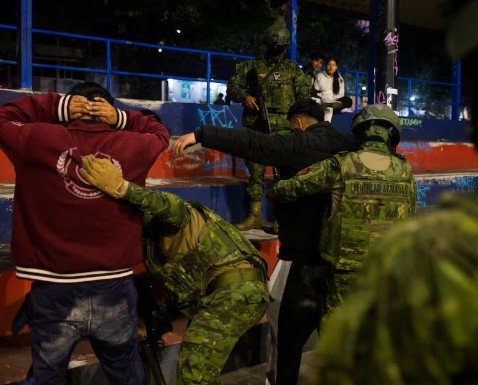
Soldiers search two men in Quito for weapons in March.
What should be done? The National Assembly should deny this bill. In the security sector, the government must act urgently in three ways. First, by designing a criminal policy that aims at arms control and the dismantling of transnational organized crime networks, which are the ones that move large illicit capital. Second, by activating a first phase of military and police reform that allows for a systematic purging of corrupt actors and a modernization of external supervision and control procedures. Third, rethinking national defense policy to recover the professional compass of the Armed Forces and avoid its organizational atrophy.
Why will this bill increase abuses?
Apparently, the president does not know the old adage: “The road to hell is paved with good intentions.” Intentions are not enough to change reality, even if they are good. It is necessary to have a strategy that adequately connects the ends with the available means. And that is what this draft of “Organic Law to dismantle the criminal economy linked to the internal armed conflict” lacks.
Although the purpose is legitimate – to dismantle criminal economies – the ways chosen to do it are foolish.
The grandiloquent declarations on International Humanitarian Law serve to camouflage three demands that the military command has made for some years in the corridors of power.
First, to provide a façade of legality to war operations, especially when “collateral damage” occurs: civilian deaths and damage to private property.
For this reason, Article 6 contemplates the official recognition of the Internal Armed Conflict as a preamble to a “State of War” or “specific regime of measures to combat it”.
This implies expressly renouncing a democratic solution to the security crisis that Ecuador is experiencing. The “State of War” replaces the “Rule of Law” and the constitutional framework remains in a legal limbo for the duration of the internal armed conflict (see Article 7).
Second, to make direct use of force without being criminally responsible.
It is well-known that since the prison massacres began, police and military justified their inaction in the absence of guarantees to intervene and exercise force. To meet this and other demands of the National Police and the Armed Forces, the “Organic Law that regulates the legitimate use of force” was created in 2022. But the massacres continued inside and outside the prisons.
Article 12 of the bew bill authorizes the “direct use of force against members of organized armed groups, especially when they are armed or initiate hostile attacks.” However, none of the 22 organizations declared as terrorist by Executive Decree 111, of January 9, 2024 (Choneros, Tiguerones, Chone Killers, etc.) have clothing that identifies them and differentiates them from the civilian population.
How, then, will police and military distinguish a civilian in the middle of the crossfire, for example?
With the exception of Colombia’s armed organizations such as the “Border Command,” which have uniforms and insignia that distinguish them from civilians, the other criminal groups and gangs that inhabit Ecuador’s cities blend in with the population. The mere impossibility of distinguishing civilians from combatants makes International Humanitarian Law inapplicable.
With this bill, cases such as that of “The Malvinas 4” will go unpunished. Article 25 expressly excludes military and police officers from the “regulations applicable to the peace regime,” that is, from the laws that govern democratic order. Despite this, if a member of the military or police is prosecuted for a common crime, Article 26 empowers the president to grant pardons. A legal aberration typical of totalitarian regimes.
The third objective is to deter the “enemy” through the exercise of terror.
In war contexts, torture becomes omnipresent. Especially when state security forces face asymmetrical and unstructured conflicts such as the one the country is experiencing. This is widely documented. In the Mexican case, for example, torture was used as a method of criminal investigation in the framework of the “war on drugs” undertaken by Felipe Calderón.
According to the reform introduced in this bill (see article 29, amendment to article 530.1 of the Comprehensive Organic Criminal Code, COIP), the “Security Bloc” will be able to detain for investigative purposes people who are part of an organized armed group without a court order. “Security Bloc” is the euphemism for the police or military command of war operations. Under its provisions, the exercise of torture and other cruel and degrading treatment, protected by the state, can be used against innocent people.
In addition, the bill creates a special jurisdiction to try members of organized armed groups or those linked to their criminal economies (see Article 24). It also creates a unified and special procedure to sanction them (see article 29, reform of article 651.7 of the COIP).
All these nonsensical ways of confronting the “internal enemy of the State” are not new in Latin America. The Inter-American Court of Human Rights has developed wide-ranging jurisprudence to curb and prevent governments from resorting to this type of abusive practices.
But none of this seems to matter to President Noboa. Article 5, paragraph k of the bill states that “the State is empowered to make its own decisions and govern within the country, without allowing other states, multilateral organizations and other institutions of international law to interfere in its sovereign decisions.” A clear warning. The national government will ignore any pronouncement of the Inter-American Human Rights System and will not accept any foreign interference.
How will this bill multiply criminal economies?
Criminal economies are phenomena that are socially organized. Two factors determine the success of an illicit economy: price and demand.
The price has to do with the economic policy of the state in relation to the activity as a whole. For example, without the prohibitionist drug regime created within the United Nations since the 1960s, under the leadership of the United States, drug trafficking would not be a good business. And without drug trafficking, U.S. federal agencies and the Pentagon would have no incentive to spread the “war on drugs” in their areas of influence; which in turn increases the price of narcotics. Not even the financial system and tax havens would have so many clients needing to hide their ill-gotten wealth.
The demand for illicit goods is more complex to be attacked by the state — because formal illegality is often confused with social illegitimacy. The fact that a good or service is illicit does not mean that it is illegitimate for its suppliers and consumers. On the contrary, the social legitimacy of illegal products and services has to do with the beliefs that mobilize the preferences of consumers and suppliers, social expectations or personal imaginaries.
For example, if illegal mining multiplies so easily, it is because large rural sectors have been cut out of the national agro-productive system, and seek other sources of subsistence. But as in any economic activity, someone governs the illicit circuits. The architecture of illegal markets is often based on the articulation of state agents, business and criminal actors.
In this sense, the bill is harmless to criminal economies. Instead of designing an institutional framework to improve the investigation and punishment of money laundering, the control of business circuits and the traceability of financial flows, it opts for the most archaic: the seizure of assets (see Article 14). Thus, the only thing the government achieves is to energize another criminal market: the purchase and sale of seized goods. It should be remembered that within the state there is a gray area of criminality that facilitates the operation of illicit economies.
But this bill goes further and allows the creation of “security zones” at the discretion of the “Security Bloc” (see article 21), superimposing economic, financial or administrative exception regimes in the spaces of Ecuadorian territory that have been declared as “security zones”. These zones, in effect, become black holes in the law where police and military will act without control of other public authority.
Thus, state agents who collude with crime will be able to expand their influence over illicit economies, increase the prices of illegal goods and services, and constitute new state-sponsored extortion protection networks.
In this scenario, lethal violence is likely to tend to decrease in the medium term, but organized crime will not. Perhaps that is what President Noboa is looking for: to lower homicide rates by giving free rein to organized crime. A new mafia peace, similar to the one former president Rafael Correa orchestrated a decade ago.
What to do?
If the intention is to combat serious crime and reduce lethal violence, the government must take the following urgent actions:
Radicalize a gun control policy. This implies reversing the reforms introduced by former President Guillermo Lasso that made the possession and carrying of weapons more flexible.
It should also:
— Create a bilateral dialogue with the United States to improve controls and limit arms trafficking to Ecuador.
— Design a criminal policy of special investigations to map, prosecute, and dismantle transnational organized crime networks. This implies not confusing the shirtless gang members who sow anxiety in the marginal urban neighborhoods, with the business organizations that manage drug trafficking or illicit gold trafficking. A redesign of the intelligence system can be a first step.
— Undertake a police and military reform around three axes: the development of a military doctrine adapted to the reality of the country; the creation of multi-purpose security forces; and the creation of external oversight and accountability mechanisms, with public funding. President Noboa’s political-electoral capital is a favorable condition for undertaking these reforms. Otherwise, the criminals capture of the state security apparatus will be unstoppable.
— Rethink a national defense policy to recover the professional authority of the Armed Forces and avoid its organizational atrophy. As the Ecuadorian Armed Forces has become bogged down in a war against the “internal enemy of the state,” they deepen the country’s strategic dependence and increase its vulnerabilities. The Peruvian invasion of Ecuador in 1941 and the Russian invasion of Ukraine from 2022 should serve to avoid making the same strategic mistakes again.
________________
Credit: Plan V



Hogar Esperanza News

Fabianos Pizzeria News

The Cuenca Dispatch

Week of September 06

U.S. sinkings of Ecuadorian fishing vessels trigger court scrutiny after 28 crew members are released.

Cuenca targets a November launch for its first new international link to Chiclayo.

Exports hit a quarterly record, but Ecuador’s import bill is rising even faster.
Fund Grace News

Property Manabi
