














Why ‘non-ultra-processed’ food labels won’t make people eat a healthier diet
By Tamar Haspel
When food manufacturers decide what to put on labels, they have one goal: to get you to buy the food.
And the history of Americans’ diets can be read in the history of food labels. Whatever the villain du jour is, we get labels about its absence: fat, high-fructose corn syrup, GMOs, gluten, seed oils, artificial colors, sugar. And for the heroes, we get labels trumpeting their presence: fiber, protein, vitamins, whole grains. Tallow, God help us.
All those labels, all those products, and, nevertheless, we’ve felt the need for yet another villain: ultra-processed foods (UPFs).
Will a “non-UPF” label help Americans eat better?
 In March, a California State Assembly member introduced legislation to create a non-UPF certification. Consumer app Wisecode has introduced a “Non-UPF Verified” shield that food manufacturers can pay to have on their products; the app also identifies ultra-processed foods that don’t carry the shield. The organization that brought you non-GMO certification also hopes to make hay with a non-UPF certification, and there’s a nonprofit group getting in on the act with a similar program.
What they all have in common, of course, is the goal of identifying UPFs. What they don’t have in common is a definition of what UPFs are — because there is no standard definition. (Turns out, getting people to agree to a standard isn’t so easy. Last July, Health Secretary Robert F. Kennedy Jr. said “defining ultra-processed foods with a clear, uniform standard” was a priority, and he has so far come up empty.)
But let’s pause for a second. I have a question for you.
Can you identify junky food?
Most of us, most of the time, probably can. Sure, there are going to be some edge cases: granola bar, junk or not junk? But the Twinkies, ramen, hot dogs, Frappuccinos, cookies, Doritos, doughnuts, Count Chocula, cinnamon buns, nachos … okay, you get the point. We generally have a pretty good idea which foods are good choices and which aren’t. And, a lot of the time, the bad choices are ultra-processed and the good ones aren’t.
But not all of the time. Some junky foods are not ultra-processed, and I have ice cream in my freezer to prove it. Some good choices are ultra-processed, and I have oat milk in my fridge to prove it. Yes, the overlap between “ultra-processed” and “junky” is substantial, and that’s why it’s tempting to use UPF as a proxy. But it’s a bad idea.
I know this sounds like Talmudic hairsplitting. Why should it matter that there are a few healthful ultra-processed options when the vast majority of UPFs is the stuff of obesity and diabetes? But the fact that “ultra-processed” is an imperfect proxy for “junk” is what makes a non-UPF label a wonderful gift to the food industry.
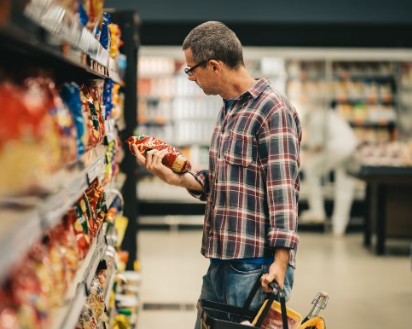
Labels can give shoppers more information, but they might not change shoppers’ habits. (Giselleflissak/Getty Images)
To understand why, think about Big Food’s goal: to sell more food. To do that, the companies focus on what matters to us, the consumers. And the things that matter to us, in study after study, are taste, price and convenience.
Processing is a godsend for taste, price and convenience! It can help manufacturers engineer delicious, cheap, ready-to-eat food. Sure, you could also use processing to make, say, lentil soup, but who would buy that? Okay, I might, and you might, too, but most people wouldn’t. Lentil soup cannot compete with instant ramen.
The processing isn’t the problem; it’s the foods that manufacturers choose to make with it.
How do you think the food industry will respond to incentives to make less-processed food? Will there be more lentil soup? Or will there be more snacks, sweets, frozen pizzas, sugary drinks, candy and breakfast cereal formulated to just barely meet the requirements for a “non-ultraprocessed” label?
My money’s on B.
When the food landscape is populated with products that are just as junky, or almost as junky, but get a health halo from a “non-UPF” label, the American diet could get worse rather than better.
Pierre Chandon, a professor of marketing and director of the INSEAD Sorbonne University Behavioral Lab in Paris, studies how consumers respond to package labels. “Often, it’s enough to be ‘healthy, according to the criterion of the day’ (no UPF now, no fat before) for the food to be categorized as ‘healthy overall,’ which means that people think it’s okay to eat more of it,” he wrote me in an email. “People now equate healthiness more with processing … than with nutritional quality.”
Marion Nestle, a professor emerita at New York University and one of the most prominent voices in nutrition, has a clear-eyed view of labels, having tracked the food industry’s use of them for decades. “Food companies fought so hard for health claims because they knew that health claims would sell products,” she told me. “This is a health aura claim, and its purpose is to encourage people to eat more.”
Still, she’s optimistic that the new labels can help people make better choices. “Avoiding UPFs is a good idea,” she said. “If a label helps people avoid them, that’ll be fine.”
I hope she’s right. But labels exist so that people feel better about buying the foods they want to eat in the first place, and as we contemplate “non-UPF” labels, we should remember SnackWell’s.
Remember SnackWell’s? In the early 1990s, when standard-issue nutrition advice was to limit dietary fat, SnackWell’s introduced a line of low-fat cookies that were wildly popular.
With the benefit of hindsight, we roll our eyes. Oh, those poor fools who bought “low-fat” cookies because Big Nutrition told them fat was bad! But they were cookies! Non-ultra-processed verification works exactly the same way.
Take, say, Simple Mills Crunchy Almond Flour Toasted Pecan Cookies. Four of them have 150 calories total, all from “purposeful ingredients and nothing artificial.” They’re verified to not be UPFs by nonultraprocessed.org. More than half their calories come from fat (half of it saturated), and they have 5 grams of added sugar (13 percent of calories).
Compare those with, say, Stella D’oro Almond Delight cookies. In 140 calories, they have 2 more grams of sugar, 2 fewer grams of fat. But the presence of caramel coloring and calcium propionate renders them ineligible for non-UPF verification.
I’m going to go out on a limb and suggest that those differences don’t have any health impact at all.
But there’s a bigger problem at work here, and physicist Richard Feynman put his finger on it in a commencement speech at Caltech in 1974. The topic was pseudoscience, and mysticism and parapsychology came under that umbrella, but so did serious, important questions that we are, theoretically, able to study: What’s the best way to teach kids to read? How can our penal system reduce crime? Scientists had studied those questions, but studied them badly.
He didn’t mention nutrition, but the pattern is the same.
The downside of bad studies isn’t just wrong answers, it’s that, when science claims a question for its own, nonexperts are disenfranchised. “Ordinary people with commonsense ideas are intimidated,” Feynman said.
And now we have scientists arguing about the definition of ultra-processing, and studies connecting it (whatever it is!) to obesity and disease, and various organizations offering it up as the new metric of healthfulness.
It’s only when people turn off their common sense — which is pretty good at sorting good food from bad — that they start thinking cookies are fine as long as they come with a non-UPF label.
Chandon, Nestle and I all agree on one thing: Non-UPF labels are unlikely to make a big difference in Americans’ diets. “Most people don’t really care about nutrition … and won’t change their habits,” Chandon told me.
So let’s add non-UPF labels to the long list of things (diets! supplements! education! money!) that won’t change how Americans eat. And maybe, just maybe, we should turn our focus to the one thing that has shown the potential that it could: the new GLP-1 weight-loss drugs.
Labels are no match for Big Food. But Big Pharma just might be.
__________________
Credit: Washington Post