









Why would a foundation sell gasoline?
By Garry Vatcher
When people hear that Fundación Hogar de Esperanza is becoming involved in gasoline distribution in the Amazon, the first reaction may be: Why would a foundation sell gasoline?
It is a fair question. The answer gets to the very heart of what we are trying to accomplish in the Amazon.
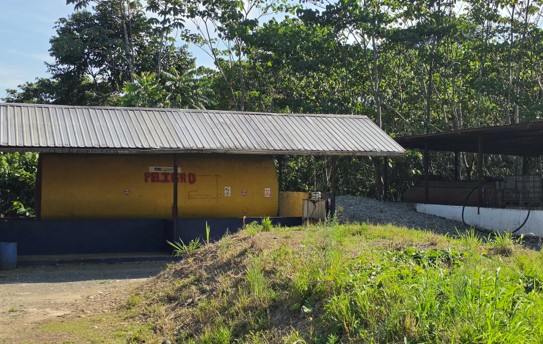
Fuel Distribution in the Amazon
For months, we have been meeting with community leaders and residents, listening to the challenges they face and discussing how we can help create sustainable solutions.
One issue kept coming up: Gasoline.
Without fuel, boats cannot transport children to school or families to medical appointments. Agricultural equipment cannot operate. Generators stop. Products cannot easily get to market. In many of these communities, without fuel, almost everything stops.
The lack of coordinated distribution has resulted in shortages and long trips simply to obtain gasoline. There have also been concerns about fuel being diverted away from the communities it is intended to serve.
We were asked whether we could help develop a solution. We did-and the relevant government authorities responded quickly, approving an initial trial that gives us the opportunity to demonstrate a very different model.
More Than Fuel
For years, assistance to Indigenous and rural communities has often followed the same pattern.
Money comes from outside. A project is funded. Something is donated.
Eventually, the money runs out and everyone starts looking for another donor.
We want to change that.
Our goal is to help create economic activity within the communities that can eventually help finance education, health care, agriculture and other community priorities themselves.
Fuel gives us an opportunity to begin doing that much sooner than we expected.
Much of the economic activity connected with the Amazon has historically benefited people somewhere else.
Products leave the Amazon.
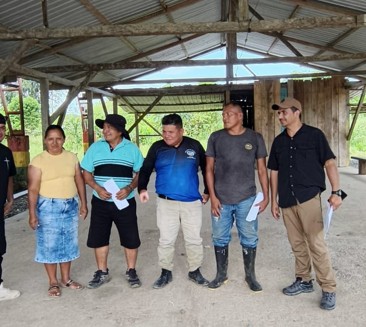
Meeting community representatives
Resources leave the Amazon.
Profits leave the Amazon.
We believe there is another way.
If fuel is something these communities already need, why shouldn’t part of the economic benefit from distributing it remain there?
A Different Model
We have received approval to begin fuel distribution on a trial basis with an initial allocation of 2,400 gallons per month. If the project operates successfully, that allocation could increase significantly.
We have committed to operating the business with the same principles we use throughout Hogar de Esperanza: Documentation. Accountability. Transparency.
Fuel purchases and sales will be documented and invoiced, volumes will be controlled, and income and expenses will be accounted for. After operating costs are paid, profits will be reinvested into projects that benefit the communities.
That is what makes this project different.
Money generated in the Amazon stays in the Amazon.
Imagine purchasing gasoline and knowing that part of the profit may eventually help provide a healthy breakfast for a child, support a medical program, develop an agricultural project, or create employment.
The customer receives something they already need. Then the money begins working again.
The communities need fuel. We need sustainable income for community projects. This model has the potential to accomplish both.
Giving Our Other Projects a Head Start
Agriculture remains an important part of our long-term plan, but agriculture takes time. Land must be prepared. Crops must be planted. People must be trained. Markets must be developed. And then we have to wait for something to grow. Fuel distribution can provide something those projects cannot provide immediately: cash flow.
At our initial allocation, we estimate approximately $1,700 per month in gross profit.
If distribution eventually reaches approximately 12,000 gallons per month, the annualized gross-profit potential at full capacity could exceed $100,000.
There will, of course, be operating expenses. Gross profit is not the same as the amount ultimately available for community programs.
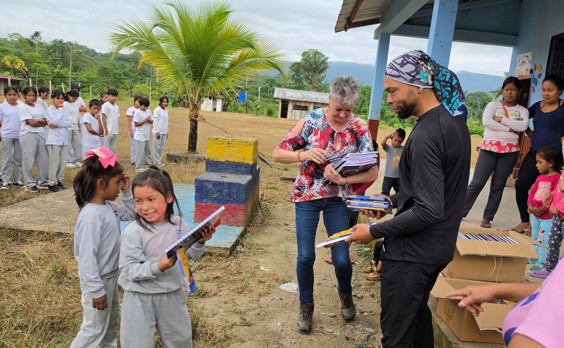
Distributing School Supplies in the Amazon
But the potential is significant.
Instead of asking donors to indefinitely pay for every medical program, school breakfast, agricultural project and new initiative, we can begin building businesses capable of helping finance those programs themselves.
That is sustainability.
What We Need to Begin
We already have one of the most important pieces in place. Our new truck will be used for distribution.
We still need storage tanks, equipment, initial fuel inventory and other infrastructure. We estimate approximately $20,000 will be required to begin operations, including about $2,600 for the initial fuel inventory. Already, we have raised $8,500.
For a relatively modest startup investment, we have an opportunity to establish an ongoing source of revenue that could benefit these communities for years.
But the significance goes beyond gasoline.
If this succeeds, we will demonstrate that helping vulnerable communities does not always mean giving things away.
Sometimes the most effective assistance is helping create an economy in which communities participate in generating the resources needed to improve their own lives.
Fuel is one business.
Agriculture will be another.
Tourism may become another.
Others will undoubtedly follow.
The principle remains the same:
Create economic activity.
Create employment.
Keep profits in the communities.
Reinvest those profits in people.
That is why Hogar de Esperanza is getting involved in gasoline distribution. We did not suddenly decide that we wanted to be in the fuel business.
We are doing it because fuel is something the communities already need, and we now have an opportunity to turn part of that everyday necessity into education, health care, economic opportunity and hope.
Money generated in the Amazon should help build the future of the Amazon.
That is the real project.
Help Us Get Started
If you would like to help provide the infrastructure needed to launch the project, you can donate here:
https://secure.qgiv.com/for/foundationhogardeesperanza
An Opportunity to Invest in Sustainability
As these businesses grow, we will also need capital.
Traditionally, that could mean commercial borrowing and the associated financing costs. Through Seeds of Hope S.A.S., we are developing another approach.
For those interested in investments of $50,000 or more, we are developing an investment option with a proposed 5% annual dividend, subject to the final legal and investment agreements.
The idea is simple. The investor receives a return. The project receives the capital it needs to grow. And more of the income generated by the businesses can remain connected to the communities rather than being used for higher-cost outside financing.
If you are interested in learning more about this opportunity, including the investment structure, use of funds, risks and legal documentation, please contact me directly at info@hogaresperanza.org.
________________
Garry Vatcher is president and founder of Foundation Hogar de Esperanza. He has been coming to Ecuador since 1987 and permanently moved to Cuenca 11 years ago. The foundation provides emergency assistance to thousands of people each year. With his guidance, the foundation has forged alliances with some of Ecuador’s major institutions including hospitals, the National Police, Amazon communities, universities, and governments. The foundation has received numerous awards and recognition for its work from local and international bodies. For information about all Foundation Hogar de Esperanza projects, go to https://hogaresperanza.org