













With the help of Cuenca expats, Christmas Spirit meets the Achuar Spirit in the Amazon
By Garry Vatcher
We set up camp along the Pastaza River in the small river port and Achuar community of Copataza. Following our usual practice, we began by asking the community leaders for permission to enter. They already knew we were coming — our patient coordinator had visited a week earlier to let them know. The leaders welcomed us warmly and spoke at length about their community’s needs. We discussed water issues, the difficulty in funding projects, and the cultural pressures they face as the modern world encroaches on their traditional ways.

Setting up camp.
Their deepest concern centered on honoring the spirits of their ancestors. For the Achuar, life is in the Amazon forest, and the spirits dwell there. Deforestation directly impacts their spirituality, and they hope to replant native species so they can reconnect more fully with those spirits.
As dusk fell, I sat by the river, watching the sunset transform this serene corner of the world. There was no electricity, so the night sky blazed with millions of stars. A gentle breeze stirred the trees, and the river flowed steadily beside us. In that moment — enveloped by darkness and guided only by starlight — I felt as though the ancestors themselves were offering their own quiet welcome. We were here on a mission to support their children.
Our journey began in Cuenca at 7 a.m. and brought us to Copataza by around 4 p.m. It was a grueling trip, including over two hours on a dirt and rock road that doesn’t appear google maps. To the outside world, it seems this place doesn’t exist. There were no hotels, restaurants, shops, or services of any kind. Camping would once have been fun, back when I was 45 years younger, but now we were in a new land — Achuar territory. After pitching our tents and making a simple dinner and coffee on a camp stove, we settled in for the night, grateful for the hospitality of the Achuar people and the profound sense of connection that lingered in the air.
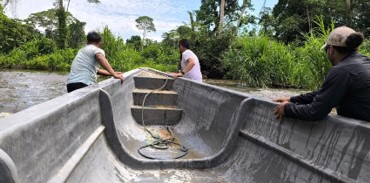
Guiding the canoe through difficult sections of river.
By 6 a.m., the community was already alive with activity. The steady hum of outboard motors filled the air as canoes crowded the port. We packed our tents and headed to the shoreline, where a canoe waited to carry us deeper into the jungle. Outsiders rarely venture here, so our presence drew curious gazes. Children bathed in the river, and women washed clothes. Now and then, a bold “Hello” rang out as young people tested the only English word they knew.
We loaded the canoe with boxes of rubber boots and candy — gifts from the expats in Cuenca — for children in Numbaimi, Mashurash, Guarani, and Tuna. We do something a little different by labeling each package with a donor’s name, creating a spiritual connection between the giver and these communities that value their profound bond with the natural world.
Then we set off on a three-hour journey upriver, seated on the canoe floor, feeling every shift of the current beneath us. Majestic birds dove for fish, wild animals swam by, and ancient trees arched overhead, sometimes toppling into the river. Our guides knew each tree, pointing out which ones they hoped to protect from the relentless flow. Monkeys and birds called out, welcoming us to their realm over the motor’s drone.
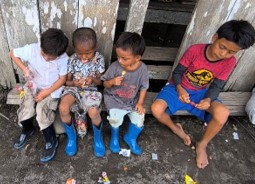
Children of the Amazon.
The Pastaza River was unforgiving — its strong current churned in whirlpools where tributaries converged. It claimed the lives of anyone who failed to respect its power. Fortunately, our driver was skilled, expertly navigating rapids and rocky sections. At times, members of our team jumped into the river to help guide the canoe through rough waters, their spirits high despite the challenge.
Upon arriving in these communities, we were welcomed by children who had been eagerly awaiting our visit. Since Christmas isn’t observed here — no trees, decorations, nativity scenes, or festive greetings — we make every effort to respect their traditions. None of our packages reference Christmas; instead, this is simply about bringing gifts and honoring their way of life.
I was struck by the children’s joy and excitement. Although I’ve visited many Shuar communities, this was my first time among the Achuar, who live deeper in the jungle, more isolated from outside influence. Yet the children’s hopes and longings were no different than those in other places. Few owned shoes, and there were almost no toys. One little boy had a plastic airplane, which he shared generously with the others — an item he could relate to because a plane lands on their small airstrip once a week, delivering supplies and transporting those needing medical care.
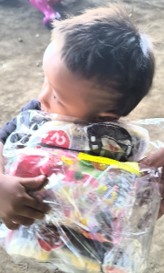
A child hugs his gift.
Here at Hogar de Esperanza in Cuenca, we often receive individuals from Amazon communities who travel for medical appointments. Their diet largely depends on yuca and plantain, and dwindling wildlife and fish stocks contribute to malnutrition. Increasingly, we see premature babies and infants with deformities or severe health issues arriving from the Amazon. Our organization provides a vital link of support for these communities, helping them navigate the complexities of the city and ensuring they receive the care they need.
As we called each child’s name, something extraordinary happened. Some kissed the label on their gift, some hugged it — sending silent kisses and hugs back to the donor who made this special moment possible. Most of the children immediately pulled on their new boots, then dug into the sweets. Candy is rare here, so they savored every moment. I spoke to three little boys perched on a bench; one handed me his Manicho bar to open, and they chatted excitedly about racing off to play in the mud—once they finished their treats.
Before leaving, we shared a community meal of fish, plantain, and yucca. Then we rode further upriver to another community where children waited for us along the shore. By the time we returned to the port of Copataza, we were exhausted. It had been a long, strenuous journey. As we headed to the car, we paused and looked back. Families along the shoreline waved goodbye. A gentle breeze stirred the trees, and it felt as though the ancestors’ spirits were bidding us farewell as well.
During the drive back, we marveled at how remarkable the day had been, reflecting on the joy we brought to these children — blending our Christmas spirit with their own in a wonderful mix of cultures. We decided that this was not just a trip; it was an experience we would never forget.
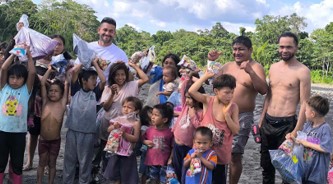
We take a group picture before we go.
When I founded Hogar de Esperanza nine years ago, I envisioned an organization that would be different — a foundation that fully respects Ecuador’s cultural diversity. We see ourselves as a teaching foundation, one that nurtures empathy, understanding, and respect in young people. While I often step back and let our staff handle the hands-on work, I’m proud to see them now taking the lead: planning projects, delivering speeches, and presenting gifts. In fact, Oscar, our patient coordinator, was the driving force behind our recent trip to the Amazon.
As expats, we have so much to offer, yet I believe our most important role is passing on enduring values to the next generation. I’m confident that what these young people learn today will outlive our involvement and continue making a difference long after we are gone.
In recent months, many organizations like ours have faced financial challenges, in part due to power cuts and other factors that have disrupted our operations. Any support you can offer would be greatly appreciated, as it directly helps the Amazon communities and others who rely on our assistance.
Thank you for being part of our mission. Your involvement ensures that we can continue supporting those in need while honoring Ecuador’s rich cultural heritage and teaching valuable life lessons to tomorrow’s leaders.
To support our work, you can make a donation here: https://foundationhogardeesperanza-bloom.kindful.com
__________________
Garry Vatcher is president and founder of Foundation Hogar de Esperanza. He has been coming to Ecuador since 1987 and permanently moved to Cuenca 11 years ago. The foundation provides emergency assistance to thousands of people each year. With his guidance, the foundation has forged alliances with some of Ecuador’s major institutions including hospitals, the National Police, Amazon communities, universities, and governments. The foundation has received numerous awards and recognition for its work from local and international bodies. For information about all Foundation Hogar de Esperanza projects, to to Foundation Hogar de Esperanza go to https://hogaresperanza.org