









World Cup winners correctly predicted by columnist
For reasons of national security, I cannot reveal here the name of the team who will win World Cup 2026. That is classified information that I am sworn to keep secret.
That is the first rule of football prediction. State your ignorance early, before events do it for you. Football has a way of turning experts into weather forecasters, and weather forecasters into philosophers.
But I do have a sure-fire prediction. Whichever team wins this World Cup will have either a player born in France or a player or manager employed at some time by an English Premier League club.
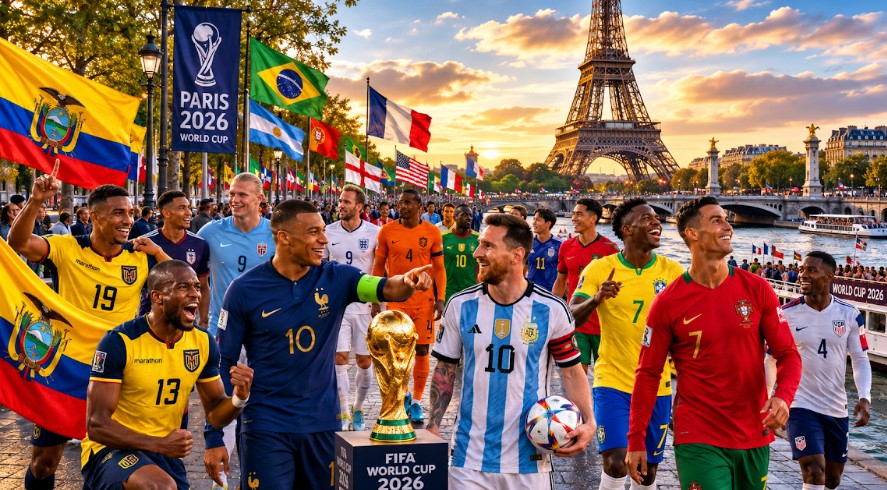 This may sound like cheating. It is, but only in the way leaving home with a sensible umbrella is cheating when the sky is overcast, because modern football is no longer arranged neatly by national borders. It is arranged by academies, passports, television money, migration, and the buying power of the Premier League.
Of the 1,248 players selected for the 2026 FIFA World Cup squads, 99 were born in France, and only 23 will represent France. The other 76 are playing for other nations. No country comes close to producing football talent at this scale.
France is no longer merely a national team. It is the global factory for footballers. Algeria leads the way with 13 French-born players in its squad, followed by Haiti with 12, DR Congo with 11, Senegal with 9, and Ivory Coast with 8. This is no accident. France has built one of the best football development systems in the world, and Paris may now be the most productive football city on earth. Greater Paris alone accounts for 4.3 percent of all players at the tournament, more than any other city or metropolitan area in the world, despite containing less than a fifth of France’s population.
A boy with talented feet can be born in France, trained in France, become a professional footballer in France, Germany, Spain or England, and then represent the country of his parents or grandparents. FIFA’s eligibility rules have made these choices increasingly common, as players with multiple nationalities can represent the country of their birth, ancestry, or residency. In the old, prehistoric version of the World Cup, nations produced their own players in their own soil. This quaint notion has been replaced by the modern version in which France produces players for everybody.
Then there is the English Premier League. The Prem is not just England’s soccer league. It is the world’s richest sorting office for football talent. 182 players linked to 20 Premier League clubs have been selected for the competition, spread across 39 of the 48 competing nations.
And then the other ten nations that have no current Premier League player in their squads still have connections to the league through former players or managers, like Mauricio Pochettino, Argentine manager of the USA team, but also formerly of three teams in the Prem. In practical terms, the Premier League is not just represented by England. It is represented by almost everyone.
Brazil has Prem players and so does Argentina. Spain has Premier League players. Portugal, Germany, the Netherlands — all of them have loads of Premier League players. Manchester City alone leads all Premier League clubs with 19 players selected across 12 different nations, while Arsenal of London are second with players representing England, Spain, France, Brazil, Norway, Belgium, Germany, and Sweden.
This makes my prediction sound less brave, but perhaps more interesting. The World Cup is still presented as nation against nation, flag against flag, anthem against anthem. In reality, the tournament is also a contest between development systems and club economies. France supplies much of the raw material which the Premier League then buys, polishes, and then sends into battle.
Ecuador is one of the best examples of how much the game has changed.
Not so long ago, an Ecuador squad was mainly a domestic squad with a few players abroad. Now the spine of the team belongs to Europe and the wider football marketplace. Moisés Caicedo is at Chelsea, Piero Hincapié at Arsenal, Willian Pacho at Paris Saint-Germain, Pervis Estupiñán at AC Milan, Joel Ordóñez at Club Brugge, Nilson Angulo at Sunderland, and Jeremy Arévalo at Stuttgart.
Kendry Páez, the teenager who was being compared to Lionel Messi before he could legally drive, is now at River Plate in Argentina. Others are spread across the Americas: Enner Valencia at Pachuca in Mexico, Félix Torres and Alan Minda at Internacional and Atlético Mineiro in Brazil, Yaimar Medina at Racing Genk in Belgium, Kevin Rodríguez at Union Saint-Gilloise.
This is arguably the most talented squad in Ecuador’s history, and the numbers from qualifying back that claim: they finished second only to defending champions Argentina in CONMEBOL, conceding just five goals across 18 matches, losing just twice, both times away from home to the only two sides ranked above them. That does not make Ecuador a favorite, but it changes the conversation considerably. Ecuador’s best players are no longer hidden away from the world in a cloudy lost world in the Andes; they are playing with and against the world’s best every week.
This also means that several Ecuadorian players are almost certainly multimillionaires.
That statement might need a little caution. A footballer’s market value is not the same as his bank account. Transfermarkt may say a player is worth €100 million, but that does not mean he has €100 million in the bank, any more than my apartment is worth three months’ rent because I like it. Market value belongs to clubs, agents, and transfer gossip. Personal wealth is another matter.
Still, some cases are obvious. Caicedo moved to Chelsea of London for a British record fee and is on a long contract. Pacho, Hincapié, Estupiñán, and Valencia have all played at levels where a career can quickly become a multimillion-dollar business. A cautious estimate would be that at least a core group of Ecuador’s squad are multimillionaires, and several more may be close. That is remarkable for a country of Ecuador’s size and economy, and it is also a sign that football globalization has reached even those nations once treated as tournament outsiders.
So who is actually going to win the World Cup?
My head says France, Argentina, Brazil, Spain, England, Portugal, Germany, the USA, or the Netherlands. My heart is less obedient. It would enjoy an Ecuador run, if only because it would confuse the people who still think Ecuador is a small Andean outpost with a football team attached. Last night they cracked multiple World Cup finalists and champions, Germany and so they are into the last 32 teams.
But my firm prediction is this: the winner will have either a French-born player or a current or former English Premier League player or manager.
If France wins, the first half of the prediction is too easy. If England wins, the second half is too easy. If Argentina wins, the Premier League is there. If Brazil wins, the Premier League is there. If Morocco, Senegal, Switzerland, the Netherlands, Portugal, Germany, or Spain wins, one category or the other is almost certainly satisfied too.
Somewhere, buried inside the winning squad, there will be the DNA of France or the English Premier League.
That may be less romantic than predicting a score in the final, but it says more about modern football than any tactical breakdown. The World Cup still wears national colors on the surface, but on its undergarments, it wears the couture label of French football academies and English television money.
That is my prediction. And I am pretty sure that regardless of which teams have the skill and good fortune to reach the final, I will be right. Put your money on it.