










Would you rather be safe than sorry?
Two years ago, when Ecuador’s electricity supply began to falter, I approached emergency planning with all the technical sophistication of an antebellum mortician. I bought candles.
This was not entirely foolish. Candles are cheap, require no instruction manual and continue working after the internet goes down. Unfortunately, they are also a fire hazard, provide about enough light to interrogate a prisoner, and are not romantic when candlelit dinners consist of eating cold leftovers during the eighth hour of a power cut.
I progressed to rechargeable light bulbs, small and then bigger UPS units and, eventually, lead-acid batteries connected to inverters. These worked, but they were heavy, awkward and surrounded by cables that gave my apartment the general appearance of a booby trap.
 At the time, many of us were buying whatever we could find. Ecuador’s blackouts eventually lasted as long as 14 hours a day, generators disappeared from stores, and the price of anything containing a battery became extortionate. There was little opportunity for leisurely comparison shopping. The electricity was off, the refrigerator was getting warmer, and the man in front of you had just bought the last rechargeable light bulb in the Feria Libre for $25.
Now we may be approaching the problem again.
The level of the Mazar reservoir has recently been falling as Ecuador enters the dry season. In mid-September it stood more than 11 metres below its maximum level, and the government is already discussing weekly electricity restrictions for the country’s largest industrial users to preserve water in the reservoir — which seems like a pretty good idea.
Officials say household power cuts are not currently planned. That is reassuring, but if you believe that, you will believe anything and rainfall has an unfortunate habit of ignoring government announcements.
The Paute-Mazar hydroelectric complex depends upon water flowing into its reservoirs. If there is not enough rain in the mountains and the reservoir continues to fall, electricity must eventually be obtained from somewhere else on the grid, conserved or cut. Colombia may not always have enough surplus electricity to rescue us, particularly if El Niño is creating problems there as well.
This does not mean that we should prepare for Armageddon. It does mean that September is probably a better time to think about backup electricity than the morning after a programme of eight-hour daily outages is announced and there is nothing in stock for newcomers. Of course you can choose for yourself whether to be safe or sorry,and if you would prefer to be sorry, you can stop reading here.
Batteries have changed
The good news is that preparing for a blackout has become easier.
Two years ago, an economical home battery system often meant buying a large lead-acid battery, an inverter, a charger and enough cable to make you feel that you should have studied electrical engineering.
Lead-acid batteries are still useful. They are relatively inexpensive and can provide dependable backup power. They are also extremely heavy, should not normally be discharged completely, and may have a relatively short useful life if repeatedly drained too deeply.
Modern portable power stations use lithium batteries and combine the battery, inverter, charger, electrical sockets, USB outlets and safety systems all in one box. You can probably guess which country they are made in. Most have a display showing how much power is being consumed and approximately how long the battery will continue supplying it.
Some can be charged from a wall socket in little more than an hour. Many can also accept power from portable solar panels.
They are not cheap, but prices have fallen and competition has increased. I recently received an invoice for a 1048 watt hours Lithium battery portable power station costing $515. The machine itself was charged at zero percent IVA, apparently because it qualified as electrical-generation or energy equipment. Only the $21.74 Servientrega charge attracted the normal 15 percent IVA.
The entire invoice came to exactly $540. For once, the tax system produced a pleasant surprise.
Owners and renters need different solutions
If you own your apartment or house, you may be able to install a comprehensive system with fixed batteries, rooftop solar panels, automatic switching and enough capacity to operate most of the property. Such a system can become a permanent improvement to the home, although condominium rules may limit what can be installed.
Renters face a different calculation, and they are the people for whom this article is principally intended.
Few tenants will want to spend thousands of dollars improving somebody else’s electrical system. Nor will the landlord necessarily permit panels, cables or fixed equipment to be installed. A renter generally needs something reasonably priced, requiring no alterations to the property, which can be unplugged and taken along if and when it is time to move.
That is one of the strongest arguments for portable power stations, UPS units, rechargeable lights and folding solar panels. They do not become part of the apartment. They remain your property, can be assembled gradually and, unlike a rooftop solar installation, will easily fit on the back of a mixto along with your sofa.
Begin with what you want to do
The mistake is to begin by asking which generator or battery to buy.
First you need to ask what you want to keep running.
If your requirements are a router, telephone, laptop, several LED lights and perhaps a television, you do not need a tremendous amount of power. A few small UPS units or a moderately sized portable power station might do the trick.
A router may consume approximately 10 to 20 watts. An LED bulb may use 8 or 10 watts. A laptop might average 40 to 70 watts, depending upon what it is doing. My own 32-inch television appears to use only about 35 watts, although larger televisions may consume considerably more, but even a large modern television may consume only 60 to 150 watts or less.
These modest loads can often be maintained for several hours by a battery holding about one kilowatt-hour of energy.
The problems immediately become apparent when we move from electronics to appliances that (deliberately) produce heat.
An electric kettle may consume 1,500 watts. An air fryer might use 1,200 to 1,700 watts. A microwave, electric stove or space heater can consume a similar amount. An electric clothes dryer can make all of these look positively restrained.
This introduces the two measurements that battery advertisements frequently muddle together.
Watts tell you how much power a unit can supply at one moment.
Watt-hours tell you approximately how long it can supply it.
A portable power station rated at 1,800 watts may be capable of operating a 1,500-watt air fryer. That does not mean it will operate the air fryer all afternoon. If the battery stores about 1,000 watt-hours, a heavy appliance could drain most of it in about half an hour.
A small heater is an even more effective way to convert an expensive battery into an empty box. I have a tiny 400W electric space heater that uses more than ten times as much power as my TV set, so warm socks remain among the most economical forms of emergency heating.
Four kinds of blackout household
The first is the communications household. It wants fiber optic internet, phones, a computer and some lights. This can be managed fairly cheaply with power banks, rechargeable bulbs and UPS units.
The second wants those things plus television and occasional refrigerator operation. A portable power station with roughly one kilowatt-hour of capacity may be appropriate, although the actual running time will depend upon the refrigerator and everything else connected.
The third household wants to cook electrically, heat rooms and operate washing machines. Its needs are much greater. A portable power station may run some of these appliances individually, but it will not run them for long.
The fourth household is determined not to notice that a blackout is taking place. It wants electric cooking, hot water, heating, washing, drying and all the comforts of normal life.
That requires a large fixed battery installation, substantial solar capacity or a fuel-powered generator. It is not something that can be achieved with a box beside the sofa, however impressive the advertisements may be.
Gas cooking has an obvious advantage during electricity cuts. A refrigerator, meanwhile, may remain safely cold for several hours if the door stays closed. Opening it every 15 minutes to see whether the food is still cold is not a recognised refrigeration strategy.
Check the building before buying anything
Apartment residents should also speak to their building administrator.
Some condominium buildings have emergency generators, but this does not necessarily mean that every socket in every apartment will continue working. The generator may supply only the elevators, water pumps, hallway lighting and security equipment.
That can still be extremely valuable. Without electricity, the loss of a lift is inconvenient, but the loss of pumps may eventually mean that the building also loses water.
Residents should ask exactly what the generator powers, how much fuel is stored, how frequently it is tested and how long it can operate.
It is better to discover that the generator supplies only the communal areas before spending a dark evening waiting for your apartment sockets to come back to life.
The lawn mower without a blade
Then there is the traditional small gasoline generator, the machine frequently seen rattling outside shops during power cuts.
It resembles a lawn mower fitted with a Briggs & Stratton engine but deprived of its cutting blade. It produces roughly the same noise, fumes and neighbourhood resentment.
A gasoline generator can supply substantial power for as long as fuel remains available, which gives it an advantage over a battery. It may be a sensible choice for a workshop, remote farmhouse or country property where it can be placed well away from people and secured against theft.
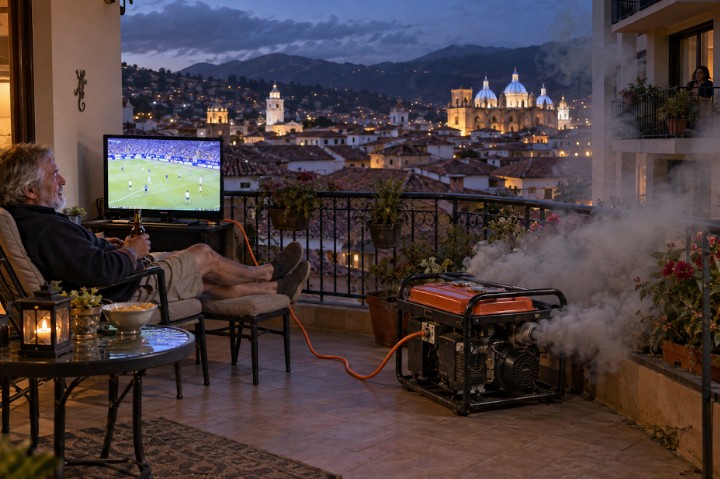
In a Cuenca apartment building or closely packed residential neighbourhood, it presents several difficulties. The engine is noisy, requires fuel and maintenance, and produces exhaust fumes containing deadly carbon monoxide. It must never be operated indoors, in a garage, in a stairwell, on an enclosed balcony or close to doors and windows.
Even if operated safely outside, your neighbours may not appreciate listening to a lawn mower for eight hours while you watch television. Nor should a portable generator be left unattended on the sidewalk or garaje area. Unless it is securely chained to something more substantial than itself, it may be providing emergency electricity to another household before the first 24 hours have elapsed.
A fuel generator can therefore be extremely useful in the right surroundings. The middle of a condominium complex is unlikely to be those surroundings.
Solar panels are useful, but not magical
For most apartment dwellers, portable solar panels may be more neighbourly.
They can extend the usefulness of a battery system, particularly during a prolonged emergency. Cuenca’s strong Andean sunlight can produce useful amounts of electricity, and a folding panel can sometimes be placed on a terrace or balcony and stored when it is not required.
But the number printed on a solar panel is its maximum output under favourable conditions. Clouds, shadows, the angle of the panel and the movement of the sun all reduce production. A 200-watt panel will not quietly generate 200 watts from dawn until dusk merely because it says so on the box.
Apartment residents may also discover that the sun is on the wrong side of the building. A magnificent view of Cuenca is not necessarily a magnificent source of solar electricity.
Solar charging is best regarded as a way to replenish essential power gradually, not as a guarantee that the air fryer can continue producing crispy roast potatoes through the collapse of the national grid.
Buy time, not electricity
A backup system does not necessarily need to reproduce normal life. Its real purpose is to buy time.
It can keep you connected, provide light, charge a phone and prevent a few hours without power from becoming a household crisis. Larger systems can add refrigeration and occasional cooking, but each additional comfort increases the cost.
My own solution has developed in layers. Small UPS units can keep the router operating and charge phones or lights. A larger portable power station can handle computers, television and selected appliances. The refrigerator can usually remain closed, and the gas stove does not care whether Mazar is full or empty.
Two years ago, I began with candles and worked my way towards a collection of heavy batteries and mysterious wires. Today, far better equipment is available in a single box. You might, however, consider getting two boxes, a larger and a smaller, if you can afford it. The reason is that your fiber optic wifi router is probably in a fixed location in your home, perhaps in a hallway, so putting a battery unit right next to it may avoid having cables running all over the place. It may also be useful to have one smaller unit that can easily be moved around as needed.
The available technology has advanced a bit since two years ago, but the basic laws of electricity have not. Before buying anything, decide what must remain on, what would merely be convenient, and what can wait until the light comes back on.
The first category is often much smaller than we imagine. The last includes the clothes dryer.