
















Your plan for when Social Security goes broke
If you are living in Ecuador on a Social Security check of, let’s say, $2,000 a month, the arithmetic is reassuringly simple. The money arrives in dollars, your rent may be $400 or less, an almuerzo can still be found for about $3, and no foreign-exchange dealer takes a bite out of your income. As a single person, you can probably live pretty comfortably on a budget of $1500 per month, or maybe less.
Now subtract $440 from that monthly check.
Your income has fallen to $1,560, but your rent has not fallen, Supermaxi has not reduced its prices by 22 percent, and your dentist has not volunteered to remove every fifth tooth free of charge.
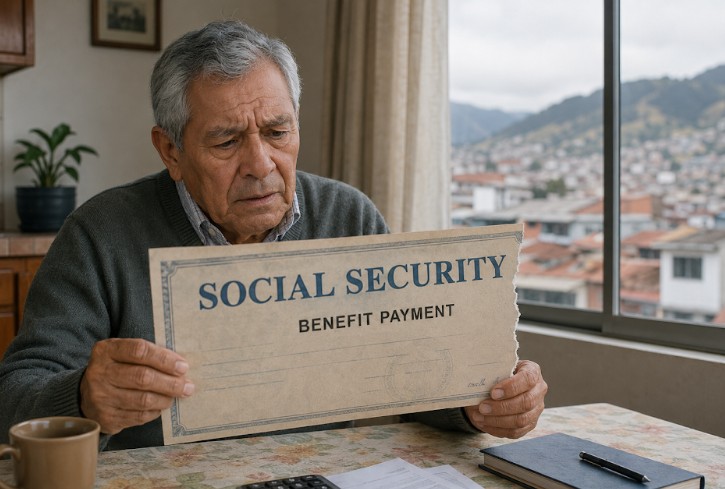 That is the practical meaning of the approaching Social Security shortfall.
It does not mean that Social Security will go broke in 2032, close its doors and stop sending checks. It does mean that, unless Congress changes the law, the program may no longer collect enough money to pay all the benefits it has promised.
For an American retiree living entirely on Social Security in Ecuador, this is not an abstract argument about Washington accounting. It is a potential household emergency with a date attached.
Two funds and two dates
Social Security is commonly discussed as if it were one enormous pension fund. Technically, it consists of two trust funds.
The Old-Age and Survivors Insurance fund, known as OASI, pays retirement and survivors’ benefits. The Disability Insurance fund, known as DI, pays disability benefits.
According to the official 2026 Social Security Trustees Report, the retirement and survivors’ fund is expected to exhaust its reserves during the fourth quarter of 2032. Payroll taxes would then be sufficient to pay about 78 percent of scheduled retirement and survivors’ benefits.
The disability fund is in much better condition and is projected to retain reserves throughout the report’s 75-year forecast.
If Congress changed the law to allow the two funds to be treated as one combined fund, their reserves would last until 2034. At that point, incoming revenue would cover about 83 percent of all scheduled benefits.
This is why one headline says 2032 and another says 2034. Neither is necessarily wrong. They are describing two different calculations.
For a retired person, however, 2032 is the date that deserves attention. Under the law as it now stands, money cannot simply be transferred from the disability fund to rescue the retirement fund without congressional approval.
Depleted does not mean empty forever
Social Security is mainly a pay-as-you-go system.
Current workers and their employers each pay 6.2 percent of covered wages into Social Security. Self-employed workers pay the full 12.4 percent. Most of that money is used to pay current beneficiaries.
During years when Social Security collected more than it needed, the surplus went into its trust funds and was invested in special United States Treasury securities. Those securities are sometimes dismissed as government IOUs, as though the money had been exchanged for a note scribbled on the back of a cocktail napkin. In fact, Treasury securities are legal obligations of the United States government.
The problem is that Social Security is now spending more than it receives. In 2025, the combined trust funds took in about $1.45 trillion and spent approximately $1.61 trillion. The difference was covered by drawing down the accumulated reserves, which fell to about $2.56 trillion.
At some point, if nothing changes, the reserve cupboard will be bare. Payroll taxes will continue arriving because Americans will continue working, but the incoming money will not be enough to meet all scheduled benefits.
Social Security will therefore not be broke or bankrupt in the ordinary sense of having debts but no income. It will be more like a household receiving $780 per month while having outgoings of $1000 per month.
That is considerably better than receiving nothing, but it is not a distinction likely to cheer the person who must decide which $220 of monthly expenses to eliminate and which birthday and Christmas gifts to eliminate.
Where did the money go?
It was not stolen by Congress, given to foreign countries or spent on some unrelated federal program. The trust funds invested their surpluses in Treasury securities, collected interest and are now redeeming those securities to pay benefits. That was how the system was designed to operate.
The real difficulty is demographic.
In 1960, there were about 5.1 covered workers for every Social Security beneficiary. By 2024, there were only about 2.7. The baby-boom generation is retiring, people generally live longer than they did when the system was created, and birth rates have fallen.
Social Security must therefore support more retired people for longer periods using contributions from proportionately fewer workers.
Immigration can add younger workers and improve the arithmetic, but it cannot by itself eliminate a shortfall of this size. Greater productivity and higher wages would help because payroll-tax revenue would rise, although future benefits are also related to earnings. There is no painless demographic miracle waiting backstage.
What would a reduction mean in Ecuador?
A 22 percent reduction would lower a $1,500 monthly benefit to $1,170. A $2,000 benefit would fall to $1,560, and a $2,500 benefit to $1,950.
The eventual reduction might not occur in precisely that form. Congress could change the law, and even the administrative method of handling a sudden shortfall could become the subject of litigation. The 78 percent figure is a projection of the money available, not a personalized notice announcing exactly what every retiree will receive.
Nevertheless, the calculation shows the scale of the danger.
Living in Ecuador provides some protection because housing, public transportation, restaurant meals and many personal services cost less than they do in the United States. It does not provide comprehensive insurance from the laws of arithmetic.
Ecuador uses the US dollar, so there would be no favorable exchange-rate movement to soften a federal benefit cut. Imported food, medicine, appliances, airline tickets and many private medical services are tied directly or indirectly to US prices.
A retiree living only on Social Security may also have fewer fallback options than someone living in the United States. Supplemental Security Income, or SSI, is a separate means-tested program and generally cannot be collected while residing abroad. Medicare provides very limited coverage outside the United States. Returning to America after years in Ecuador might mean confronting rents of $1,500 or $2,000 with a reduced Social Security check and no established home.
An expatriate can live well on less in Ecuador, but he cannot necessarily recover from a sudden permanent loss of one-fifth of his income.
Annual cost-of-living adjustments would continue under present law, but they would not repair the original cut. If a $2,000 check were reduced to $1,560 and later received a 3 percent COLA, it would become about $1,607, not $2,060. The escalator would continue moving, but from a much lower floor.
What can Congress do?
There are only three basic choices: collect more money, promise less money or combine the two.
One option is to raise the 12.4 percent Social Security payroll tax. The American Academy of Actuaries calculates that an immediate increase of about 3.65 percentage points, divided between workers and employers, could finance scheduled benefits for 75 years under the assumptions it used. That would take the combined rate to approximately 16.05 percent.
Another option is to raise or remove the ceiling on wages subject to Social Security tax. In 2026, the tax applies only to the first $184,500 of earnings. Someone earning $1 million therefore finishes paying Social Security tax long before reaching the end of the year.
It sounds obvious to tax all earnings, but the details matter. Social Security traditionally links taxable earnings to benefits. Congress would have to decide whether people paying additional tax should earn additional benefits, receive only limited additional benefits or receive none at all.
Congress could also gradually increase the full retirement age, alter the formula for new benefits, use a less generous inflation measure or reduce payments for higher-income retirees. Raising the retirement age is effectively a benefit reduction, even when it is presented as recognition that people are living longer. It also falls more heavily on workers in physically demanding occupations and on groups with shorter life expectancies.
No single proposal is politically painless. That is why Congress has perfected the strategy of discussing Social Security reform urgently while postponing it indefinitely.
Haven’t we been here before?
Yes. Social Security approached a financing crisis in the early 1980s. President Ronald Reagan and House Speaker Tip O’Neill, who agreed on very little else, accepted a bipartisan rescue package in 1983.
The legislation accelerated previously scheduled payroll-tax increases, gradually raised the full retirement age, brought newly hired federal employees into Social Security and subjected some benefits to federal income tax.
The rescue was intended to provide long-term stability, but “long term” is not the same as forever. Forty-nine years will have passed between the 1983 legislation and the projected 2032 depletion date. That is not evidence that the earlier rescue failed. It is evidence that pension systems require periodic adjustment as populations and economies change.
The encouraging conclusion is that Social Security can be repaired again. The discouraging conclusion is that every year of delay makes the repair more painful.
Changes introduced now could be phased in, protecting current retirees and giving younger workers time to adjust. Changes made in 2032 would have to take effect much more abruptly. The official 2026 report puts the combined program’s 75-year actuarial deficit at 4.42 percent of taxable payroll, substantially worse than the 3.82 percent estimated only one year earlier.
Will Congress really allow the cut?
Probably not, but “probably” is a poor foundation for a retirement budget.
Older Americans vote in large numbers. Tens of millions depend on Social Security, and any member of Congress who permitted an avoidable 22 percent reduction would have an interesting conversation at the next election.
More likely, Congress will eventually assemble a package of tax increases, benefit adjustments and transfers between the two trust funds. Current beneficiaries, particularly those with modest incomes, may be protected. Politicians could also wait until the last possible moment and pass a temporary measure that moves the crisis a few years down the road.
What retirees should not do is assume that living abroad makes them invisible to any reduction. Retirement benefits earned in the United States do not become more secure because the recipient’s bank account happens to be in Cuenca.
Nor should anyone panic, sell possessions or book a flight back to Miami. These are projections, not payment notices, and Congress has several years in which to act.
But a retiree who depends entirely on Social Security should follow the debate, maintain whatever emergency reserve is possible and avoid arranging permanent expenses that consume every dollar of the present benefit.
Social Security is not going to disappear in 2032. That comforting statement is true, but the less comforting truth is that receiving 78 cents of every promised dollar is not the same thing as being paid in full.
The central figures in this article come from the 2026 Social Security Trustees Report and the accompanying Social Security Administration release.



Hogar Esperanza News

Fund Grace News

Fabianos Pizzeria News

The Cuenca Dispatch

Week of October 25

Ecuador heads into a four-day November holiday built around Cuenca’s Independence Day.

El Niño’s early rains have already affected more than 30,000 people across Ecuador.

Exporters press Constitutional Court to move three major trade agreements forward
Manabi property
