


















City council votes to repeal rural land use ordinance following protests; New security law challenged in court; Economy grows 3% in first quarter
The Cuenca Municipal Council on Friday night voted to repeal the Ordinance Controlling and Sanctioning the Use and Occupation of Land. The 11 to five vote will be reconsidered in a second debate before it becomes final.
The vote followed Mayor Cristian Zamora’s agreement to reconsider three rural land use ordinances following recent protests, including the 24-hour roadblock by protesters of the Cuenca-Guayaquil highway.
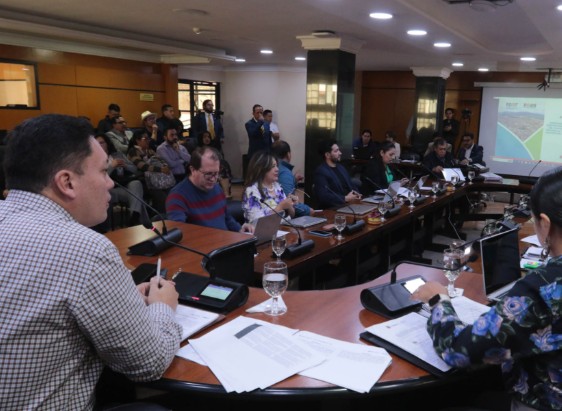
Mayor Cristian Zamora presided at the municipal council meeting Friday night.
The three ordinances cover a wide range of issues, including lot sizes, permitting of building projects, geological restrictions, taxation and penalties. Activists claim the ordinances are unfair and reflect urban over rural interests.
During Friday’s debate, some council members argued that repealing the ordinances would allow a building “free-for-all” in rural areas, “By law, the city of Cuenca is obligated to provide services to rural locations in the canton and if structures are poorly constructed and located in areas unsuitable for building, the city will pay a price,” José Fajardo argued. “Rules can be changed and modified but they should not be thrown out entirely.”
It is unclear when the two other ordinances will be debated by the council. Protest leaders in rural communities say they will organize more protests, including roadblocks, if their demands are not met.
New security law challenged in court
The National Solidarity Law, which grants the government new authority to monitor and investigate private communication and other activities of residents if it suspects criminal motives, is being challenged in the Constitutional Court.
A suit filed by Gabriel René Salvador, a private citizen, claims the law “violates fundamental principles of the Constitution and International Humanitarian Law.” The law, supported by President Daniel Noboa, passed the National Assembly last week.
The case has been assigned to Constitutional Court Judge Teresa Nuques, who will analyze the lawsuit and determine if it should be considered by the full court.
The suit argues that the law violates the principle of constitutional supremacy by granting exceptional powers to the president. In addition, it claims that it combines “unrelated elements without a logical connection,” such as national security, presidential pardons and tax incentives, in violation of constitutional and National Assembly rules.
Plaintiff Salvador also rejects the recognition of the state of “internal armed conflict” as defined by Noboa. “Ecuador is a signatory to the International Humanitarian Law, supported by the 1949 Geneva Treaty, which does not recognize such a conflict,” the suit maintains.
Economy grows 3% in first quarter
The Central Bank of Ecuador reported better-than-expected 3% GDP growth in the first quarter of 2025. According to Guillermo Avellán, general manager of the bank, the number reflects a rebound in household consumption from late 2024 when the country suffered daily electric blackouts.
Avellán reported that the growth is “especially impressive” since the economy had to overcome the effects of lower oil sales and the lower international oil prices. “Based on preliminary numbers we believe the improvement has continued into the second quarter and will hold steady throughout the year,” he said.