

















Going through the trees
A curious thing happens when North Americans arrive in Cuenca. Within the first week someone will tell you that crossing the street here feels dangerous because there are no jaywalking laws.
The assumption behind this remark is perfectly logical. If the United States has laws against crossing the street outside marked crossings, then the United States must be safer for pedestrians than a city like Cuenca where people wander across the road whenever a gap appears between taxis.
The difficulty with this tidy theory is that it does not appear to be true.
In fact, the United States has several times the pedestrian death rate of many countries where crossing mid-block is perfectly normal behavior. Drivers in those countries tend to assume that human beings will behave like human beings and step into the road when it suits them, which produces a useful habit of caution that no ordinance can easily replicate.
 In Cuenca the process is simple. You look left, you look right, and you begin crossing with the confidence of someone who has no intention of dying in front of a yellow Kia taxi.
Visitors sometimes interpret this as chaos. Residents interpret it as Tuesday.
The idea that pedestrians once owned the street is not as strange as it sounds. The word “jaywalker” itself was originally an insult, promoted in the 1920s by automobile interests in the United States to persuade lawmakers that anyone crossing outside a painted line was a fool who deserved what happened to him.
Before that campaign, streets in many places functioned more like the streets of Cuenca do today. People crossed where it was convenient, carts and vehicles moved around them, and everyone understood that the road was a shared space rather than a racetrack.
My own family encountered the early motor age from the other side of the equation.
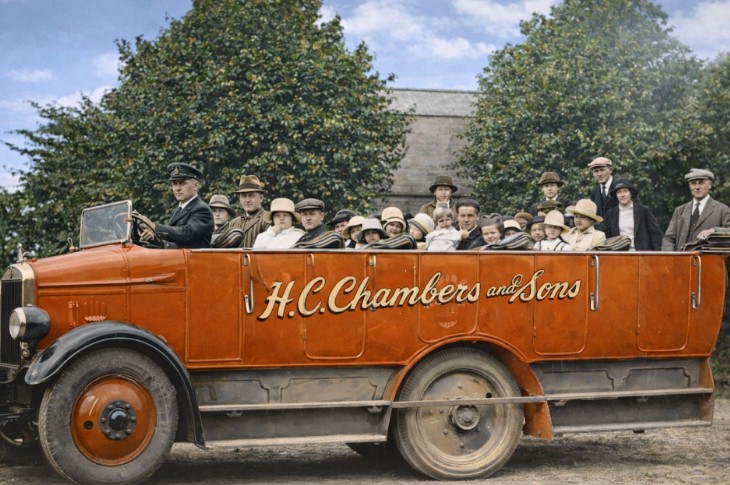
My great-grandfather ran a small business in England renting horses and carts. After the First World War he purchased a surplus ambulance on the cheap, removed the medical fittings, installed wooden benches, and began running what might generously be called a bus service that took people into town for weekly shopping, or sometimes to the seaside for a day at the beach, as shown in the image provided above.
The company was named H.C. Chambers and Sons, which was accurate because the sons drove the buses while grandpa Chambers wore a top hat, coordinated the timetables with his pocket watch, and made regular deposits at the bank with weighty sacks of copper coins. The family were devout Baptists, so no buses ever ran on Sundays and this was still very much the case until at least 2012 when the company was sold to a regional operator.
By about 1940 my grandfather, a pharmacist by trade, was driving one of those vehicles when a tragic accident occurred in which a school child was killed. I do not know the precise details of the incident, but people have told me that he was never quite the same afterward. He died five years later of a stroke at the age of forty-nine, several years before I was born. He was a Baptist lay preacher and there was no psychological counseling in those days. There was simply the rest of your life and then the grave and that was your lot.
Road deaths were not exactly rare events in mid-century Britain. One of my sister’s friends, a twelve-year-old twin, was killed by a bus about one hundred yards from our house during the brutal winter of 1963 when ice covered the roads for weeks. Many years later I found myself working alongside the surviving twin sister, which made me wish that there were still two of her, since she was dating a friend of mine.
On another occasion five teenagers from our village were all killed in a head-on crash one winter’s night, which was very upsetting.
When I think back to that period, I realize how many young people I once knew who did not reach the age of thirty. The recipe was usually simple enough to describe: narrow roads, winter ice, and a pub closing time with alcohol deserving an honorable mention.
I do not mean to sound melodramatic about this. It was simply the world we lived in. Cars were becoming common and affordable, especially if they were old and had dicey braking systems, drink-driving laws were weak until the breathalyzer arrived in 1967, and winter roads in northern England could resemble skating rinks with unyielding dry-stone walls waiting patiently when a rabbit, hedgehog, stoat, or stray sheep jumped into your headlights on a cold night when there was what we called ‘black ice’ forming on the roads.
Later, when I was working in Bermuda, I encountered a local expression that summarized a similar problem rather efficiently. If a motorcyclist had been riding too fast on one of the island’s narrow roads where the speed limit was 20 mph and failed to correctly negotiate a bend, someone would invariably remark that he “went froo de trees,” which meant that the rider had left the road and met his end in an oleander grove.
Looking back, I sometimes think a surprising number of us survived, which may explain why I now find myself living in a city where the coldest local hazard is a mildly confused expat standing at a traffic light wondering whether he is allowed to step into the road.
Here in Cuenca there is no ice, very little or no snow, occasional hail, and a general understanding that if a pedestrian begins crossing the street he probably intends to reach the other side.
It is not a perfect system, but it has a certain philosophical elegance.
And for someone who grew up in a place where winter roads and late-night beer carried off so many childhood friends, the absence of ice alone feels like a very sensible civic policy.