










An expat: To be or not to be
This article is part of “Facelift Ecuador: Share Your Positive Story!“, an initiative to publish positive articles from CuencaHighLife readers. If you would like to submit your story, click here.
By Lorenzo
 I came to Ecuador in 1977 as a Peace Corps volunteer. I worked with an Ecuadorian counterpart as an agricultural agent in San Joaquin outside of Cuenca. I rented the bottom floor of an adobe house for $20/month (500 sucres) close to Baños.
Back then, the landscape was open pasture, cornfields, and eucalyptus forests with an occasional adobe dwelling scattered in between. Times have changed! There was no electricity back then. We lit candles at night and hung meat on a wire to cure in the sun. Without lights to block the view, star gazing was awesome. I was up on the mountain one night with some friends when we looked south and spotted the Southern Cross bigger than life. It was an emotional experience I will always remember.
There was no running water. Rainwater was collected off the roof into large concrete tanks for drinking and cooking. Water from scattered open wells was also used for cooking if you didn’t mind finding an occasional tadpole in the soup. I drank Guitig. I would rotate between the bath houses in Cuenca and Baños to shower. Everyone else bathed and washed clothes in the cold Yanuncay River.
In those days, gringos in Cuenca were a rarity. Ecuadorians were curious, but friendly as they are now and it wasn’t hard to integrate into the community. Everyone called me “Meester”. Folks would ask questions that I and my Spanish dictionary would try to answer. It was a great way to learn Spanish. My partner in San Joaquin wrote a letter requesting an extension of my service from two years to three. The request was granted.
In that third year I married the girl next door. Was it fate? Or was it the love potion that so many think her mother sprinkled in my food? We returned to the U.S. I found my career. My Ecuadorian wife learned English. She became a U.S. citizen. She finished a four-year degree in education and became a Spanish teacher in the public school system. I was very proud. We raised four children and now have a bunch of grandkids. They all live there and not here. We live here most of the time. We built a house two lots down from where I lived as a PC volunteer. We go back to our home in the States for a couple months twice a year.
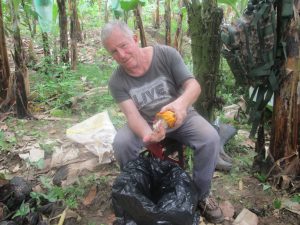
I don’t consider myself an expat. We still own our home in the U.S. I feel as connected there as I do here. After we become really old we will probably spend more time there because it’s more comfortable/convenient for old folks than in Ecuador. In the meantime, we thoroughly enjoy our life in Ecuador. I like the challenge of speaking Spanish. It’s a beautiful language. Living in a community of mostly family members guarantees constant drama. It’s entertainment for me – not so much for my wife. She enjoys tending her year-round vegetable/flower garden. She also raises egg laying hens. We go down to the coast twice a month to cultivate cocoa on land we inherited and bought outside of Machala. We lease the rest to a banana grower.
I enjoy shopping in the markets where truly fresh fruits and vegetables are found. The “almuerzo” is one of the greatest of human inventions. I like the fact that I can be up in the mountains, hop a bus going east or west and several hours later be in a totally different environment – different weather, different food, different flora/fauna, different dialect/customs. Variety is the spice of life.
A lesson I’ve learned from living in Ecuador is to “roll with the punches/go with the flow”. Things seldom go according to plan – beginning with folks not showing up on time. Somehow the magic makes it all work in the end — every time. Once I found myself in front of an immigration officer as she pointed out my expired visa (my fault – long story). I jokingly asked her if I was going to jail. She smiled (as only an Ecuadorian senorita can smile) and told me, “In Ecuador there is always a solution.” That has been my motto ever since.