















As he makes deals with China, Noboa performs a ‘balancing act’ not to upset relations with the U.S.
Diplomats and economists are complimenting President Daniel Noboa for expanding Ecuador’s relationship with China in Tuesday’s meeting with Chinese President Xi Jinping. On Wednesday, Noboa met with other Chinese officials, including Zhao Leji, chairman of the National People’s Congress.
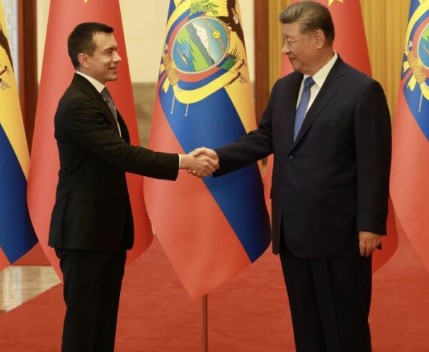
President Daniel Noboa with Chinese President Xi Jinping before Tuesday’s meeting in Beijing.
“He recognizes the growing economic power of China and knows that China will soon be Ecuador’s major trading partner,” says Julio José Prado, former Production Minister. “Like most of us, he sees China’s economic influence rising as that of the U.S. declines.”
Former Ecuador ambassador to the U.S. Francisco Carrión also praised the government’s warm approach to China but says there must be a “balancing act” not to upset relations with the U.S., especially regarding security issues. “We have made agreements with the U.S. involving the fight against international drug trafficking and these could be put at risk if the U.S. government objects to any of the projects China and Ecuador are announcing.”
On the other hand, Carrión insists that it is Ecuador’s right to work closely with any country where it sees benefits to its interests. “In several recent matters, Ecuador has appeared to approach the U.S. government on bended knee and acted with submission. We should demonstrate more self-respect and act as a sovereign nation.”
He added, “So far, President [Donald] Trump has not invited Noboa to the White House while China rolled out the red carpet for him.”
Economist Po Chun Lee sees few negative consequences of Noboa’s meetings with Xi Jinping and Zhao Leji. “There are no military agreements coming out of these meetings that would threaten the North Americans. All agreements are commercial in nature,” Lee says.
“One issue that could potentially raise alarms with the U.S. are discussions to develop a digital currency system in Ecuador, but this is the international trend, and I don’t see the U.S. standing in the way,” Lee says. “A second issue is the introduction of Chinese artificial intelligence in Ecuador, but this is an area where Ecuador has the right to choose the systems and vendors of its choice.”
A key factor in expanding relations with China, says Prado, is that China has money to invest overseas. “The talks currently underway include major infrastructure projects in areas of power generation, hospitals, highways and mining,” he says. “The U.S. offers no real investments and given its massive national debt and engagement in foreign wars, it probably cannot afford to.”
Prado adds. “I think the government is wise to acknowledge the winds of change and to recognize China’s increasing importance in the international economy.”



Hogar Esperanza News

Fabianos Pizzeria News

Fund Grace News

Property Amazon

Property Kuralt

The Cuenca Dispatch

Week of August 16

Azuay stays under state of exception as authorities track criminal groups expanding around Cuenca.
Older adults and people with disabilities can now request vehicle tax break online.

That unresolved bank complaint has another place to go and the service is free.