















Dollarnomics 101 for gringos: Why dollars behave differently in Ecuador than they do in the U.S.
The other day an expat retired engineer at my patio de comidas table told me he did not understand why Ecuador’s interest rates never budge when the Fed raises its own. In that moment I realized most of us brought our dollars here without quite knowing how they behave once they land.
Many gringos now living in Ecuador grew up assuming that money just sort of appears when the economy needs it. Back in the States, that is mostly true: U.S. banks lend out dollars they do not really have, and the Federal Reserve can conjure up new ones with a keystroke. In other words, the US government can literally print money, but Ecuador’s government cannot.
 The balance of payments, that important national accounting of what comes in and what goes out, and which is so crucial to island economies, is something most Americans never bother to think about, but it is Ecuador’s household ledger: dollars earned from exports, remittances, and visitors on one side, dollars spent on imports and travel on the other.
When more dollars leave than arrive, the whole system loosens like a belt with no new holes, and before long the economy starts drooping, and showing cracks, like a trasero de plomero.
When Ecuador switched to the U.S. dollar back in 2000, it was like moving into a rental house with four sturdy walls and no spare keys. The place does not fall with every gust of wind, but the rental contract says that you cannot install a new toilet or change the decor without the landlord’s permission. The landlord, in this case, lives in Washington, D.C. in a pillared palace with marble floors that is called the Federal Reserve.
Dollarization stopped the hyperinflation that once made prices change faster than the dollar dials on a gasoline pump. It turned the old currency known as the sucre into a memory and brought calm after years of chaos. But calm has a price: Ecuador no longer controls its own money supply. The dollar landlords of the Federal Reserve do.
That means Ecuador’s banks cannot simply create new dollars by lending the way U.S. banks can. In the United States, a mortgage is more than a home loan, it is new money conjured out of the ether, thanks to confidence that replayments will be made, and laws and regulations.
In Ecuador, every dollar lent must already exist somewhere: earned from exports, wired home by migrants, spent by tourists, or borrowed from abroad, or deposited in banks by expats. The system is mostly safe, but the money supply is tight, because the banks cannot create new money out of thin air–air that is very thin anyway, at 8000 feet.
Fortunately, one of Ecuador’s strengths is the steady flow of dollars sent home by its citizens working overseas. In 2023 those remittances reached roughly five and a half billion dollars, nearly five percent of the nation’s GDP, or about $300 per person.
For many families those incoming dollars mean food on the table, tuition paid, or a new roof and for the Ecuadorian banking system they mean fresh liquidity, a regular top-up for the national dollar jar. Alongside oil revenue and tourism, these returning dollars are the lifeblood that keeps credit circulating.
Panama solved its dollar problem long ago by becoming a kind of international dollar pump. Its banks pull dollars in from all over the world and push them back out as loans. Ecuador’s banks, by contrast, live on a local drip feed of oil, remittances, and cautious savers. When that inflow slows, say oil prices drop, or migrants send home less when they are kicked out of the US, there are simply fewer dollars kicking around for the banks to lend out.
And when dollars leave the country, they rarely come back quickly. Every imported pickup truck, bottle of Scotch, or online order from Amazon or Temu sends hard currency out and creates a small vacuum at home. Even Western Union remittances, the great safety valve of the economy, cannot always fill the gaps.
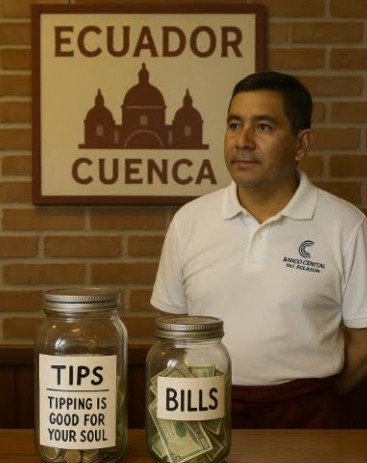
So when economists talk about liquidity, what they really mean is how many dollars are left in the jar. Ecuador’s tip jar is clear glass, everyone can see when it is half empty. The government cannot print its way out, and the banks cannot multiply what is not there. Expansion depends on keeping the dollars flowing in faster than they leak out.
And here is why expats are so valuable to Ecuador: they bring in foreign income but spend it locally.
Every pension payment, Social Security check, or overseas transfer goes straight into rent, groceries, taxis, and healthcare. That money doesn’t leave the country again, it pays the plumber, the landlord, and the woman selling fruit in the market. Unlike large-scale tourism or mining, there’s no middleman taking a cut or shipping profits abroad.
Expats help steady the housing market, keep small businesses alive through the slow season, and support jobs in everything from dentistry to delivery apps. In short, they are an invisible export earning hard currency for Ecuador without exporting anything at all.
That is why your landlord prefers you to pay your rent in cash and your plumber tucks bills into his back pocket, they all know about the two jars. Prices stay steady, and nobody wakes up to find their savings worth half as much. But growth comes by invitation only.
To grow faster, Ecuador needs more tourists, more exports, more investors, or more expats with juicy pensions and stock market accounts.
But every dollar that leaves the country or is skimmed off by Visa, Mastercard, or Uber shrinks the economy imperceptibly but inexorably.