















Ecudador’s best retirement city
People often ask me why I chose Cuenca, and they usually expect the answer to involve the colonial center, the mild climate, the lack of mosquitos, or the comparatively low cost of living. Those things certainly helped persuade me, but after several years here, and after traveling through much of the rest of Ecuador, I have gradually reached a different conclusion. What sets Cuenca apart from almost everywhere else I have visited is not that it is the prettiest or the cheapest place in the country. It is simply that it is easy to get around in Cuenca.
That may not sound like high praise until one reaches retirement age. Younger people are drawn to excitement, opportunity, and nightlife, but older people start to value other things. They want a city where the ordinary business of living, visiting a doctor, buying groceries, meeting friends for lunch, catching a bus to another province, can be done without turning the errand into an expedition. Having spent time in Quito, Guayaquil, Manta, Machala, Azogues, Otavalo, Salinas, and even the Galápagos Islands, I keep coming back to Cuenca with a growing appreciation for how efficiently the place actually runs.
 The first thing that becomes apparent is the transport system, which is unusually good by Ecuadorian standards. The tram runs through the center and links the bus terminal and the airport to the beltway, the bus network covers most of the city, taxis are plentiful and startlingly cheap, and a beltway diverts much of the through traffic away from the historic center.
None of these features would impress on their own, but together they make it genuinely possible to get from almost any point in Cuenca to any other quickly and cheaply. I have not found that combination anywhere else in the country.
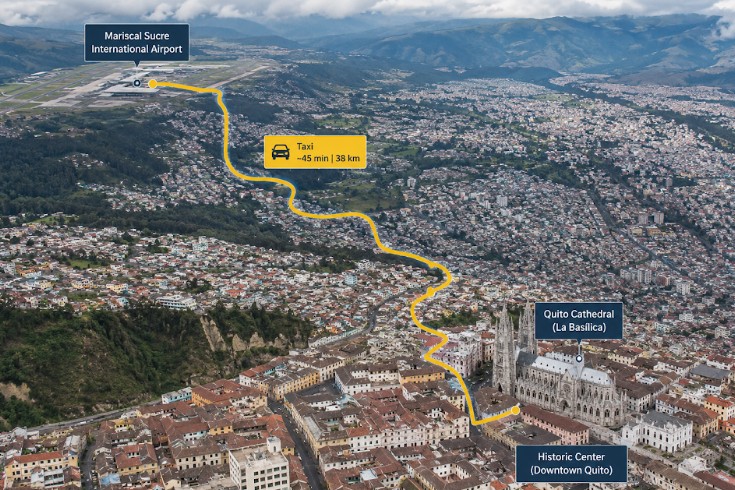
The airport tells the story better than anything else I can point to. A taxi from Cuenca’s airport to the city center costs about a dollar fifty and takes a few minutes.
Fly into Quito instead and the same journey from the airport can eat an hour of your day and twenty dollars of your budget, assuming the traffic on the Panamericana is behaving itself, which it rarely is. For a retiree arriving with suitcases and jet lag, that is the whole argument in miniature.
Quito illustrates the wider point well. It is a magnificent city, with dramatic scenery, a rich history, and museums that reward repeated visits, but it stretches for mile after mile along a narrow valley pinned between mountains. Crossing town often means a long crawl through traffic, and the altitude alone can turn a modest walk into a genuine test of stamina for visitors and retirees alike.
Guayaquil has the opposite problem. It is flatter, larger, and economically vigorous, but tropical heat, humidity, and traffic noise and fumes conspire to make even short trips exhausting. Both cities have real strengths, but neither offers the effortless mobility that makes daily life in Cuenca so pleasant.
The same holds for Ecuador’s smaller destinations. Manta benefits from its position on the Pacific coast and has built a growing expatriate community, but it has always struck me as considerably pricier than Cuenca, and the smell from the fish-processing plants when the breeze comes off the ocean occasionally reminds visitors that this is, first and foremost, a working port.
Otavalo has one of the continent’s most celebrated indigenous markets and spectacular scenery, but it remains a market town whose services reflect its size. Machala has prospered on bananas, and Azogues has its own understated provincial charm, but neither offers the range of facilities that many retirees eventually come to need or want.
One of Cuenca’s lesser-known advantages is how much is packed into a compact area. The city has several modern shopping malls, countless supermarkets, banks, pharmacies, and restaurants, along with a proper intercity bus terminal and an airport with regular flights to Quito and a few to Guayaquil. It also has universities, specialist clinics, and major hospitals: the kind of institutions younger people rarely think about but that matter more with every passing year. Retirement has a way of reminding you that a city should be judged not just by how it treats you on a good day, but by how it treats you on a bad one.
Then there are the four rivers, which deserve more credit than they usually get. Rather than vanishing behind warehouses, concrete embankments or subterranean culverts , much of the river system is lined with pleasant walkways that cross the city from west to east. Cuenca’s riverside paths suggest a city that took walking seriously from the start. They turn a stroll from one neighborhood to another into transportation rather than exercise to be endured.
Cuenca’s topography adds its own quiet advantage. Because so much of the city slopes gently down toward the historic center, you can push a shopping cart downhill to the supermarket without much effort, load it up, and then have a taxi carry both you and the groceries home back up the hill for the price of an extra loaf of bread. This is admittedly a small thing, but retirement is built from an accumulation of small conveniences rather than grand ones. Even dog owners come out ahead, since dogs are welcome on the tram alongside their owners, a detail that still surprises visitors from cities that are less pet-friendly.
None of this makes Cuenca perfect. It has roadworks, congestion, bureaucracy, and the occasional power cut like anywhere else. Nor does it mean everyone should retire here. Some people want the ocean, others want the energy of a capital city, and others want the slow pace of a small coastal town. Ecuador happens to offer all three, which is its own kind of luck.
For me, the calculation gets simpler every time I come home from another trip. A retirement city should make life easier, not harder. It should let people stay independent for as long as possible without forcing them to drive everywhere or plan lengthy expeditions just to buy milk or pectin.
I have traveled to most corners of Ecuador looking for a reason to change my mind, and I keep arriving at the same answer. Cuenca may not be everyone’s favorite city in the country, but for the practical business of growing older in comfort, convenience, and independence, I have not found anywhere in Ecuador that does the job better.



Hogar Esperanza News

The Cuenca Dispatch

Week of August 23

Ecuador’s economy grew 2% during the first half of 2026 compared with the same period a year earlier, according to new Banco Central del Ecuador data.

Cuenca gets a prime view of next week’s deep partial lunar eclipse.

Ecuador’s economy grows 2% in the first half of 2026.
Fabianos Pizzeria News

Nice apartment banner
Fund Grace News

Property Manabi
