













Experts warn that energy crisis isn’t over, regret that it was ‘mostly ignored’ during election campaign
Guayaquil electrical engineering professor Ricardo Rojas says he was “alarmed” that the country’s electrical crisis was not a major topic during the election campaign. “Two or three months ago, it dominated everyone’s thoughts but once blackout ended it was mostly forgotten — and not just by voters but by those running for public office,” he says.
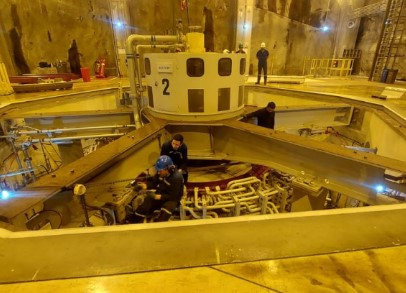
A power generation station at the Molino plant in the Paute-Mazar complex.
“The blackouts cost the economy at least two billion dollars and thousands of jobs and controlled our lives for months, but now it is like we have amnesia about it and want to put it out of our minds,” Rojas says. “I was stunned that it received so little attention before the election, but it is as big a problem as crime and the lack of funding for health care and education. The crisis and the blackouts will return, maybe sooner than later, so we ignore it at our own risk.”
Rojas calls the response to the crisis by the Noboa government “limited and poorly planned.” With the additional thermally produced energy added to the power grid since the first blackouts a year ago, we have only addressed about 5% of the energy deficit he says. “At this point we have added less than 300 thermal megawatts to the grid, and we need triple or quadruple this before the dry season begins in July and August.”
An even bigger issue is the lack of a comprehensive energy plan for the future, Rojas said. “Since we only react to shortages and don’t make long-term plans, we are always on the verge of another disaster, and when that happens, we apply Band-Aids that are more intended for news headlines than for a real solution.”
The hydroelectric system also needs a plan
Milton Pérez, former president of the Azuay College of Electrical Engineers, agrees and said long-range planning is also necessary for the existing hydroelectric facilities. “We need to add more thermal capacity as well as wind and solar, but we also need to focus on the hydro plants that produce 80% of the country’s energy today.”
An example close to home that needs attention, says Pérez, is the Paute-Mazar complex on the Azuay-Canar province border. “Given our experience with the recent drought, we should consider expanding the capacity of the reservoirs as well as adding conservation practices to maintain water levels during dry periods,” he says. “These practices are well-known and used in much of the world, but we have been slow to adopt them.”
He adds: “We learned in the last drought how important the generations plants at Mazar are to the country. At full operation they can meet more than half of the national demand, so it makes sense to improve and optimize the complex in preparation of the next drought.”
Pérez also agrees with Rojas about the “collective amnesia” about the energy crisis. “It’s amazing how quickly people and politicians have forgotten about it, especially since it hurt so many people economically and otherwise.”
He adds: “We better put it back at the top of the agenda or we will pay the price again. Yes, it is raining but this is a temporary, seasonal phenomenon, and dry weather will return.”