











Fingerlickin’ good
It was probably sometime around June or July in1982, when I was working in Bermuda, that I was invited to the house of someone who had a satellite dish to watch a World Cup football match. During the afternoon I was introduced to a friend of a friend who worked as a chef at one of Bermuda’s more expensive steak restaurants, located in an old colonial-style house overlooking Castle Harbour, complete with outdoor terrace, sea breeze, and the sort of view that encouraged people to order another bottle of wine.
At that age I had never really thought much about how restaurants worked behind the scenes. Eating out still retained a certain mild glamour. My wife and I would not have spent fifty dollars on a meal except perhaps for a birthday or anniversary, but it still belonged to the category of special occasion. Restaurants existed in a slightly magical world beyond ordinary domestic cooking.
 The soccer-loving chef explained that much of his work consisted of unpacking frozen steaks from wholesale cartons, marinating them for a couple of days, and grilling them to order. He told me they cost the restaurant about two dollars apiece and were priced at around twenty dollars on the menu, which was serious money forty years ago.
What struck me was not outrage. The customers were not being poisoned. The steaks were probably perfectly good, the terrace overlooking Castle Harbour was real enough and the historic Bermuda home was real enough. Yet it was the first time I consciously realized that the interests of a restaurateur and the interests of a diner are, in a purely economic sense, directly opposed.
One party wishes to buy food as cheaply as possible and sell it as dearly as possible to make as much profit as possible. The other wishes to eat as well as possible for as little as possible.
Civilization somehow survives because both sides compromise.
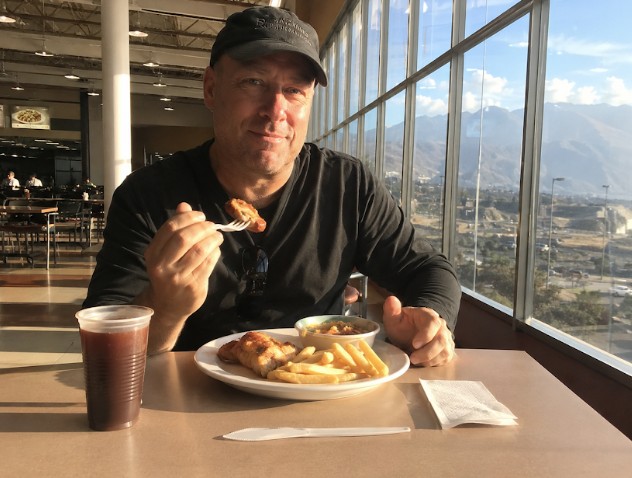
I found myself thinking about this again recently while eating lunch in a food court on the west side of Cuenca. For a centavo short of six dollars I received an excellent chunk of roasted chicken breast, surprisingly good french fries, a side dish involving rice, beans, and cheese, and a drink of tamarind juice. The food itself was genuinely delicious, so there was absolutely nothing wrong with the cooking, but the problems began elsewhere.
The tiny plastic knife bent uselessly against the chicken breast. Eventually, giving up, I picked it up with my fingers, which immediately became greasy. The napkin provided was approximately the size and absorbency of a postage stamp. The tamarind juice arrived in a flimsy plastic cup that flexed alarmingly when lifted. Worst of all, my table sat directly in the afternoon sun, which in Cuenca can transform a pleasant ambience into a trial by fire.
As I sat there wiping chicken grease from my fingers with what appeared to be recycled tracing paper, I began mentally calculating how much extra I would willingly pay for a proper knife, a china plate, a larger napkin, and a table in the shade.
The answer surprised me, because in that moment I realized I would probably bid as high as ten dollars.
Suddenly the economics of restaurants began rearranging themselves in my head. What restaurants often sell is not necessarily better food, but the removal of small irritations. Shade, silverware, a stable chair, a plate, a glass, a napkin and the absence of plastic.
The expensive Bermuda steakhouse and the Cuenca food court suddenly appeared as mirror images of each other. In Bermuda, relatively ordinary industrial food had been elevated by atmosphere, architecture, harbor views, and social ritual. In Cuenca, excellent food was slightly sabotaged by environmental inconvenience. Neither meal was really about food alone.
This also caused me to think about reports that certain politicians and billionaires enjoy ordering fast food meals from McDonalds or similar personally delivered to their mansions. I have increasingly begun to suspect that at least part of this is performative, because if I personally became a billionaire tomorrow after founding some technology company called BookFace or Tick-Tack, the very first thing I would do would be to hire an excellent private chef. I certainly would not be sending out for lukewarm hamburgers, dried up fries, and plastic sachets of condiments wrapped in paper bags.
I would probably buy farmland. I would want fresh eggs, proper tomatoes, real lettuce, decent onions, greenhouse vegetables, dairy products, and fresh bread, and I would have vegetable frames and polyurethane tunnels and hire someone whose job was growing the right breeds of tomatoes and potatoes and apples at the right time of year. These foods from my private farm would probably follow me onto my private aircraft.
The true luxury of wealth is probably not ordering out from restaurants at all. It is reaching the point where the kitchen begins following you around instead of the other way round.
Which perhaps explains why airport food is so terrible and so expensive at the same time. Once you are trapped beyond security, or halfway up the Eiffel Tower, the laws of normal economics begin to weaken. A sandwich becomes less a meal than a hostage negotiation. At that point you are no longer paying for food. but for location.
This may also explain why some of the happiest meals I have eaten in Ecuador have cost only a few dollars, while some expensive meals elsewhere have mainly involved admiring views, waiting for waiters, and pretending that decorative parsley constituted culinary sophistication.
That Bermuda chef accidentally taught me something important all those years ago. The two-dollar steak was not the scandal.
The thing I now realize is that the rental of the chair with the view of the sunset overlooking Bermuda’s Castle Harbour may have been worth every penny of the other eighteen dollars.