














Government apologizes for the 2024 kidnapping and deaths of four Guayaquil boys
The commander of the Ecuadorian Air Force, Mauricio Salazar, apologized Thursday to the families of four Guayaquil boys kidnapped and murdered in December 2024. The apology was ordered by the Constitutional Court.
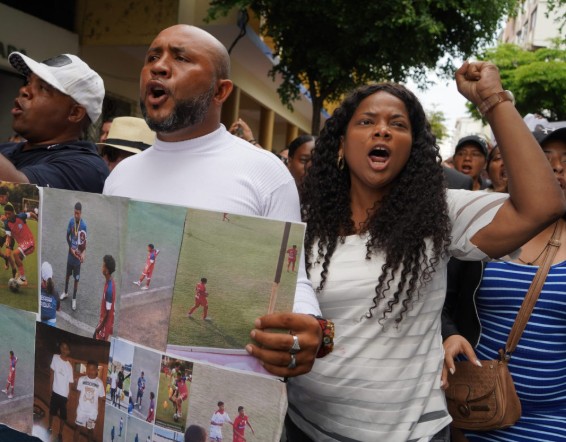
The parents and friends of four Guayaquil boys demanded information about their disappearance and murders in 2025.
“I appear before the families of Josué, Ismael, Steven and Nehemías and before the citizens of Ecuador to recognize, with shame and pain, that the government is responsible for a horrendous event, the forced disappearance and subsequent deaths of four Afro-descendant children, residents of a neighborhood in the south of Guayaquil,” Salazar said in a personally delivered statement.
“I apologize for taking away their freedom, their childhood and their right to live with dignity,” he said.
In his apology, Salazar said that military patrols illegally and arbitrarily detained the boys on December 8, 2024. “The three teenagers and a child were deprived of the protection of the law and were placed in defenselessness circumstances by the patrol,” he said.
He continued: “The state did not protect Josué, Ismael and Steven and Nehemías, as was its obligation, and the Armed Forces failed to fulfill its main function to protect the rights, freedoms and guarantees of citizens.”
The bodies of the four boys were found a week after their apprehension, shot and partially burned near an Air Force base west of Guayaquil.
In addition, Salazar accepted responsibility that the Ecuador Defense Ministry and Armed Forces did not provide the families with immediate, complete and truthful information about the detention, whereabouts and fate of the four minors in what become known as the Malvinas case.
“The official response was late, fragmentary and contradictory, which violated the right of the families to know the truth,” he said.
In addition, the commander admitted that the public statements issued by the Defense Ministry reinforced racial stereotypes and prejudices regarding the boys’ Afro-Ecuadorian heritage. “For this, we explicitly ask forgiveness from the mothers, fathers, sisters, brothers, and other relatives of the boys, as well as from the residents of their neighborhood and Ecuadorian society as a whole,” Salazar said.
Finally, the Air Force commander said he hopes the case will serve to remind all public servants that no one, including the military, is above the law. “In the memory of Josué, Ismael, Steven and Nehemiah, the government maintains that this apology is not an empty or symbolic gesture, but the beginning of a renewed effort toward truth, justice and comprehensive reparation,” he said.