













High-profile gang murders return with a vengeance following months of relative calm
Sunbathers at Cojimíes in Manabí Province watched with curiosity Sunday as a small boat approached the beach at high speed. “It is unusual to see motorboats going this fast near the shore and we wondered what they were doing when they pulled their boat onto the sand,” an unidentified tourist told a Manta newspaper. “And then the horrorible things began.”
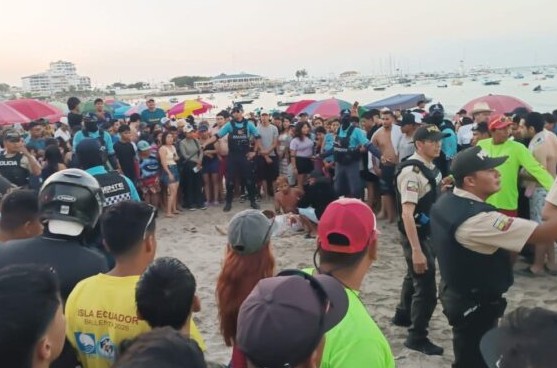
A crowd gathers around the body of man killed while he was sunbathing Monday on the beach near Salinas.
The two men from the boat walked up to a row of people in beach chairs, pulled handguns from their belts and opened fire. When the shooting stopped, three men lay dead and a woman was severely injured. The shooters ran back to the boat and headed back to sea.
Also on Sunday, a 24-year-old man sitting under a beach umbrella near Salinas was killed by a hooded shooter who, according to bystanders, approached from the malecon. As the victim lay on the sand and as tourists fled screaming, the gunman fired at least five more rounds into his head and torso.
Two other coastal massacres were recorded since Sunday. In one, two men were murdered Monday inside a beach bar in Playas. The victims were shot at close range by three hooded shooters as two potential victims escaped, sprinting down the beach.
Another mass murder occurred early Wednesday in Prosperina, north of Guayaquil, when four men and a woman were gunned down in a private home. At least six gunmen arrived in a truck and on motorcycles, announced themselves as police before firing an estimated 50 rounds into the victims.
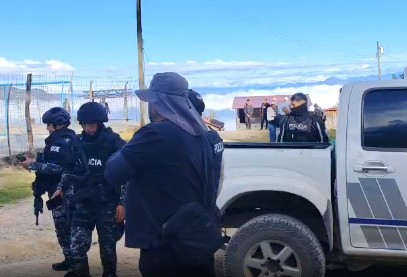
Police investigate the murders of eight people at an illegal gold mine west of Pucará in Azuay Province.
In statements, National Police commanders in Manabí, Santa Elena and Guayas provinces said all the murders were believed to be gang-related. “The capture by police of criminal gangs leaders in recent weeks has created disorganization within the gangs as well as territorial conflicts,” a police spokesman in Guayaquil said. “The new violence tells us we have more work to do to restore peace in these provinces.”
Police have not released full reports on the attacks, although they say the Santa Elana victim and two of the victims at Cojimíes had criminal records. An unidentified police officer responding to the Prospina massacre told a radio reporter that it was a case of “criminals killing each other.”
In addition to the coastal killings, police continue to investigate the Thursday massacre of seven men and a woman at an illegal gold mine in western Azuay Province. The victims’ bodies were found in two shallow graves near Pucará and investigators say they were hacked to death with machetes. Three of the bodies had been decapitated.
Zonal Police Captain Juan Rodríguez said “preliminary information” is that the victims were working at the mine and being paid by one gang when a second gang moved in take gain control. “We believe the murdered people were not part of a gang and were simply employees,” Rodríguez said. One of the victims, he said, was a medical student from Cuenca working parttime to pay his expenses.
Former National Police commander Carlos Jaramillo said the murders in Guayas, Manabí, and Santa Elena were intended to be public spectacles. “The gangs are sending a message that they remain in control,” he said. “Their methods are intended to frighten and intimidate the public.”
From January to June, there was a slight reduction in high-profile killings, Jaramillo said. “The killings were continuing, of course, but in a less public manner. We also had what I consider political killings in the cases of Monika Silva and [Gloria Alexandra] Bravo and I am disappointed at the lack of progress by the government in those investigations.
Silva, who was murdered at her home near Montañita in June, was conducting investigations of land deals involving public officials, including President Daniel Noboa. Bravo, a federal prosecutor, was investigating the apparent bombing of an Ecuadorian fishing boat by the U.S. in July in which eight men died.
“What stands out for me is the lack of intelligence operations within the criminal gangs by the government,” Jaramillo says. “The entire emphasis seems to be putting soldiers and more police on the streets and occasionally blowing up a drug house or gold mine. The hard work is to get close to the bad guys and gather the intelligence that can effectively disrupt their operations, including the killings, and this is not happening. This work does not make headlines but it can lead to real progress.”
Jaramillo adds: “From the law enforcement perspective, very little has been accomplished in dismantling the criminal structures operating in the country. We are not making the progress the government claims.”



Hogar Esperanza News

Fabianos Pizzeria News

The Cuenca Dispatch

Week of September 06

U.S. sinkings of Ecuadorian fishing vessels trigger court scrutiny after 28 crew members are released.

Cuenca targets a November launch for its first new international link to Chiclayo.

Exports hit a quarterly record, but Ecuador’s import bill is rising even faster.
Property Manabi

Fund Grace News
