














In Beijing meeting, Noboa and Xi Jinping focus on trade, energy, mining and technology issues
Ecuador and China have agreed to expand cooperation “in areas of mutual interest” with an emphasis on trade, energy, mining and technology. In a three-hour meeting Tuesday in Beijing, President Daniel Noboa and Chinese President Xi Jinping began by acknowledging the rapid growth of trade between the two countries that followed the signing of the 2025 free trade agreement.
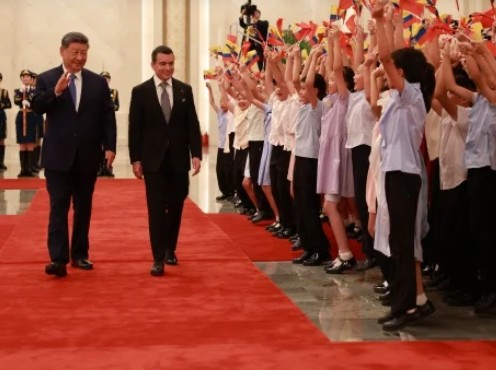
Prior to Tuesday meeting, President Daniel Noboa and Chinese President Xi Jinping took a walk down the red carpet, saluted by a youth choir.
Early in the conversation, Noboa reported that Ecuador’s exports to China grew 23% in the first six months of 2026 compared to 2025. He also reported that Ecuador has paid off most of its debt to China, the majority of it in oil. The debt is currently $1.7 billion, down from $8.2 billion ten years ago.
Before the meeting, Ecuador Economy Minister Sariha Moya issued a statement that China will replace the U.S. as Ecuador’s top trading partner “within a matter of months.”
Xi Jinping agreed that trade showed “impressive gains” for both countries and said he saw no reason the gains would not continue. Before the meeting of the two presidents, China’s Trade Ministry announced that it was no longer considering banning imports of Ecuadorian shrimp. The ministry said updated tests indicate that contamination in most shipments has been corrected although it said it will continue to monitor shipments from six shrimp farms.
According to Chinese news agency Xinhua, Noboa and Xi Jinping discussed Chinese investments in developing a “digital economy” in Ecuador as well as joint projects to enhance education and improve business and government efficiency. The projects would involve the incorporation of Chinese artificial intelligence systems.
The conversations also covered possible Chinese investments in renewable energy installations, according to Xinhua. Noboa said Ecuador is in “urgent need” of additional power generation capacity, especially non-polluting “green energy” projects.
Among other topics discussed was what Xi Jinping said was “the need to restore peace” in the Latin American and Caribbean region. “The nations of the area should not be bullied by other nations and should independently choose their trade and cooperation partners,” he said. He also criticized the “extra-legal” bombing of boats in the Caribbean and Pacific by the U.S. and said disputes should be resolved through “multi-national actions.”
On the issue of Taiwan, Noboa said he “respected and supported” Beijing’s One China position. “China has the right to defend and protect its sovereignty and territorial integrity,” he said.
On Monday, China announced a number of grants to support public health care, education, production and employment projects in Ecuador. Among them was one of $21 million to the Public Health Ministry to upgrade operating rooms and dialysis services at hospitals. Another grant, for $43 million, will be divided between several security and human development projects. China also pledged to assist “as needed with recovery from the El Niño weather event.”
At the conclusion of the meeting the presidents praised each other, saying they looked forward to “long and prosperous” relationship. Noboa told Xi Jinping that in Ecuador he has “a friend on the other side of the Pacific” who he can count.
Xinhua said a detailed report on the meeting and the agreements reached will be released soon.
Meetings of Ecuadorian and Chinese officials will continue through the week to work out details of agreements reached in the presidential meeting. Accompanying Noboa in China are Roberto Kury, Ecuador Foreign Minister; Sariha Moya, Economic Minister; Irene Vélez, Communication Secretary; and Julio Neira, Secretary of Public Administration.
China is the first stop on Noboa’s 13-day Asia trip. Next week he visits Vietnam and Singapore.



Hogar Esperanza News

Property Kuralt

Property Amazon

Fund Grace News

The Cuenca Dispatch

Week of August 16

Azuay stays under state of exception as authorities track criminal groups expanding around Cuenca.

Older adults and people with disabilities can now request vehicle tax break online.

That unresolved bank complaint has another place to go and the service is free.
Fabianos Pizzeria News