












The airport meal nobody sells
One of the odder features of modern air travel is that airports have become brilliant at selling almost everything except the one thing a traveler actually needs at six in the morning.
My last trip took me through four international airports and one ecological airport with windmills, and between them I could have bought luxury watches, designer sunglasses, perfume, expensive whisky, gourmet chocolates, World Cup T-shirts, electronic gadgets, neck pillows, turtle-shaped key fobs, and enough coffee to keep a city awake for a week. Finding an ordinary breakfast, though, was another matter entirely.
 This wasn’t for lack of food. Quite the opposite, because departure lounges now resemble shopping malls that happen to have the occasional aircraft warming up outside in the parking lot, with a café every few yards offering muffins the size of footballs, cinnamon rolls, artisan sandwiches, sushi, pizza, or burgers. But if all you wanted was a sensible breakfast to eat on the plane, the options thinned out fast.
Airlines no longer help much either. There was a time when you boarded, settled into your seat, and if it happened to be breakfast time, breakfast simply appeared with bacon, sausages, French toast and coffee. These days, unless you’re in a premium cabin or on certain long-haul routes, you’re lucky to get a paper cup of coffee without reaching for your credit card, which shifts the whole burden onto the airport. And the airport, as far as I can tell, has never noticed.
Take an early flight I recently caught from Cuenca to Quito. The travel agent recommended arriving four hours ahead of departure, a suggestion I found faintly alarming until she explained, smiling, that the advice was really aimed at Ecuadorians, many of whom have a well-known tendency to operate in an adjacent time zone. Three hours would do fine for gringos like us, she said. In the event we ignored both figures and turned up two hours before takeoff instead, and still managed to be the first passengers in the building. Check-in had only just opened. Security had only just opened. Within three minutes we were sitting in an almost empty departure lounge with dimmed lights, wondering why we’d bothered getting out of bed so early.
Now do the arithmetic on a six o’clock departure. It usually means leaving the house around three in the morning, and almost nobody feels like frying bacon and eggs, pouring cereal, and then washing up and drying greasy dishes before calling Azutaxi. So most people either skip breakfast altogether or grab whatever’s easiest on the way out the door. Then they clear security, and suddenly they have time on their hands, often an hour or two of it, with nothing to spend it on but an overpriced pastry laced with a lethal dose of canela.
So why don’t airports sell proper flight breakfast kits?
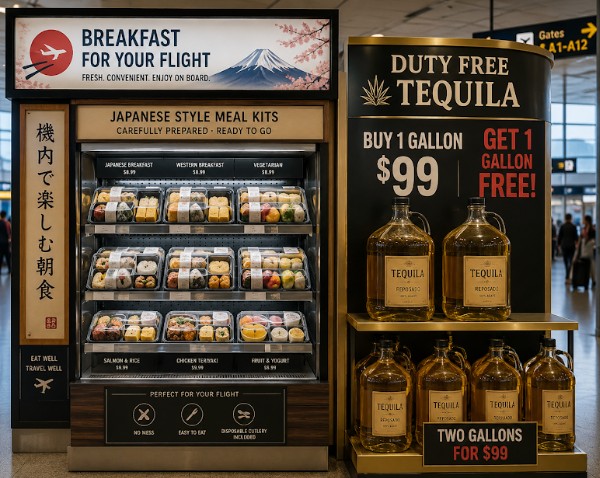
Picture a refrigerated case near the gate, clearly labeled: Breakfast for Your Flight. Inside, a croissant, butter, jam, yogurt, fruit, a small carton of orange juice, and a napkin, wet wipe for the hands, a spoon, and a knife, all sealed and ready to slide into a backpack. Or a British-style ploughman’s lunch box or a vegetarian option. Something built for children, with smaller portions and less mess.
None of this is a new idea. Japanese train stations have been selling beautifully packaged meal boxes, ekiben, to travelers for generations, and convenience stores across Asia are stocked with fresh meal packs meant to be eaten later rather than on the spot. The concept exists and works well, but simply hasn’t found its way into the airport terminals of the Western hemisphere, where the entire business model still runs on getting people to eat standing up, right now, at whatever price the till says.
The irony is maybe that airlines have quietly outsourced breakfast to the airport, but the airport still behaves as though the airline is serving it.
I’d rather carry breakfast onto the plane, wait until we’ve reached cruising altitude, and eat while the sun comes up outside the window. Breakfast tastes better that way, somehow, than it does gulped down in a crowded food court while glancing every thirty seconds at the departure board in case there is a gate change.
There are probably sound commercial reasons for the current arrangement. Fresh meal kits have a limited shelf life, restaurants prefer selling food that must be eaten on the spot, and airlines would rather you buy their own stale tuna sandwiches once you’re airborne and have no choice but to cough up or starve.
Even so, it feels like a gap. Airports have mastered the art of persuading travelers to buy a hundred-dollar bottle of perfume they never meant to purchase, or a pair of noise-canceling headphones that probably don’t work, yet they overlook something nearly every passenger would genuinely welcome: not another cinnamon bun, not another gourmet burger, but a normal people breakfast for the journey ahead.
Sometimes the most obvious business opportunities are hiding in plain sight, somewhere between the Duty Free gallon jars of tequila and Gate 27C.



Hogar Esperanza News


The Cuenca Dispatch

Week of September 06

U.S. sinkings of Ecuadorian fishing vessels trigger court scrutiny after 28 crew members are released.

Cuenca targets a November launch for its first new international link to Chiclayo.
Exports hit a quarterly record, but Ecuador’s import bill is rising even faster.
Fabianos Pizzeria News

Fund Grace News