












The coming tsunami of Chinese AI
By Peter Yared
For years, the United States has tried to slow China’s progress in artificial intelligence by restricting exports of advanced AI chips and semiconductor manufacturing equipment. That strategy may have bought time, but it is now backfiring. China has become self-sufficient in AI and is getting ready to export its technology everywhere. Controls that limit America’s ability to compete could hand the global AI market to China on a silver platter and will eventually put even America’s superpower status at risk.
Export controls are motivated by fear of enhancing China’s military capability, but that case is weaker than it seems. Many military AI applications run on smaller models and specialized hardware, not only on the most advanced data center GPUs. And where large-scale compute capacity does matter, China has developed qualitatively comparable domestic alternatives. Those systems may still lag behind America’s best in efficiency, but cost and training time are not decisive constraints for the Chinese military.
 The real strategic question is no longer whether America can slow China’s technological advance at the margin, but whether we can remain the global leaders in building, deploying, and selling AI. That’s why President Trump’s AI Action Plan prioritizes global adoption of American AI.
On that front, China is moving faster than many policymakers realize. Its open-source models are the best in the world and trail America’s best-paid models by just months. One survey found that 24 percent of Y Combinator’s most recent cohort of Silicon Valley startups were using Chinese open-source models because they are cheap to run and easy to fine-tune.
On April 24, DeepSeek unveiled its new V4 open-source AI model. Though it still falls slightly behind the best American proprietary models on technical benchmarks, for most uses it is virtually indistinguishable from them in performance. More important is the dramatic reduction in “total cost of ownership” and cost per token, which allows V4 to deliver nearly frontier capability at much more competitive prices. Worst of all, U.S. export controls forced Chinese AI companies to figure out how to rely on Chinese chips, and sure enough V4 is optimized for the latest Huawei chips.
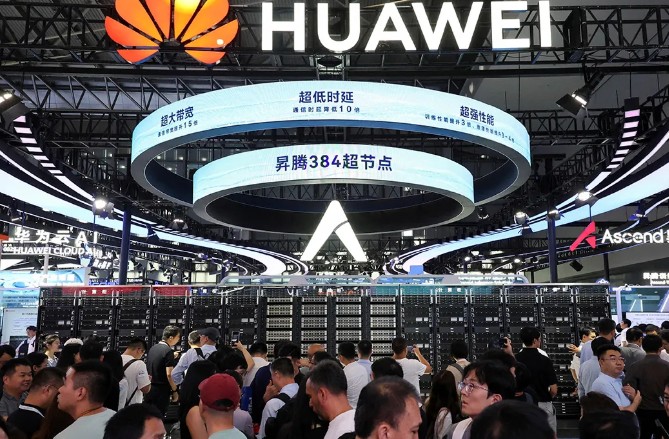
Many in Washington still assume that whatever progress China makes in models, it cannot match the United States in hardware. That belief is dangerously outdated. Huawei is the clearest example. U.S. export controls initially crushed its revenue, but they also handed it a virtual monopoly over the Chinese AI market. Now its revenue is back at record levels. Huawei’s newest Ascend 950PRchip, which is designed for actual model use (a.k.a., “inference”) matches the performance of Nvidia’s H200 and is three times more powerful than the H20 that was cleared for export just a year ago. ByteDance and Alibaba are placing large orders. Exports to South Korea are planned for later this year. This is a true Sputnik moment, and it is only the beginning. China is getting ready to swamp the world with exports of its AI technology.
By one estimate, export controls are diverting roughly $60 billion in revenue from American AI firms to Chinese chipmakers, principally Huawei, which spends 20 percent of revenue on R&D. It’s no surprise that Huawei is using that revenue to fund the research, engineering, and ecosystem development needed to build a fully indigenous AI stack. The export control crowd hopes to hold China back, but what they have mostly accomplished is to massively subsidize and accelerate Huawei’s rise as an AI giant.
Huawei is not alone. Chinese chipmakers and cloud companies are pouring resources into AI infrastructure. Huawei rival Cambricon’s revenue surged 453 percent in 2025, as it sold 117,000 chips. Alibaba’s T-Head has shipped roughly 470,000 AI chips, with most going to external customers rather than internal use. Large firms such as Alibaba, Tencent, ByteDance, and Baidu are not only buying more compute capacity but also developing their own. The flywheel of revenue and investment needed to develop a globally dominant AI stack is now spinning furiously in China.
The anti-export crowd consistently underestimates China’s production capacity. Take High-Bandwidth Memory (HBM) for example, now considered the key bottleneck in AI chip production. One prominent report by the Council on Foreign Relations estimated that China could produce no more than 2 million HBM packages per year. Just days after that report was released, Chinese memory maker CXMT’s Hong Kong IPO revealed that CXMT alone will be able to produce 20 million HBM stacks in 2026, ten times more than the councils estimate. Huawei could theoretically ship millions of Ascend units in 2026 if allocations and yields continue to rise in semiconductor and HBM manufacturing. Huawei already has orders for nearly 800,000 of its new Ascend 950PR chips for 2026, on top of the similar amount of older chips it already planned to ship this year. That’s about 25 percent of Nvidia’s yearly production of data center GPUs.
China is also advancing on the most technically difficult front: semiconductors. China’s SMIC is producing seven-nanometer chips at scale. Its yields remain below Taiwan’s best, but they are improving, and China can make up in volume what it lacks in chip-level performance. China now accounts for roughly a quarter of global twelve-inch wafer-fab capacity, and much of the new capacity coming online globally is in China.
Even software, America’s deepest competitive “moat,” is no longer secure. Nvidia’s true advantage was never merely silicon; it was CUDA, the developer library that locked the world into its chips. Export controls pushed Chinese developers off CUDA and into Huawei’s CANN ecosystem. That created short-term pain, but it also accelerated the rise of a parallel AI software stack independent of America’s.
This should force a rethink in Washington. China isn’t willing to sacrifice market share in order to indigenize technology. In fact, it readily accepts supply chain dependencies where the economics make sense. China still imports Boeing jetliners, even though Beijing would love to replace them with COMAC aircraft. Likewise, Intel CPUs still sit inside most Chinese laptops. (Perhaps because of effective lobbying by Intel, the export control crowd in Congress has not focused on CPUs, despite their criticality in military applications and in AI inference.)
China would prefer not to depend on foreign companies, but its highest priority is market share. That should be America’s priority as well. China is still behind America’s most cutting-edge technology but is poised to swamp the world — including the United States — with cheap AI that performs more than well enough for any AI task.
Export controls undermine America’s long-term technological edge by shrinking addressable markets, raising unit costs, chilling investment, and pushing developers toward Chinese alternatives. The surest way to preserve American commercial and military leadership is not to hit the brakes in a futile attempt to slow China down, but to innovate faster.
_________________
Credit: National Review